BackDisinflation

Disinflation

Solana
2026-08-28 19:53:12

Solana validators approve proposal to double SOL disinflation rate to 30%

Solana validators have approved SGP-0002, a governance proposal that raises the network’s annual disinflation rate from 15% to 30% while keeping its long-term inflation target at 1.5%. Final voting results showed 67% support, 25.16% opposition and 7.84% abstentions, with participation reaching 60.7% of eligible stake. According to Solana Compass, the revised issuance schedule would bring Solana to its 1.5% terminal inflation rate in about 2.8 years, versus roughly 5.7 years under the previous framework. The change is also estimated to cut issuance by about 18.9 million SOL over the next six years. The vote took place during Solana’s first binding governance process, which also approved a proposed Solana Constitution and rejected a separate measure on resource and inclusion fees. Voting data showed a split among major participants, including Figment, Helius, Jupiter and Kraken. The governance update comes as US-listed Solana investment products continue to draw capital, with Bloomberg ETF analyst Eric Balchunas saying Bitwise’s Solana ETF has surpassed $1 billion in assets and US Solana ETFs have seen about $1.7 billion in cumulative net inflows.


00
Solana validators approve proposal to double SOL disinflation rate to 30%
Solana
2026-08-28 15:32:53

Solana Validators Pass Faster SOL Disinflation Plan in First Governance Win as Kraken Flips Late

Solana validators have approved SGP-0002, a proposal that doubles the pace of SOL emission declines and marks the first measure to clear the network’s new onchain governance system. It is also the first time Solana validators have agreed to cut issuance. The vote closed Friday with 176.29 million SOL in favor, 66.19 million against, and 20.63 million abstaining. Excluding abstentions, support reached 72.7%, above the required two-thirds supermajority. Participation came in at 60.70% of a 433.49 million SOL snapshot across 1,326 voters, clearing quorum. The late stage of the vote drew attention after Kraken changed the position of its larger validator from fully against to 90.34% in favor, while Galaxy also shifted part of its stance. Even so, the report says Kraken’s reversal alone did not determine the outcome, since support would still have finished at 69.4% under its original vote. The proposal raises Solana’s annual disinflation rate from 15% to 30%, pushing the network more quickly toward a 1.5% terminal inflation floor. Backers estimate the change will remove about 18.9 million SOL from emissions over six years and move the terminal inflation timeline up to the first half of 2029 from 2032. Opponents, led by staking infrastructure firms, argued the change would reduce staking yields and pressure validator economics. Two other proposals, including the draft Solana Constitution, also finalized in the same voting window.

30
Solana Validators Pass Faster SOL Disinflation Plan in First Governance Win as Kraken Flips Late
Solana
2026-08-28 17:47:42

Solana's First Binding Governance Vote Passes SGP-0002, Pulling 1.5% Issuance Floor to 2029

According to Decrypt, Solana's validators have completed the network's first binding on-chain governance vote. SGP-0002, named "Double Disinflation," passed with 67.0% support, just above the 66.67% threshold. Crypto exchange Kraken consistently voted against the measure for most of the period before switching to support at the last moment. The proposal raises the annual decline rate of new SOL issuance from 15% to 30%, bringing the fixed 1.5% issuance floor to an expected 2029 instead of the original 2032, while cutting expected issuance by about 18.9 million SOL over six years. SGP-0001, the "Solana Constitution," was approved with 86.0% support and formalizes the framework for future governance votes. Staking yields are expected to decline from around 5.25% to about 2.25% within three years. SGP-0003, which would have split transaction fees into base and resource components and raised daily burns from about 650 SOL to as much as 9,000 SOL, failed with 53.9% support.

60
Solana's First Binding Governance Vote Passes SGP-0002, Pulling 1.5% Issuance Floor to 2029
Solana
2026-08-28 15:34:08

Solana’s first on-chain governance vote ends with SGP-0003 rejected after fee model dispute

Solana’s first formal on-chain governance vote has closed, sending SGP-0001 and SGP-0002 into implementation while rejecting the more contentious SGP-0003 proposal. The three proposals, which opened for voting on Aug. 23, covered a formal governance framework, changes to SOL’s inflation schedule, and a redesign of transaction fees. SGP-0001 and SGP-0002 cleared the required thresholds of one-third participation from all valid staked SOL and a two-thirds approval ratio among votes cast. SGP-0003, which would have overhauled how the network prices blockspace, received 54.3% support, below the 66.6% bar. The split exposed competing priorities inside the Solana ecosystem. Supporters said charging more for resource-heavy transactions would better align costs with network usage and could sharply increase SOL burned through fees. Critics, including application developers, argued the proposal would raise costs for complex on-chain activity and make core business assumptions subject to governance risk. The vote leaves Solana with a new governance process and a faster path to lower inflation, but without consensus on how its growing financial infrastructure should price network resources.

80
Solana’s first on-chain governance vote ends with SGP-0003 rejected after fee model dispute
Solana
2026-08-28 06:22:10

Solana Supply Slowdown Plan Narrows Through, $800K Burn Proposal Trails

Solana's governance process is currently handling three supply-related proposals, all of which have cleared quorum. According to CoinDesk, a plan to slow the creation of new SOL tokens is only narrowly passing. A separate proposal to sharply increase token burns — referred to in CoinDesk's headline as the $800K burn proposal — remains below the two-thirds support required for passage. The first measure represents a faster disinflation path for Solana, meaning it would reduce the rate at which new SOL enters circulation. The second would significantly raise the burn rate, removing a larger volume of tokens from circulation over time. As it stands, the supply slowdown plan holds a thin lead, while the burn proposal trails, lacking the supermajority needed to move forward. CoinDesk reported the voting status on Aug. 28, 2026. All three proposals had reached quorum at the time of the report, but final vote margins were not disclosed.

70
Solana Supply Slowdown Plan Narrows Through, $800K Burn Proposal Trails
Solana
2026-08-27 15:12:18

SOL Jumps as Solana Validators Near Final Call on Inflation and Burn Proposals

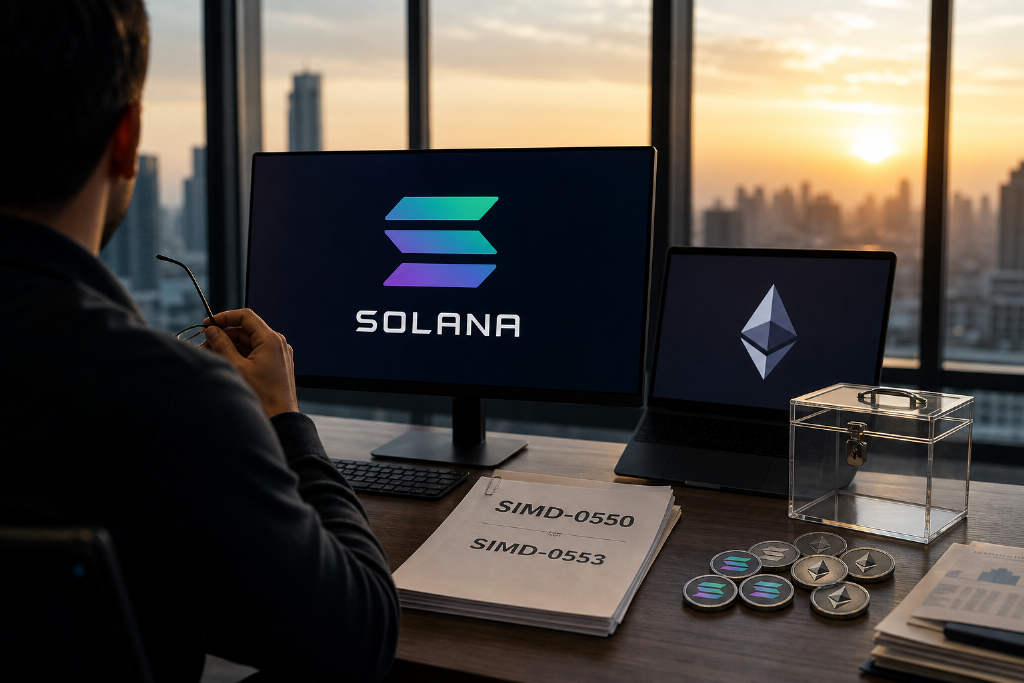
Solana’s native token SOL rose more than 8% over the past 24 hours and was on track for its strongest month since 2024, up roughly 44% since the start of August and back above $105 for the first time since January. The move came as Solana validators approached the end of a major governance vote that could change how the network manages token supply. The vote, set to close around 15:30 UTC at the end of epoch 1023, covers three Solana Governance Proposals, or SGPs, under a new on-chain system that gives validators and SOL delegators binding, stake-weighted voting rights for the first time. One proposal would ratify a Solana Constitution. The other two, SIMD-550 and SIMD-553, focus on token issuance and burn mechanics. SIMD-550 would double Solana’s disinflation rate from 15% to 30%, bringing the network to its 1.5% inflation floor by 2029 instead of 2032 and reducing issuance by about 18.9 million SOL over six years. SIMD-553 would split transaction fees into an inclusion fee paid to validators and a resource fee that would be burned, potentially lifting daily burn from about 650 SOL to as much as 9,000 SOL. Both proposals require a two-thirds supermajority of participating stake, and results are expected within hours after voting ends.

80
SOL Jumps as Solana Validators Near Final Call on Inflation and Burn Proposals
Solana
2026-08-16 15:50:50

Max Resnick Reframes L1 Valuation Around Tokenholder Value as Solana Fee Debate Heats Up

As the Solana community prepares to vote on SIMD-0550 and SIMD-0553, Max Resnick, former head of research at Consensys and now a key developer in the Solana ecosystem, has laid out a broader argument about how Layer 1 blockchains should be valued. His central point is that growth narratives alone — rising developer counts, higher transaction volumes, or claims that a token could become money — do not amount to a complete valuation framework unless they explain how economic activity flows back to token holders. Resnick argues that L1 tokens can be analyzed with logic similar to equities. In his view, fee burns resemble stock buybacks, while distributing fees to stakers looks more like dividends. By contrast, inflationary staking rewards should not automatically be treated as revenue or operating cost, because they largely reflect a transfer of value between token holders rather than net value created by the network. He also says analysts need consistent standards for revenue, cost and total supply. The piece goes on to examine fee quality, pricing power and fee design. Resnick says the market may overestimate the durability of bull-market fee spikes while underestimating the moat created by network effects on mature chains such as Solana and Ethereum. He also points to a structural issue in resource-based pricing and highlights Anatoly Yakovenko’s proposal to charge 0.5 basis points on SPL token transfers as one path toward more value-sensitive fees.

460
Max Resnick Reframes L1 Valuation Around Tokenholder Value as Solana Fee Debate Heats Up
Federal Reser
2026-08-05 20:07:51

Fed's Cook: Rate Hike on Table If Disinflation Stalls

Federal Reserve Governor Cook said the Fed is prepared to raise interest rates if the disinflation trend does not resume. ChainCatcher relayed the remarks in a newsflash, citing a report by Jinshi.

950
Fed's Cook: Rate Hike on Table If Disinflation Stalls