IBM

IBM
2026-08-26 12:07:40

IBM Closes HRL Laboratories Acquisition to Expand Quantum Manufacturing Push

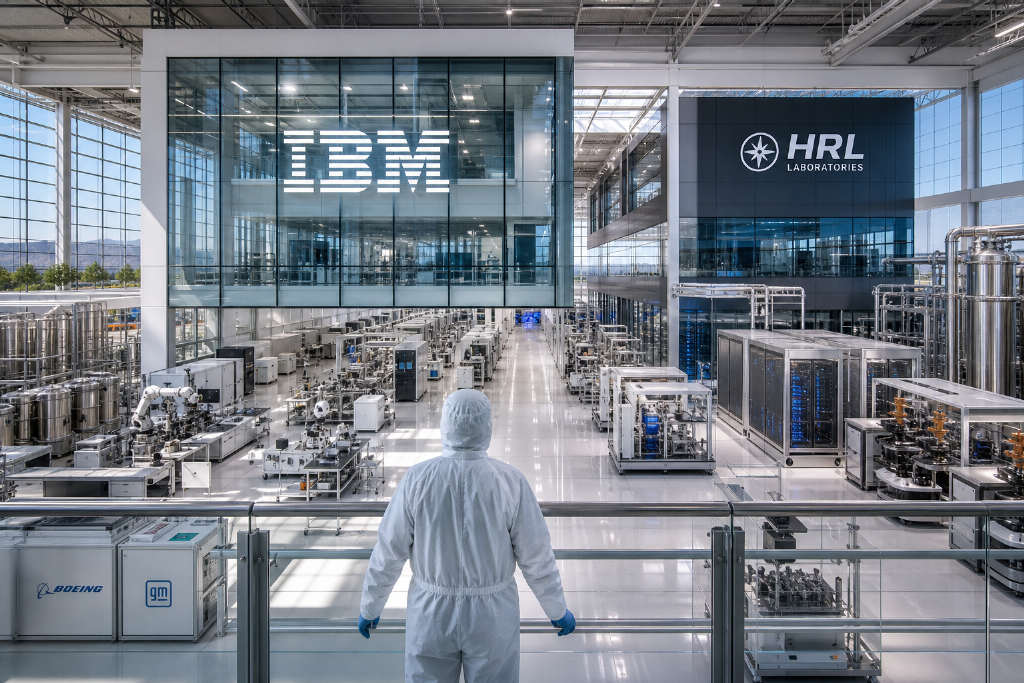
IBM said it has completed its acquisition of HRL Laboratories, LLC, a research institution with expertise spanning quantum computing, quantum sensing, advanced communications, electronics, manufacturing, and materials science. The company said the deal adds to its broader innovation and investment efforts in quantum manufacturing and infrastructure. IBM also highlighted HRL’s capabilities in silicon-based quantum technologies, saying that expertise could open future collaboration opportunities with Anderon, IBM’s pure-play quantum wafer foundry, and support scalable manufacturing methods aimed at speeding learning cycles across multiple quantum computing approaches. Boeing and General Motors, identified as HRL’s former owners, will continue working with IBM and HRL on quantum applications and advanced technology development. Financial terms of the transaction were not disclosed.

50
IBM Closes HRL Laboratories Acquisition to Expand Quantum Manufacturing Push
IBM
2026-08-26 12:08:54

IBM closes acquisition of HRL Laboratories to deepen quantum manufacturing push

IBM said it has completed its acquisition of HRL Laboratories, LLC, according to Newswire. HRL is described as a leading research and development organization with expertise spanning quantum computing, quantum sensing, advanced communications, electronics, manufacturing, and materials science. IBM said the deal adds to its broader innovation and investment efforts in quantum manufacturing and infrastructure. The company also pointed to HRL’s background in silicon-based quantum technologies as opening opportunities for future work with Anderon, IBM’s pure-play quantum wafer foundry. IBM said that collaboration could support scalable manufacturing methods and help speed learning cycles across multiple quantum computing modalities. Boeing and General Motors, identified as HRL’s former owners, will continue working with IBM and HRL on quantum applications and advanced technology development. Financial terms of the transaction were not disclosed.
20
IBM closes acquisition of HRL Laboratories to deepen quantum manufacturing push
IBM
2026-08-26 05:50:50

IBM unveils Granite 4.2 open-source reasoning models with native chain-of-thought support

IBM has released the Granite 4.2 family of open-source reasoning language models, introducing three parameter sizes: 3B, 8B, and 30B. The series is built around explicit reasoning, with each model able to generate a chain of thought before answering. IBM also included a thinking/non-thinking switch and a low-power mode across the lineup. The models use a decoder-only dense Transformer architecture, were pretrained from scratch on roughly 15 trillion tokens, and then post-trained through a multi-stage reinforcement learning pipeline. IBM said the 8B and 30B versions include agentic reinforcement learning modules, allowing them to learn tasks such as editing code, operating a terminal, and performing web search in real sandbox environments. All Granite 4.2 models are released under the Apache 2.0 license, which permits downloading, fine-tuning, and commercial production use. IBM also introduced two 470M-parameter Granite Speech 5.0 Turbo CTC speech models. In SWE-Bench Verified, the 8B and 30B models scored 47.67 and 57.00, respectively. According to MarkTechPost, the models are aimed at sectors including software development, finance, healthcare, telecommunications, and the public sector.

50
IBM unveils Granite 4.2 open-source reasoning models with native chain-of-thought support
IBM
2026-08-25 15:03:07

IBM releases Granite Speech 5.0 Turbo CTC transcription model

IBM has released Granite Speech 5.0 Turbo CTC, a speech transcription model positioned around speed and accuracy. According to the company’s official blog, the model is presented as an "extremely fast and accurate transcription" solution. The release was also referenced on Hugging Face. The announcement, cited by Techub News, did not include additional technical specifications, pricing details, or rollout timelines in the provided source. Based on the available information, the release centers on transcription performance, with IBM highlighting both throughput and recognition quality as the model’s main selling points. No other product claims or deployment details were disclosed in the source text.

70
IBM releases Granite Speech 5.0 Turbo CTC transcription model
Circle
2026-08-24 08:12:09

Circle’s rally puts the spotlight on Arc, not just stablecoin fundamentals

Circle shares climbed sharply over three trading days in August, but the move appears to have been driven more by a broader crypto equity rebound than by a sudden change in company fundamentals. The stock rose 9.56% on Aug. 19 to close at $78.59, added 6.45% on Aug. 20 to finish at $83.66, and then gained another 5.16% on Aug. 21 to $87.98. During the same stretch, Bitcoin moved back above $70,000, U.S. Treasury yields fell, and crypto-related stocks broadly advanced. The article argues that Circle’s core business remains mixed. In the second quarter of 2026, USDC circulation reached $73.3 billion at quarter end, average circulation was $76.5 billion, and on-chain transaction volume hit $14.8 trillion, up 151% year over year. Yet total revenue and reserve income came in at $701 million, up just 7%, while reserve yield fell from 4.14% to 3.48%. That matters because more than 85% of Circle’s revenue still comes from interest on reserve assets. Longer term, the focus shifts to Circle’s stablecoin-native blockchain Arc and Circle Payments Network, or CPN. Arc’s public mainnet is scheduled for Sept. 16, with institutions including BlackRock, Visa, Mastercard, DTCC, ICE, Standard Chartered, and MoneyGram involved as validators or integration partners. A $259 valuation cited in the piece reflects a 2030 scenario in which Arc and CPN mature into meaningful revenue engines, far above the roughly $101 average Wall Street target tied to the next 12 months.

290
Circle’s rally puts the spotlight on Arc, not just stablecoin fundamentals
CoreWeave
2026-08-21 08:03:28

Goldman Sachs Keeps Neutral on CoreWeave, Raises 12-Month Price Target to $139

CoreWeave shares rose 19% after the company reported second-quarter results, with Goldman Sachs saying the near-term setup is becoming clearer even as longer-term margin durability remains unsettled. In a report dated Aug. 20, Goldman maintained its Neutral rating and lifted its 12-month price target to $139 from $121, implying 53% upside from the current share price cited in the note. The bank said three core lines of evidence now support the company’s near-term case: demand remains ahead of supply, pricing is holding firm across both new and older chip generations, and capacity expansion continues on schedule. CoreWeave’s revenue backlog rose 5% quarter over quarter to $104 billion, while more than $25 billion of additional committed contracts had already been added after the start of the third quarter. Goldman’s bigger debate is over long-term monetization and margins. It pointed to managed inference, platform services, and CoreWeave Omni as the main software-related areas to watch. The firm said software and platform revenue must become a more dependable contributor to growth and profitability before a more constructive rating would be warranted.

170
Goldman Sachs Keeps Neutral on CoreWeave, Raises 12-Month Price Target to $139
Elon Musk
2026-08-14 08:12:12

Musk says memory, not compute, is the real bottleneck for AI agents

Elon Musk backed a claim on X that memory, rather than raw compute, is the real rate-limiting factor in the age of AI agents, replying that 「Few realize this.」 The point is one he has made repeatedly this year. According to the source material, Musk raised the issue at Tesla’s first-quarter earnings call on April 22, echoed complaints about memory price inflation in late June, and then gave a sharper figure at SpaceX’s Q2 earnings call in early August: memory capacity is growing about 20% a year, while demand is rising 200% or more. The report ties that view to a broader shift in AI infrastructure. As agentic systems hold much larger context windows and persistent task histories, KV cache becomes a bigger memory burden. With HBM still expensive and tight in supply, companies are moving more context data down the memory stack into NAND and storage. NVIDIA’s Inference Context Memory Storage Platform, introduced at CES, is cited as one example, using Dynamo and NIXL to place KV cache on NVMe SSDs. The same report also tracks how markets are reading the memory cycle. Korean brokerages cut target prices for Samsung Electronics and SK hynix on concerns that the conventional memory upcycle may have peaked, while Sandisk later issued long-term revenue growth guidance that helped memory shares rebound across Asia.

520
Musk says memory, not compute, is the real bottleneck for AI agents
PayPal
2026-08-13 13:21:35

PayPal Backs PYUSD While Keeping a Foot in Open USD as Stablecoin Competition Shifts

PayPal’s second-quarter results showed a business that beat expectations on headline numbers while revealing a more complicated picture around its stablecoin push. The company reported $8.68 billion in revenue, total payment volume of $486.4 billion, and raised its full-year adjusted EPS outlook to about $5.38. At the same time, management elevated PYUSD’s role inside the company, folded it into a new “Payment Services & Crypto” segment, and described the token as a key enabler for PayPal World and a “commerce-first” stablecoin aimed at consumers and merchants. That strategic messaging is running into weaker on-chain momentum. PYUSD supply climbed to roughly $4.2 billion in March after expansion to 70 markets and deployment across nine blockchains, but fell about 31% by the end of the second quarter to around $2.7 billion. As of early August, circulating supply stood at about 2.7 billion PYUSD, with a market cap near $2.72 billion and a stablecoin ranking around No. 32 on CoinGecko. A second pressure point comes from Open USD, a consortium-style project announced on June 30 and expected to launch in the second half of 2026. Operated by Open Standard and backed by more than 140 partners including Visa, Mastercard, Stripe, Shopify, BlackRock, BNY, Standard Chartered, Google, IBM, Coinbase, Solana and Aave, the project uses a different economic model from PYUSD. PayPal is one of its partners, meaning the company is supporting its own branded stablecoin while also reserving a place in a broader industry network.

240
PayPal Backs PYUSD While Keeping a Foot in Open USD as Stablecoin Competition Shifts