ICM

Andrej Karpat
2026-07-06 03:29:56

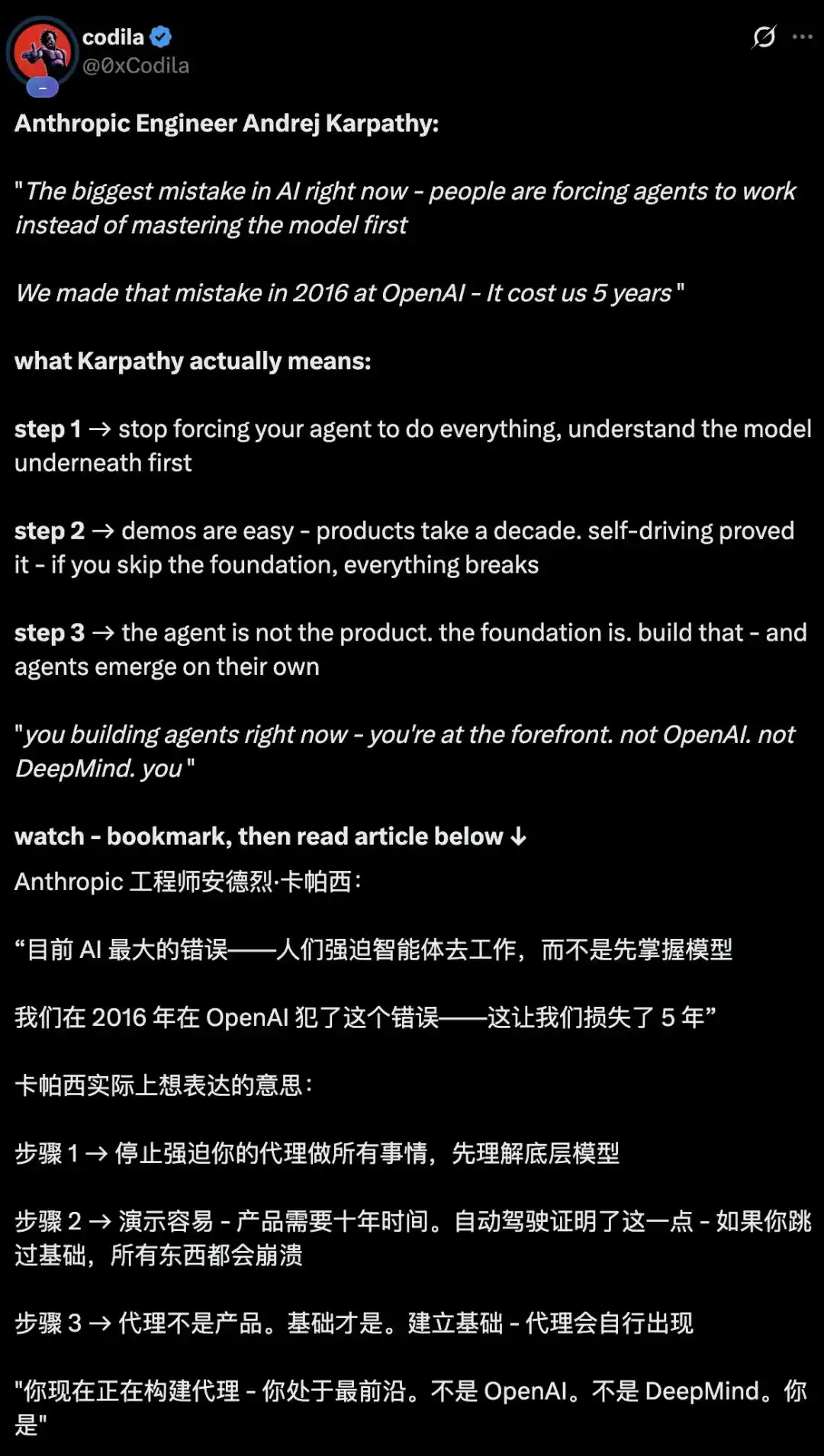
Karpathy Warns Agent Builders: Fix Foundation Models Before Forcing Agents to Work

Andrej Karpathy has argued that one of the biggest mistakes in today’s AI industry is pushing agents to perform tasks before the underlying foundation models are truly understood and improved. In a recent talk aimed at agent developers, he revisited OpenAI’s 2016 World of Bits project, which attempted to train agents to use keyboards and mice to complete web tasks such as booking flights and ordering food. Karpathy said the effort ultimately arrived too early, when reinforcement learning was still the main available tool and the underlying model capabilities were not ready. He used that experience to make a broader point about the current agent boom: flashy demos are relatively easy to build, but turning them into robust products can take a decade. Drawing comparisons with autonomous driving and VR, he said agents belong to the same category of technologies that are easy to imagine and demo, yet extremely difficult to commercialize at scale. Karpathy also urged researchers to look to neuroscience for clues about memory, action selection, and coordination inside intelligent systems. At the same time, he said the frontier of agent capability is still open, and that startups and independent developers may be better positioned than large labs to experiment quickly in a field where no one has an overwhelming multi-year lead yet.

1040
Karpathy Warns Agent Builders: Fix Foundation Models Before Forcing Agents to Work
ICML 2026
2026-07-06 03:29:56

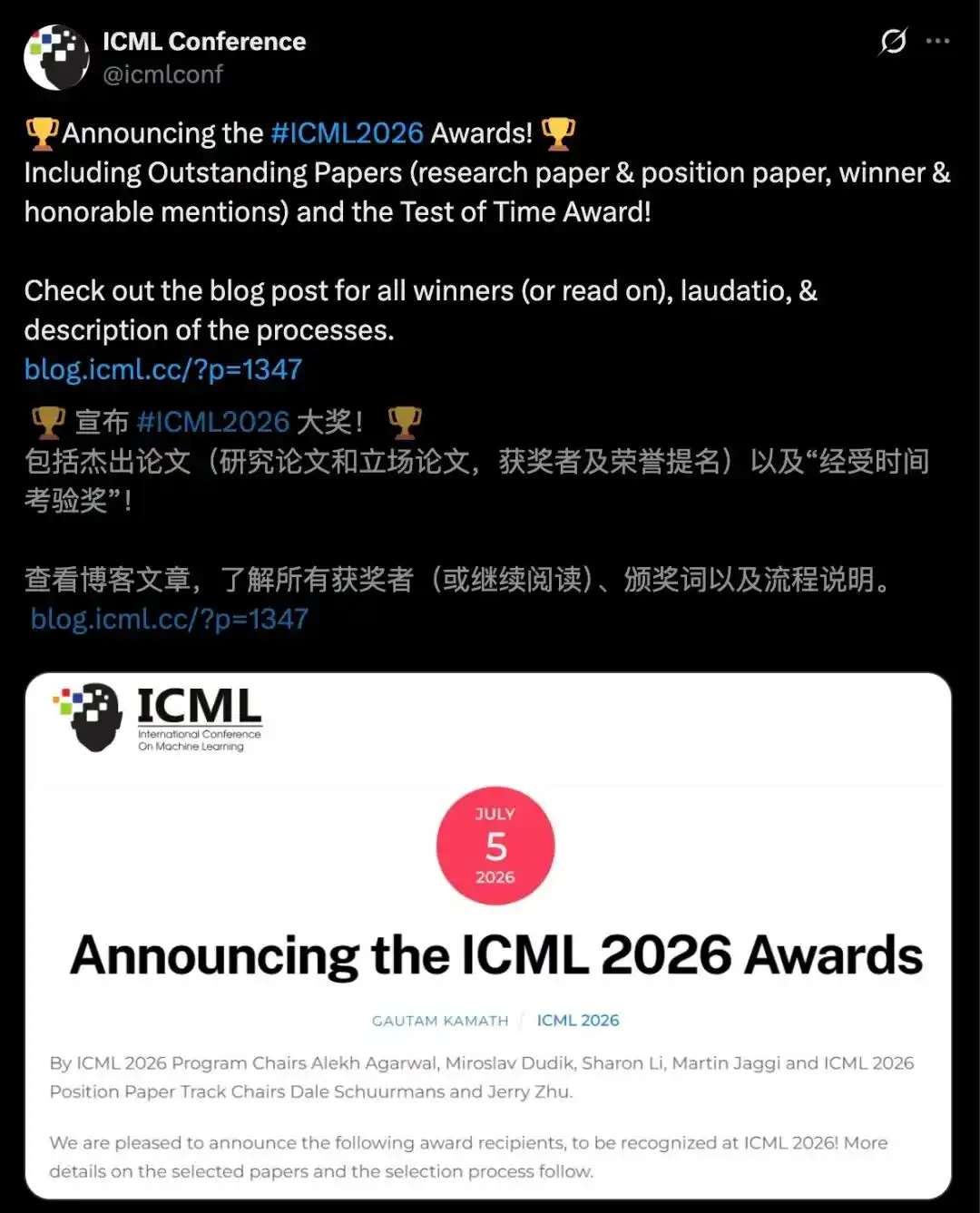
ICML 2026 Awards Spotlight Diffusion Models as DeepMind’s A3C Wins Test-of-Time Prize

ICML 2026 has announced its annual award winners, with diffusion-model research emerging as the clearest theme of the year. Two diffusion-related papers won distinguished paper honors: one challenged the claimed benefits of arbitrary-order generation in diffusion language models, while the other advanced high-accuracy sampling for diffusion models and log-concave distributions. Together, the selections suggest the field is shifting from headline-grabbing architectural claims toward deeper scrutiny of assumptions and stronger theoretical infrastructure. The conference also gave its distinguished position paper award to a work arguing that the AI alignment community may be unintentionally building tools that can be repurposed for censorship. That recognition points to a broader internal debate in AI safety over the boundary between safety mechanisms and content-control infrastructure. Meanwhile, the ICML 2026 Test-of-Time Award went to DeepMind’s 2016 paper “Asynchronous Methods for Deep Reinforcement Learning,” which introduced the A3C algorithm. The award highlights the enduring influence of asynchronous reinforcement learning on modern RL systems, including later developments in large-scale alignment and policy optimization.

1150
ICML 2026 Awards Spotlight Diffusion Models as DeepMind’s A3C Wins Test-of-Time Prize
Internet Capi
2026-06-28 19:01:01

Deep Dive into Internet Capital Markets 2026: US Regulatory Breakthroughs and the Institutional Wave on Solana

This article analyzes the crypto industry's transition from experimental to industrial phase, highlighting US regulatory milestones such as the GENIUS Act and SEC/CFTC joint guidance, and Solana's role as the core infrastructure for Internet Capital Markets (ICM). It details eight real-world institutional use cases including J.P. Morgan's commercial paper issuance, Western Union's stablecoin payments, and Apollo's private credit tokenization. The piece also provides a strategic framework for Asian institutions across executable, transitional, and exploratory stages, emphasizing the fast-follower window before standards solidify.

440
Deep Dive into Internet Capital Markets 2026: US Regulatory Breakthroughs and the Institutional Wave on Solana