ISP

Goldman Sachs
2026-09-03 06:06:15

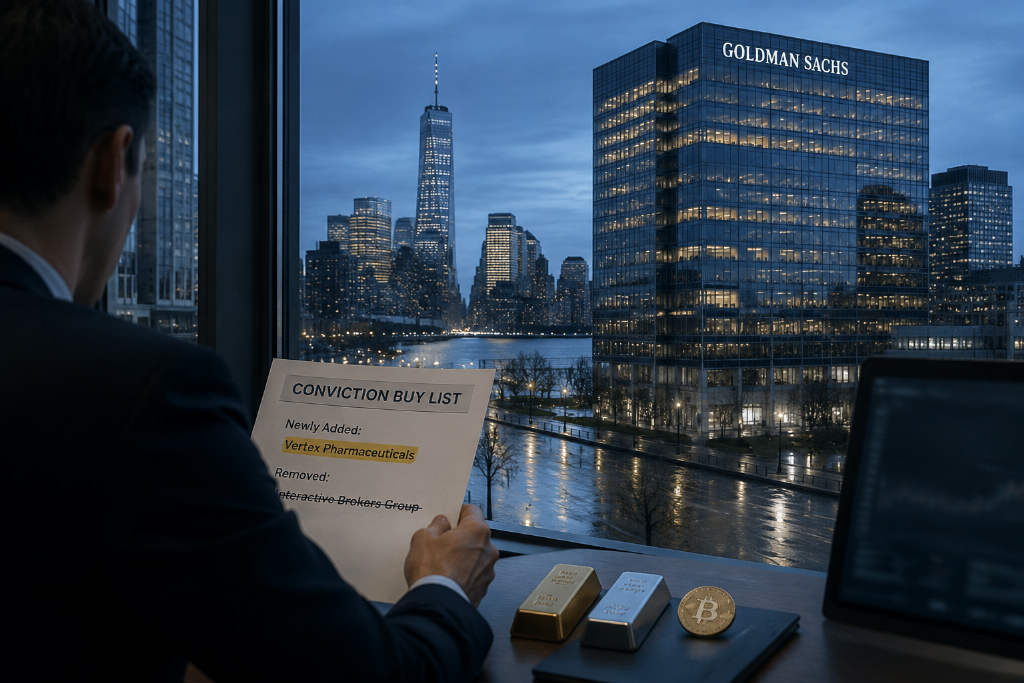
Goldman Sachs refreshes its high-conviction U.S. buy list, adds Vertex and removes Interactive Brokers

Goldman Sachs updated its U.S. high-conviction buy list for September, keeping the roster at 23 stocks while adding Vertex Pharmaceuticals and removing Interactive Brokers Group. In its Sept. 1 monthly report, the bank said the entire gain in U.S. equities during August was concentrated in the first two trading days of the month. After that, markets drifted into a summer trading range, with risk assets lacking a clear direction even after Nvidia delivered strong earnings. Goldman said the 10-year Treasury yield rose 9 basis points from the start of the month, Brent crude was little changed, and gold, silver and Bitcoin gained 9%, 22% and 24%, respectively. Against what it described as a catalyst vacuum, the firm argued that better opportunities may lie in companies undergoing material change that could set a new direction for the fourth quarter. Goldman highlighted Vertex as the most notable addition, with analyst Salveen Richter pointing to five potential multi-billion-dollar commercial opportunities across cystic fibrosis, pain, kidney disease, hematology and endocrinology. The report also reviewed strong August performers such as Estée Lauder, DoorDash and TPG, while maintaining buy views on laggards including Viking Holdings and Applied Materials despite recent stock pressure.

340
Goldman Sachs refreshes its high-conviction U.S. buy list, adds Vertex and removes Interactive Brokers
Artificial In
2026-08-31 10:55:20

From the Dartmouth proposal to Jensen Huang’s AGI remark: a 70-year history of AI booms, winters and shifting definitions

MarsBit revisits the 70-year arc of artificial intelligence through a current flashpoint: Jensen Huang’s remark on Nvidia’s August 26, 2026 earnings call that, "for a lot of tasks, we can say that we have achieved AGI." The article does not treat that line as settled fact. Instead, it uses the debate around it to trace AI from the 1955 Dartmouth proposal, where John McCarthy, Marvin Minsky, Nathaniel Rochester and Claude Shannon outlined a summer project built on the idea that learning and intelligence could, in principle, be described precisely enough for a machine to simulate them. The piece walks through the field’s early optimism, the perceptron era, symbolic AI, the Lighthill report, expert systems, the two AI winters, and the period when researchers avoided the term "AI" altogether in favor of machine learning, pattern recognition and related labels. It then follows the buildup to the deep learning turn, including ImageNet, AlexNet, DeepMind’s reinforcement learning work, AlphaGo, and the Transformer paper "Attention Is All You Need," before moving into BERT, GPT, scaling laws, Chinchilla, diffusion models and ChatGPT. The central argument is that AI history keeps repeating a few patterns: promises outrun capabilities, definitions keep moving, and methods built to scale with compute often overtake systems packed with hand-crafted human knowledge. On that basis, the question of whether AGI has been achieved remains unresolved not only because capability is contested, but because the term itself has never had a fixed, falsifiable definition.

280
From the Dartmouth proposal to Jensen Huang’s AGI remark: a 70-year history of AI booms, winters and shifting definitions
FOLD
2026-08-28 08:05:12

FOLD jumps after Bithumb KRW listing, but $120 million FDV faces an early unlock test

The Interfold’s token, FOLD, rose after South Korean exchange Bithumb announced a KRW trading pair on Aug. 28, briefly touching $0.10 and trading at $0.094 at the time of writing. That left the token with a circulating market capitalization of about $30.71 million and a fully diluted valuation near $120 million. The listing marked FOLD’s third major exchange debut in nine days, following launches on Upbit and Kraken after its Aug. 19 token generation event and the rollout of Network Alpha, the first production phase of its mainnet. The move also sharpened attention on who is setting the token’s price. Before Bithumb joined, Upbit’s KRW pair already accounted for roughly 55% of global volume, while two Uniswap v4 pools made up just over 30%. Earlier public price discovery through two Uniswap continuous clearing auctions had valued FOLD at roughly $0.023 and $0.0224, putting FDV near $27.6 million. Against a spot price near $0.096, those auction buyers were sitting on paper gains of about 4.2x to 4.3x. Supply remains a central issue. FOLD has a total supply of 1.2 billion, with 27.22% circulating at TGE. Linear unlocks for the foundation treasury, Gnosis Guild, airdrops, and team advisors are set to begin on Sept. 1, adding about 21.63 million tokens per month, or 6.6% of the current circulating supply.

1180
FOLD jumps after Bithumb KRW listing, but $120 million FDV faces an early unlock test
Ingenic
2026-08-25 02:09:10

Ingenic Joins the A+H Ranks After Hong Kong Listing, Backed by Memory, Compute and Analog Chip Lines

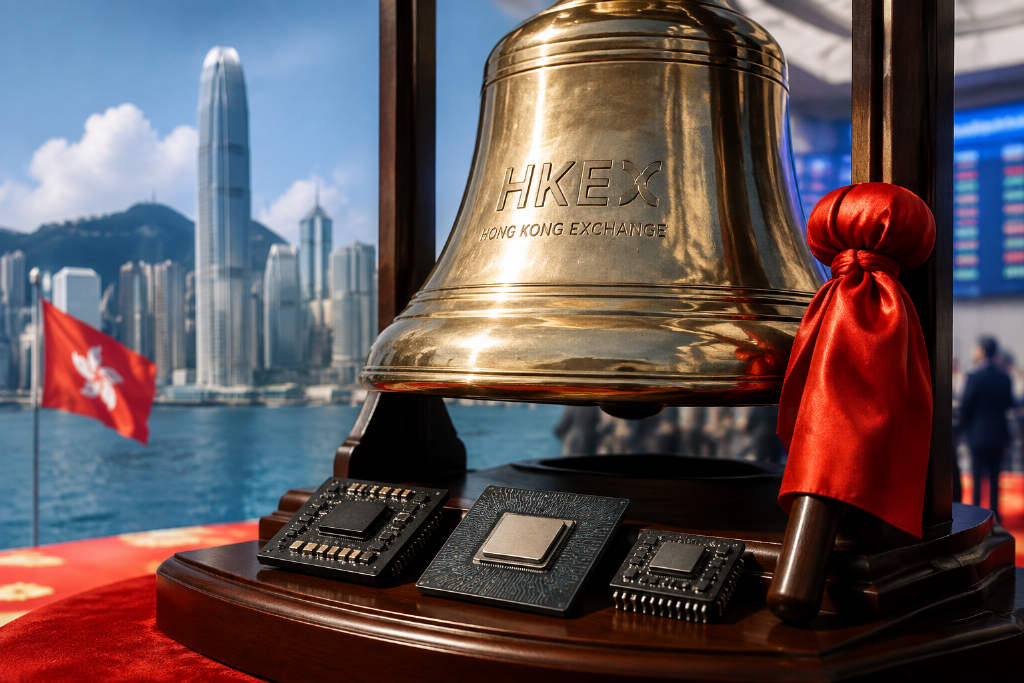
Ingenic rang the opening bell in Hong Kong on Aug. 25, debuting at HK$100 per H share and reaching an opening market capitalization of about HK$51.5 billion. The company had already been listed on Shenzhen’s ChiNext board since May 31, 2011, and the new listing places it among semiconductor companies with both A-share and H-share listings. The prospectus outlines a chip platform strategy built across three product lines: memory, compute and analog. That structure took shape after Ingenic completed its acquisition of Beijing Silicon and indirectly took control of Integrated Silicon Solution Inc. (ISSI) in 2020. Since then, the company has operated around three brands: ISSI for memory, Ingenic for compute and Lumissil for analog. Its recent numbers show a rebound. Revenue moved from RMB 45.31 billion in 2023 to RMB 42.13 billion in 2024, then back up to RMB 47.41 billion in 2025. First-quarter 2026 revenue reached RMB 15.60 billion, up 47.1% from a year earlier, while net profit rose to RMB 3.20 billion and gross margin climbed to 42.6%. Ingenic said it expects to raise HK$3.13 billion from the Hong Kong offering. Half of the proceeds are earmarked for R&D, while 25% is set aside for strategic investments and acquisitions.

510
Ingenic Joins the A+H Ranks After Hong Kong Listing, Backed by Memory, Compute and Analog Chip Lines
Pudgy Penguin
2026-08-14 08:26:43

Pudgy Penguins co-founder’s Spritehood NFT mint sells out in 53 minutes on Robinhood Chain

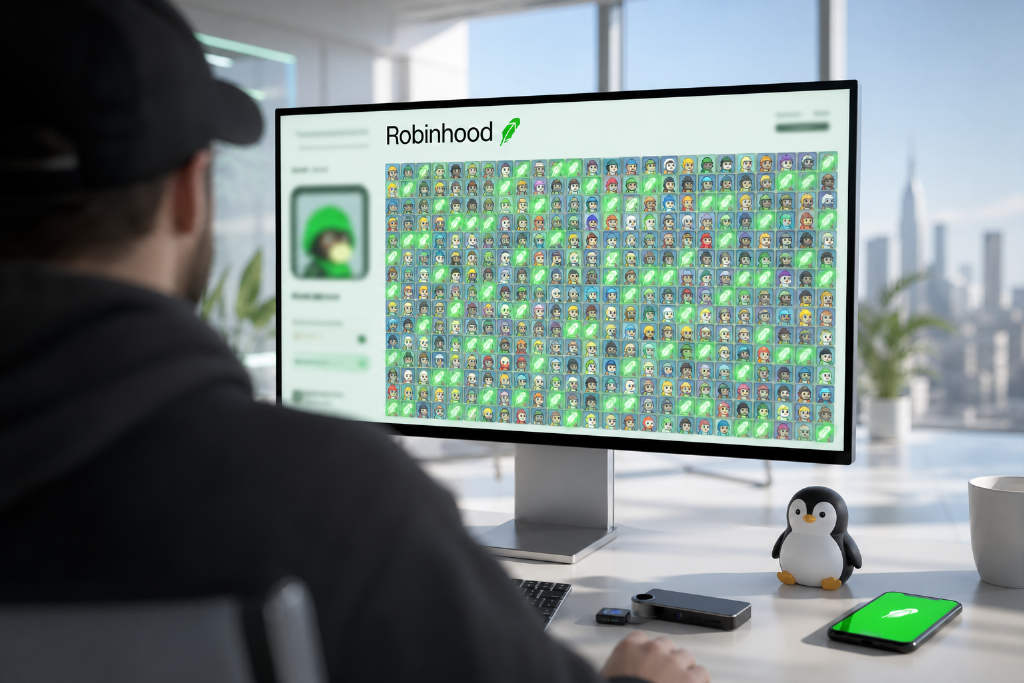
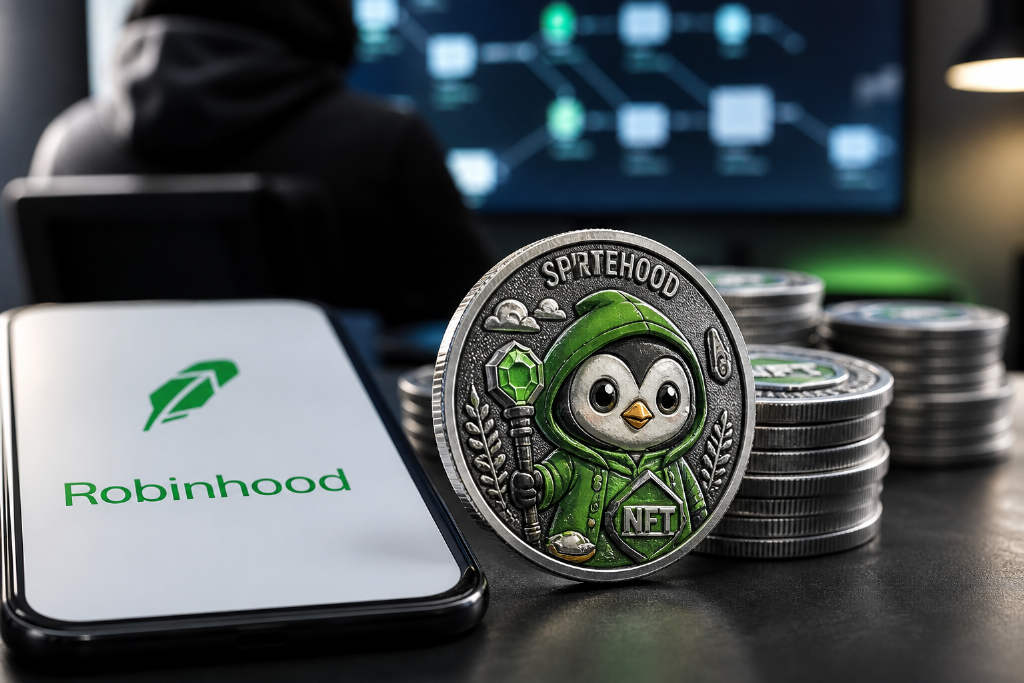
Cole Villemain, a co-founder of Pudgy Penguins who was removed from the project by community vote in 2022, returned to the NFT market on Aug. 11 with a new collection called Spritehood on Robinhood Chain. The drop featured 44,444 NFTs under the WISP label and sold out in 53 minutes, generating about $1.28 million in revenue, or roughly 684 ETH. Of the total supply, 42,956 were paid mints, while 1,488 had been distributed for free before the public sale. Pricing was split between 37,430 mints at $17 each and 5,526 mints at $117, with the extra $100 tied to an upgrade option. The project uses an RPG-style structure with 10 classes, and holders can later burn Wisp NFTs to summon customizable sprites. The launch also drew renewed attention to Villemain’s history, including the 2022 treasury controversy around Pudgy Penguins and earlier claims highlighted by ZachXBT. On Aug. 13, Robinhood Chain posted $1.05 million in 24-hour NFT trading volume, above Ethereum’s less than $525,000 during the same period, according to the source article.

990
Pudgy Penguins co-founder’s Spritehood NFT mint sells out in 53 minutes on Robinhood Chain
Pudgy Penguin
2026-08-14 07:03:23

Former Pudgy Penguins co-founder Cole sells out Spritehood NFT drop on Robinhood Chain

Former Pudgy Penguins co-founder Cole Villemain has sold out a new NFT project, Spritehood, on Robinhood Chain, with 44,444 NFTs gone in less than an hour. On-chain analysis shared by 0xlaplaced put the sale’s actual proceeds at about $1.28 million, well above the $755,000 figure that had circulated in the community during the mint. The breakdown cited in the analysis showed 37,430 items sold at $17 each and another 5,526 sold at $117, with the full sale lasting roughly 53 minutes and 48 seconds. At the same time, the project’s Spritehood Wisp, or WISP, contract still appeared as unverified on Blockscout, leaving the contract logic and fund distribution mechanism unavailable for public review. The launch has also revived scrutiny of Villemain’s past. Before the sale, he promoted the project on X, including a July 11 teaser and later giveaway campaigns tied to likes, reposts and follows. Community criticism has pointed back to his removal from the original Pudgy Penguins team in January 2022, while blockchain investigator ZachXBT had already published a long post in 2021 raising sharp questions about his earlier conduct.

600
Former Pudgy Penguins co-founder Cole sells out Spritehood NFT drop on Robinhood Chain
Pudgy Penguin
2026-08-11 14:57:03

Ousted Pudgy Penguins co-founder sells out 44,444 NFT mint on Robinhood Chain

Cole Villemain, the Pudgy Penguins co-founder removed by holders in January 2022, sold out a 44,444-piece NFT collection called Spritehood on Robinhood Chain in less than an hour on Aug. 11. An onchain breakdown shared by X account 0xlaplaced said the paid mint ran for 53 minutes and 48 seconds, with 37,430 tokens sold at $17 and 5,526 sold at $117, bringing the total to $1,282,852, or 684.28 ETH at mint-time pricing. The same analysis also said 1,488 tokens were issued for free across 20 zero-price transactions before the paid sale began. The contract has drawn attention because its source code is not verified on Robinhood Chain’s Blockscout explorer. The Spritehood Wisp ERC-721 token, under the symbol WISP at address 0xd6577124F96394faee65AfD2408f2ffA88445f63, shows a total supply of 44,444, but buyers cannot inspect published code for the pricing and distribution logic. Critics on X called the sale a cash grab, while scrutiny around Villemain’s history was amplified by his past removal from Pudgy Penguins and an earlier thread from blockchain investigator ZachXBT. What buyers ultimately receive for $17 or $117 remains unclear.

450
Ousted Pudgy Penguins co-founder sells out 44,444 NFT mint on Robinhood Chain
ARK Invest
2026-08-03 04:45:53

ARKK’s top three holdings as of July 31 were Tesla, SpaceX and Tempus AI

ARK Invest trading data showed that on July 31, the ARK Innovation ETF (ARKK) sold 18,855 shares of Snowflake (SNOW), a position worth about $5.5 million based on the latest closing price. The data also showed recent portfolio changes tied to Cathie Wood, including reductions in Shopify, 10x Genomics, Figma and Iridium Communications, while adding CoreWeave, Circle, Pony AI and Kodiak AI. As of July 31, Tesla remained ARKK’s largest holding at 9.42%. SpaceX ranked second at 4.92%, followed by Tempus AI at 4.81%. The rest of the fund’s top 10 holdings were CRISPR Therapeutics at 4.66%, Coinbase at 4.54%, Shopify at 4.54%, AMD at 3.96%, Circle at 3.82%, Robinhood at 3.54% and 10x Genomics at 3.43%. The holding data was cited by TheStreet and relayed in a newsflash from Odaily.

1130
ARKK’s top three holdings as of July 31 were Tesla, SpaceX and Tempus AI