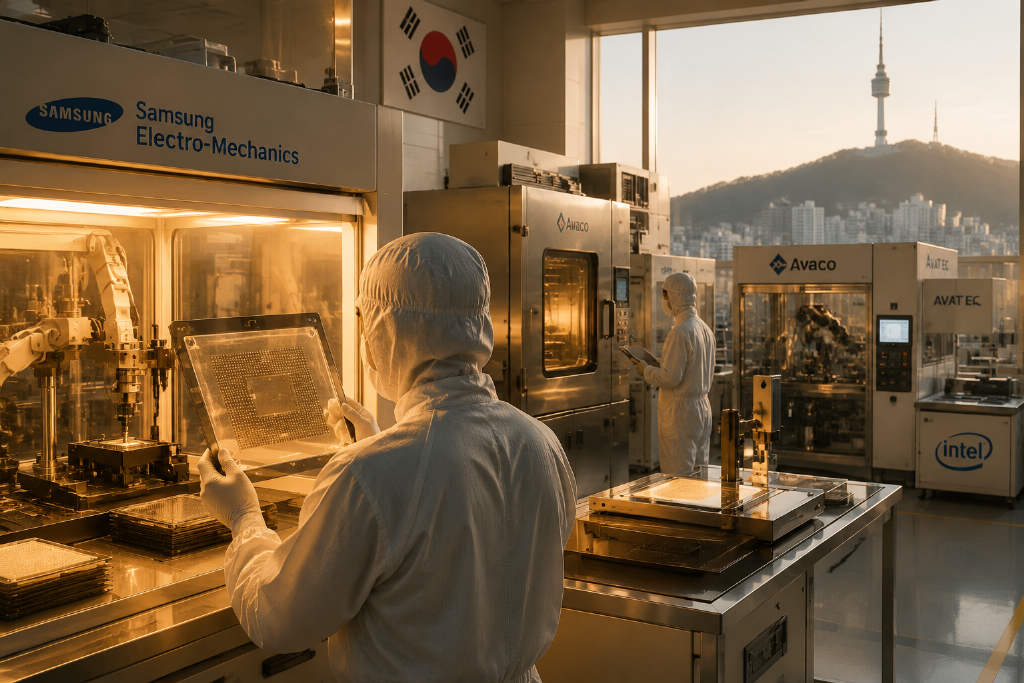
Glass substrate timelines keep shifting as the industry runs into its first real delivery test
Glass substrates are moving out of the announcement phase and into a harder stage where customer qualification, reliability testing, and yield determine who can actually ship. A cluster of developments in late July and August 2026 captures that transition: Intel and Lens Technology advanced their cooperation on TGV-based packaging for AI-era applications, Korean equipment maker Avaco and affiliate AVAT EC launched a pilot line for TGV process verification, and supply-chain information indicated Samsung Electro-Mechanics had run into a bottleneck in customer sample reliability testing, potentially pushing related mass-production timing beyond 2028. The common thread is that theoretical material advantages are no longer enough. After drilling, copper filling, routing, and assembly, glass substrates still have to pass customer-specific evaluations for thermal cycling, humidity resistance, flatness, warpage, and signal continuity. That process cannot be accelerated simply by spending more or leaning on market enthusiasm. Across the sector, companies are still building pilot lines, producing samples, and entering technical testing, while formal certification and volume orders remain uncertain in many cases. The result is a production calendar that keeps moving to the right, even as AI infrastructure and high-performance computing continue to support demand for advanced packaging materials.