MPP

Stripe
2026-07-21 12:30:08

Stripe, PayPal and stablecoins: why the payment business remains structurally fragmented

A commentary published by MarsBit on July 21 argues that Stripe’s latest push around PayPal, stablecoins and agent-driven payments reflects a broader reality in financial technology: payments remain fragmented, deeply tied to banking infrastructure and resistant to any single company’s attempt at full control. The piece says Stripe missed its pandemic-era IPO window after once reaching a $100 billion valuation, then turned to acquisitions and new narratives spanning merchant acquiring, stablecoins and agent-side protocols. In the author’s view, that strategy is partly an effort to fill Stripe’s weak consumer-facing position after limited progress using stablecoins to crack the C-end market. The article also casts doubt on whether PayPal, despite products such as Venmo and PYUSD, can reverse its decline through new business lines alone. It further compares Stripe with Circle, saying both are moving toward a mix of public chains, stablecoins and settlement rails, while arguing that long-term value may sit less in token issuance economics and more in settlement efficiency. The core claim is that third-party payments have no simple “first principle” because the sector is shaped by local licensing, banking control and a durable patchwork of regional operators.

1840
Stripe, PayPal and stablecoins: why the payment business remains structurally fragmented
Galaxy Digita
2026-07-19 12:03:13

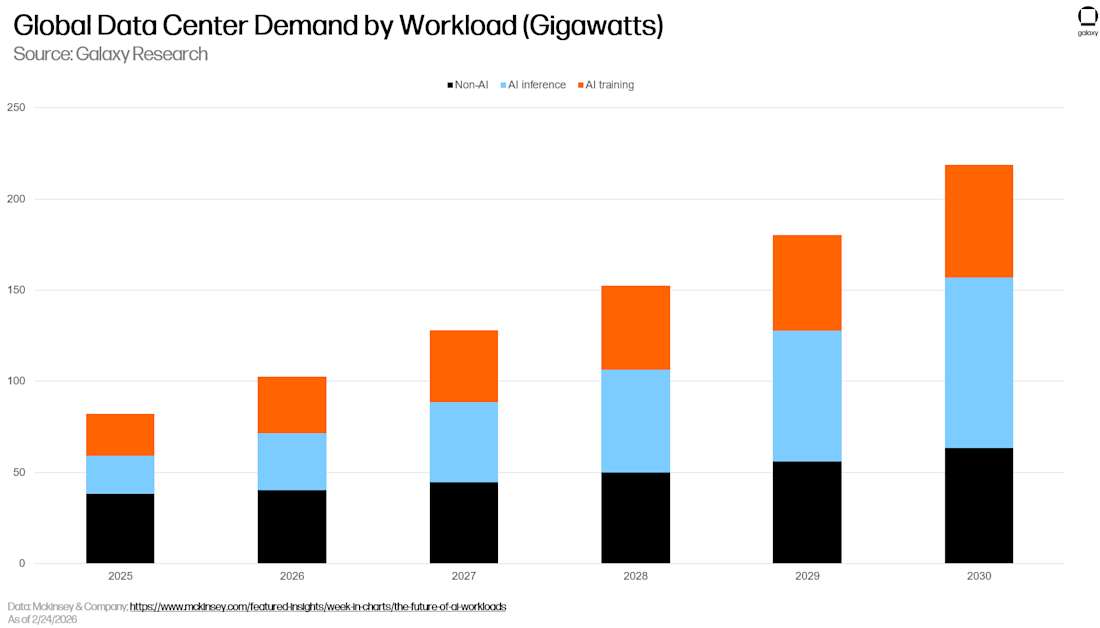
Galaxy says on-chain capital markets for AI inference are starting to take shape

Galaxy Digital research vice president Lucas Tcheyan argues that an “on-chain inference capital market” is beginning to emerge as AI inference, GPU supply, payment rails, tokenization tools and financing infrastructure converge into a more integrated system. In the piece, republished by WuBlockchain and translated by TechFlow, he frames inference as a fast-growing economic layer that is moving beyond centralized APIs controlled by companies such as OpenAI and Anthropic. The report breaks the market into several connected parts. On the off-chain side, GPU index providers including Ornn and Silicon Data are trying to standardize compute pricing, while ICE and CME have announced plans for GPU futures. On-chain, the stack includes decentralized inference providers, model developers, router layers, agent payment standards, tokenized access markets and credit protocols that finance GPU hardware. Tcheyan focuses on four examples. Venice turns future inference access into transferable claims through its VVV and DIEM token structure. Pearl and Ambient try to tie network security to real inference work through “useful proof of work,” though both still face open questions around real demand and token value capture. USD.AI takes a different route by using stablecoin deposits to fund GPU-backed loans for smaller compute operators. Galaxy’s conclusion is that the sector remains early: financing has found the clearest product-market fit so far, while the broader tokenized inference economy still needs to prove durable demand, execution and pricing power.

1440
Galaxy says on-chain capital markets for AI inference are starting to take shape
Visa
2026-07-16 14:31:23

Visa’s Cuy Sheffield says x402 has processed about $19M in adjusted onchain volume

Visa’s head of crypto, Cuy Sheffield, said x402 has handled about $19 million in adjusted onchain volume across roughly 134 million transactions since May 2025, citing a Visa and Artemis report he referenced in a Wednesday thread on X. x402 is described as a payments protocol for agent- and machine-initiated onchain transactions. The figures were adjusted to remove identified wash activity and test transactions using Artemis Analytics onchain data as of April 21, 2026. Sheffield said the exercise was meant to isolate what activity was “actually real” before drawing conclusions. The report also notes that cumulative raw onchain totals are higher than the adjusted figures. His post included a chart titled “Cumulative x402 Volume (Adjusted),” powered by Artemis, but the chart appeared to show cumulative volume reaching about $15 million by April 21 and starting around October, which does not match the thread’s text citing about $19 million since May 2025. Sheffield did not explain the discrepancy in the post. He also said activity is highly concentrated: the top 1% of x402 buyers, about 4,000 wallets, account for about 90% of adjusted volume and around half of adjusted transactions, while 422,000 wallets have paid for something onchain. By chain, Base accounts for about 90% of adjusted transactions and 93% of adjusted volume, followed by Solana and Polygon. Sheffield added that MPP, a related protocol, has been live since March and is averaging about 20,000 transactions per day, though he did not define it or cite a data source in the thread.

1060
Visa’s Cuy Sheffield says x402 has processed about $19M in adjusted onchain volume