NAURA

semiconductor
2026-09-02 12:13:13

China’s chip equipment push moves into tougher territory as metrology advances and bottlenecks persist

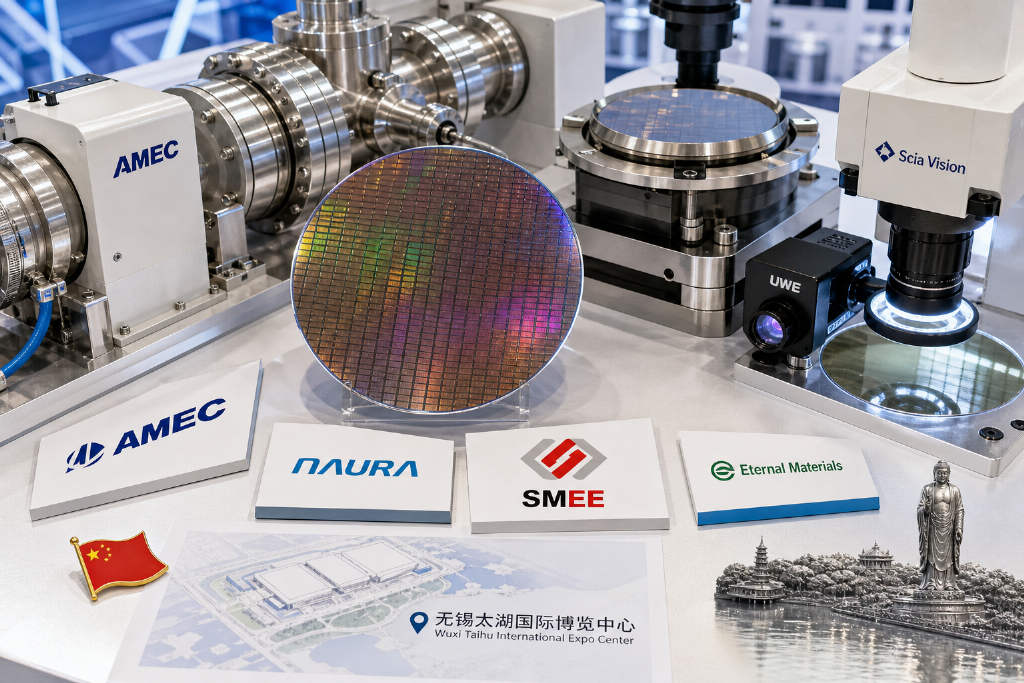
China’s semiconductor equipment industry is entering a more demanding phase, with the easiest import-substitution wins largely behind it and harder categories now drawing the most attention. At CSEAC 2026 in Wuxi, equipment makers and component suppliers used the show to present where domestic progress stands across process tools, metrology and inspection systems, advanced packaging, and core parts. In process equipment, companies such as Advanced Micro-Fabrication Equipment Inc. China (AMEC), NAURA, and Shanghai Micro Electronics Equipment showed continued expansion across etch, deposition, and lithography-related systems. But ion implanters remain a major weak spot. According to data cited by Aion Semiconductor, overall localization in ion implantation is still below 15%, with high-current tools below 10% and high-energy tools largely blank. Metrology and inspection appear to be moving faster. eGenerate, Yuwei Semiconductor, and SDRA were among the companies highlighted for equipment already in volume delivery or advanced validation. In advanced packaging, wafer-to-wafer bonding is more mature, while die-to-wafer bonding is still largely in validation. The report also points to continued progress in domestic core components, arguing that the sector is shifting from isolated breakthroughs toward broader ecosystem building, even as trust barriers, validation constraints, and long R&D cycles remain in place.
40
China’s chip equipment push moves into tougher territory as metrology advances and bottlenecks persist
AMEC
2026-08-31 12:11:14

AMEC’s rise in etching tools puts China chip equipment makers under a brighter global spotlight

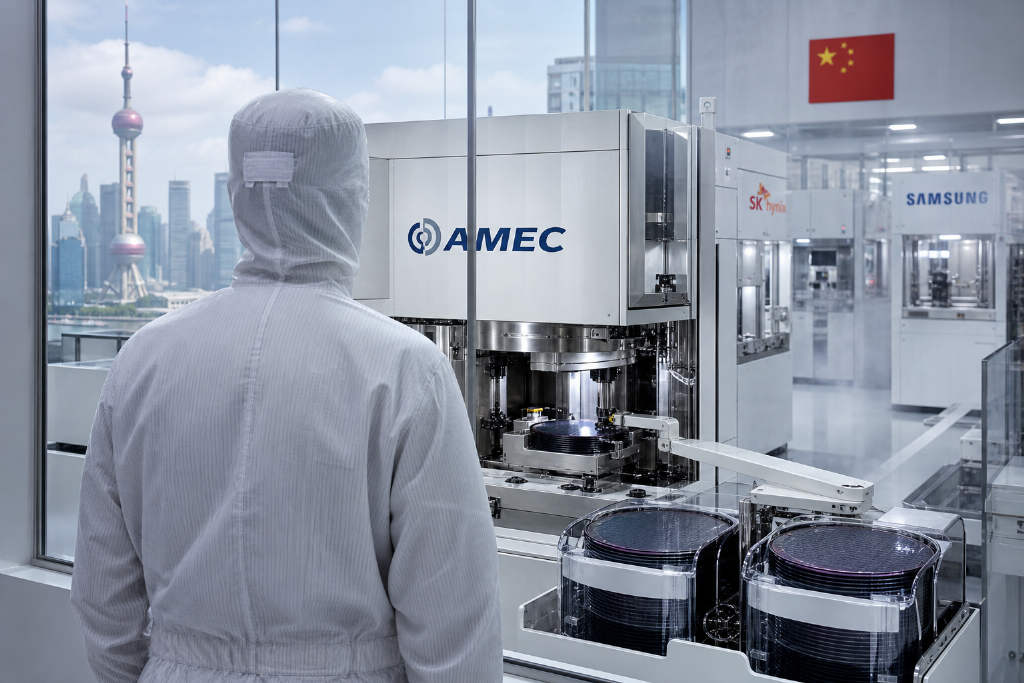
A long-form report carried by MarsBit and credited to WeChat account HSTL8888 traces how Advanced Micro-Fabrication Equipment Inc. China, or AMEC, moved from a startup backed by local government funding in Shanghai to a supplier validated by Taiwan Semiconductor Manufacturing Co. The piece opens with a Reuters report from early August saying Samsung Electronics and SK Hynix were evaluating AMEC chipmaking tools for use in their fabs in China, and that testing of the company’s etching tools may have started about two years ago. Samsung later denied it had ever considered the move, while SK Hynix declined to comment. The report then broadens into a history of China’s semiconductor equipment industry, covering AMEC, Piotech-related deposition efforts, Hwatsing for CMP, Skyverse for wafer inspection, ACM Research Shanghai for cleaning tools, and NAURA as a platform-style equipment company built through acquisitions. It argues that tightening U.S. export controls, support from domestic fabs such as Semiconductor Manufacturing International Corp. and funding through the National Integrated Circuit Industry Investment Fund together accelerated localization. Citing industry and official figures, the article says China’s overall localization rate in semiconductor equipment rose from under 5% to about 20% by 2025, while major foundries kept capacity utilization above 90% in the first seven months of this year.

70
AMEC’s rise in etching tools puts China chip equipment makers under a brighter global spotlight
Bernstein
2026-08-13 02:02:49

Bernstein lifts WFE outlook through 2028, with DRAM and logic spending driving a 75% two-year rise

Bernstein has raised its global wafer fab equipment, or WFE, spending forecasts for 2026 through 2028 and says the current upcycle in chip equipment spending still has room to run. The firm now expects WFE to reach $148 billion in 2026, $204 billion in 2027, and $259 billion in 2028, up from prior estimates of $141 billion, $175 billion, and $198 billion. That implies cumulative growth of 75% over two years. The upgrade spans most applications and regions, but Bernstein said the larger contribution comes from memory outside China and from foundry and logic spending in China. DRAM and NAND are expected to post the fastest growth, outpacing logic and foundry. For 2027, Bernstein forecasts DRAM WFE at $69 billion, NAND at $20 billion, and logic/foundry at $104 billion, each above its earlier projections. The report also points to stronger-than-expected resilience in China. Bernstein forecasts China WFE demand at $57 billion in 2026, $57.3 billion in 2027, and $101 billion in 2028, with a sharp step-up tied to broad capacity expansion across memory, advanced logic, and mature logic. It also said recent pullbacks in semiconductor equipment stocks have created more attractive entry points, while warning that the views, ratings, and price targets cited are those of Bernstein analysts and do not constitute investment advice.

2140
Bernstein lifts WFE outlook through 2028, with DRAM and logic spending driving a 75% two-year rise
Chaopure Appl
2026-08-11 05:24:34

Chaopure Applied Materials jumps as much as 654.66% after Shenzhen debut, market value tops 50.7 billion yuan

Chengdu Chaopure Applied Materials Co., a Sichuan-based supplier of core semiconductor equipment components, began trading on the Shenzhen Stock Exchange on Aug. 11 after pricing its A-share IPO at 65.99 yuan per share. The company sold 25.461539 million new shares, raising about 1.68 billion yuan in gross proceeds and about 1.557 billion yuan in net proceeds, above the 1.125 billion yuan target set out in its prospectus. On its first trading day, the stock opened at 450 yuan, up 581.92% from the offer price, and was quoted at 498 yuan at 10:20:39 a.m., representing a 654.66% gain and a market capitalization of 50.719 billion yuan. According to the prospectus cited in the original report, Chaopure plans to use the proceeds for an industrialization project for core optical components used in semiconductor equipment, a semiconductor materials and surface treatment project, a capacity expansion project at its Meishan base, headquarters and R&D center construction, and working capital. The company, founded in August 2005, focuses on special coating components for semiconductor equipment and precision optical devices. The report said it is among the few domestic suppliers of core components for etching equipment at 5 nm and below. The report also outlined the company’s ownership, financial performance from 2023 to 2025, customer and supplier concentration, and the roles of brothers Chai Jie and Chai Lin, who remain the key controlling shareholders after the listing.

1070
Chaopure Applied Materials jumps as much as 654.66% after Shenzhen debut, market value tops 50.7 billion yuan
Policy Regula
2026-08-05 11:36:10

Export controls are reshaping chip-equipment buying, with supply certainty now part of the pitch

A MarsBit article citing a Reuters report says Samsung Electronics and SK Hynix are evaluating etching tools made by Chinese semiconductor equipment maker AMEC at plants in China, though Samsung later denied it was testing or considering AMEC equipment, and there is no evidence of a large procurement agreement. The piece argues that the more important issue is not whether AMEC wins an order soon, but why companies that already have mature Western equipment supply chains would even begin testing Chinese tools. Its answer is tied to U.S. export controls. For chipmakers, a tool is not judged only by performance, yield, efficiency and cost. Long-term access to spare parts, software updates and field service matters because equipment is expected to stay on a production line for years. The article says that policy risk is now affecting how customers assess whether a supplier can remain dependable over a decade or more. The report also points to progress by Chinese equipment vendors, especially in etching. It says AMEC’s etching equipment sales reached about 9.832 billion yuan in 2025, up about 35% year over year, and argues that some domestic tools have moved beyond small-batch validation into sustained use in mass production. Even so, the article stresses that testing at China-based fabs does not mean Chinese vendors have already entered global procurement systems.

1160
Export controls are reshaping chip-equipment buying, with supply certainty now part of the pitch
Gate
2026-08-04 04:14:46

Gate to launch 10 stock-derivatives perpetual contracts and roll out a 50,000 USDT airdrop campaign

Gate said its stock derivatives section will debut 10 perpetual contracts on August 4 at 13:30 (UTC+8), with all contracts settled in USDT and offering 1x to 20x leverage. The first batch includes CAMBRICON, EOPTOLINK, IEIT, MONTAGE, FII, NAURA, AMEC, SUNGROW, CMOC and BLUEFOCUS, each listed with their corresponding China A-share tickers. The exchange also said it will open the 12th new-token airdrop event for its stock derivatives section from August 4 at 16:00 to August 13 at 16:00 (UTC+8). Under the campaign, new users can receive 5 USDT after completing their first futures trade, while participants who complete daily trading-volume check-ins for eligible contracts can collect as much as 35 USDT in total. Users trading the designated contracts will also be able to share a 30,000 USDT prize pool. According to the official announcement cited by ChainCatcher, the total prize pool for the event is 50,000 USDT, and the maximum reward available to a single participant is 240 USDT.

1130
Gate to launch 10 stock-derivatives perpetual contracts and roll out a 50,000 USDT airdrop campaign
JZL Capital
2026-08-03 12:30:56

JZL Capital weekly: Fed split widens as ETF outflows keep pressure on BTC

JZL Capital’s weekly note for July 27 to Aug. 2 said markets were driven by a more divided Federal Reserve, softer headline inflation led by energy prices, widening dispersion across Chinese and U.S. equities, and renewed pressure on Bitcoin from spot ETF outflows. The July Federal Open Market Committee kept the federal funds rate at 3.50% to 3.75% by a 9-3 vote, with three officials explicitly backing a 25 basis point hike, which the report described as a hawkish pause rather than a neutral hold. In the U.S., June PCE slowed to 3.7% year over year from 4.1%, while core PCE eased only to 3.3% from 3.4%, suggesting headline disinflation came mainly from energy instead of a broad cooling in core pressures. In equities, the report said investors increasingly rewarded cloud revenue growth, earnings delivery and free cash flow, pointing to Microsoft’s 21.75% weekly rise and Azure’s 43% growth. In crypto, BTC fell from $65,400 to around $63,114 during the week, while U.S. spot BTC ETFs posted about $61.5 million in net outflows, reinforcing a market structure that JZL said is now constrained more by weak spot demand and internal selling pressure than by macro risk alone.

1210
JZL Capital weekly: Fed split widens as ETF outflows keep pressure on BTC
CXMT
2026-07-24 01:24:41

CXMT to List on Shanghai STAR Market on July 27 at Roughly RMB 580 Billion Valuation

ChangXin Memory Technologies, described in the report as China’s leading DRAM storage IDM player, is set to officially list on Shanghai’s STAR Market on July 27 with an issuance valuation of about RMB 580 billion. The company plans to raise RMB 29.5 billion, with roughly RMB 22.066 billion earmarked for equipment procurement and installation. The report also laid out a broad map of companies tied to the supply chain. In equipment, NAURA has already shipped etch and thin-film deposition tools in volume, while Advanced Micro-Fabrication Equipment Inc. China is still moving through verification and volume procurement for etch and thin-film tools. ACM Research’s CMP equipment has entered the core supply chain, and testing equipment makers Precision Measurement Electronics and Jztest are also cited as beneficiaries. On the materials side, the report named Yahc, Guanggang Gases, Jinhong Gas, Red Avenue New Materials, Jingrui Electronic Materials and Debang Technology. It also mentioned packaging and module-related names including Huatian Technology, Longsys and Delingli, as well as distributor Sunlord Electronics. According to the report, several listed firms hold indirect stakes through industry funds, with Shangfeng Cement holding about 0.1517% before the offering.

1010
CXMT to List on Shanghai STAR Market on July 27 at Roughly RMB 580 Billion Valuation