OCP

Compute Futur
2026-08-24 15:06:57

Compute derivatives take shape as GPUs move from IT hardware to financial assets

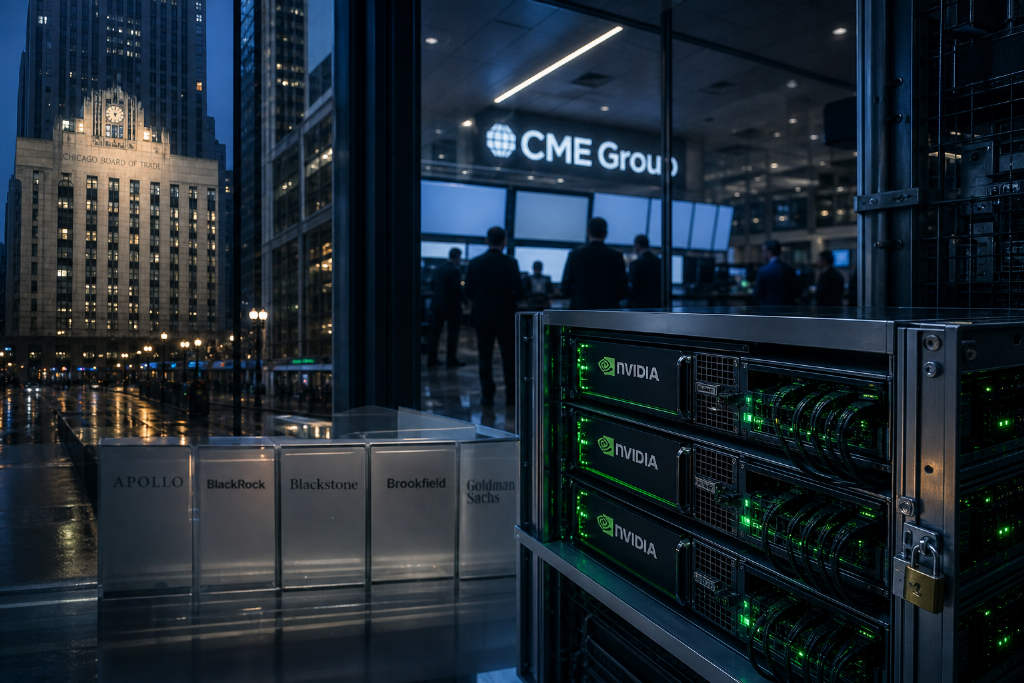
Nvidia’s August 10 announcement that it wants GPUs treated as investable, financeable infrastructure assets was followed a day later by CME Group’s plan to launch futures tied to GPU rental prices on October 5. Taken together with ICE’s competing contracts, FalconX’s OTC swap, Polymarket’s on-chain block trade, and Kalshi’s AI compute forward curve, the market is beginning to build a full stack around compute pricing. The shift is not just about trading products. It starts with a change in classification: Nvidia argues GPUs should be viewed less like fast-depreciating hardware and more like infrastructure with reusable capacity and recurring cash flow. That argument is being tested against a difficult reality, including steep declines in secondary-market prices for H100 chips and open questions around residual value support. China is moving on a parallel track. Shanghai has run spot compute trading infrastructure since 2023, and a June 2 government document explicitly called for research preparations for compute futures. Reports also suggest the Shanghai Futures Exchange is exploring an AI Token-linked design rather than the GPU hourly rental model used in the U.S. The result is a market that is no longer limited to leasing servers: it is slowly becoming a system for pricing, hedging, financing, and potentially collateralizing compute itself.

60
Compute derivatives take shape as GPUs move from IT hardware to financial assets
Market Analys
2026-08-06 13:44:00

Interconnect Moves to the Top of the Bottleneck Stack as HBM and Memory Hierarchies Face Repricing

A PANews analysis argues that August 4, 2026 marked a turning point for the memory industry. On the same day, SK hynix and SanDisk introduced the first standard for high-bandwidth flash, or HBF, at FMS 2026, while TrendForce reported that Nvidia was evaluating lower HBM configurations for Rubin Ultra. The article says those two developments point in the same direction: the core constraint in AI infrastructure is shifting away from on-package memory alone and toward interconnects across chips, packages, racks, and systems. The piece traces that shift through Nvidia’s Vera Rubin launch, NVLink 6 bandwidth gains, Spectrum-X CPO shipments, Intel’s EMIB-T packaging push, TSMC’s reported work on an EMIB-like approach, and the emergence of UCIe-linked memory tiers such as HBF. In that framework, optical and electrical interconnects sit at the top of the stack, advanced packaging becomes the physical foundation, HBM remains essential but less open-ended from an investment perspective, HBF represents a new category aimed at inference-era capacity pressure, and CXL memory pooling remains an option for later years. Rather than framing this as a broad “memory bull market,” the article’s main point is that value inside the storage empire is being redistributed as the bottleneck migrates.

1310
Interconnect Moves to the Top of the Bottleneck Stack as HBM and Memory Hierarchies Face Repricing
HBF
2026-08-04 11:43:12

HBF standard goes public, but near-term focus stays on SanDisk earnings and NAND pricing

WhiteLine Daily said the launch of a public HBF specification matters because it turns the concept from a single-company proposal into a shared industry standard. SK hynix and SanDisk published the first HBF technical specification through the Open Compute Project, defining 8-layer and 16-layer NAND stacks, capacities of up to 512GB per package, bandwidth tiers of roughly 0.4 TB/s to 3.0 TB/s, and UCIe connectivity to CPUs, GPUs and other accelerators. Google and Tenstorrent have also joined the HBF consortium. The report argues that HBF is not meant to replace HBM. Instead, it adds a new memory tier between HBM and SSD, placing larger-capacity storage closer to xPU compute. High-frequency, latency-sensitive data would still remain in HBM or DRAM, while model weights with lower access frequency could sit in HBF. That setup may be especially relevant for MoE models, where many expert weights stay idle most of the time yet still consume capacity. WhiteLine Daily said the short-term investment angle is still not HBF revenue, since first HBF samples are scheduled for the second half of 2026 and the first inference device samples using HBF are expected in early 2027. The nearer catalysts are SanDisk’s earnings, NAND pricing, data center demand, margins, customer agreements, and enterprise SSD progress.

750
HBF standard goes public, but near-term focus stays on SanDisk earnings and NAND pricing
U.S. Premarke
2026-08-04 13:00:22

U.S. premarket roundup: spot Bitcoin ETFs add $170.1 million as policy and tech headlines stack up

BlockBeats published a six-item U.S. premarket news roundup on Aug. 4, covering policy, geopolitics, semiconductor developments, equity strategy, and crypto ETF flows. The report said the Trump administration is drafting a ban on imports of new Chinese data center components, while the Federal Communications Commission is preparing import restrictions on Chinese optical transceivers used for high-speed fiber data transmission in data centers, with a plan to roll out the measures within this year. U.S. Treasury Secretary Bessent said an agreement with Iran could be reached as soon as tomorrow, reopening the Strait of Hormuz. In hardware, SK hynix and SanDisk released the first HBF, or high-bandwidth flash, standard through OCP and presented related AI memory solutions at FMS 2026 in Santa Clara, California. The roundup also cited a warning from Huawei’s semiconductor chief, who said Nvidia’s chip scaling is nearing physical limits and could trigger an “avalanche” if it passes a critical threshold. JPMorgan said it still favors a “technology + cyclicals” stock allocation and recommended healthcare as a third core theme. In crypto funds, U.S. spot Bitcoin ETFs recorded net inflows of $170.1 million yesterday, while spot Ether ETFs posted net outflows of $11.9 million.

710
U.S. premarket roundup: spot Bitcoin ETFs add $170.1 million as policy and tech headlines stack up
SK hynix
2026-08-04 00:28:09

SK hynix and Sandisk unveil first HBF standard at FMS 2026, with Google and Tenstorrent joining alliance

SK hynix said at FMS 2026 that it has jointly released the first High Bandwidth Flash, or HBF, standard specification with Sandisk, roughly six months after the two companies formed the alliance in February this year. The specification has been disclosed through the Open Compute Project and sets out key parameters including capacities of up to 512GB, three bandwidth tiers topping out at about 3.0TB/s, and use of the UCIe interconnect interface. Google and Tenstorrent have confirmed they are joining the HBF alliance. The technology is positioned as a new storage tier between high-bandwidth memory and SSDs, combining HBM-class transfer speeds with NAND’s larger capacity scaling. During the event, SK hynix also publicly showed its 10th-generation V10 375-layer 4D NAND wafer and related product for the first time, saying energy efficiency is 2.5 times better than the previous generation and that mass production is expected early next year. In a conference presentation, an SK hynix executive also outlined a tiered memory architecture as a way to address data-processing demands in the AI inference era.

1150
SK hynix and Sandisk unveil first HBF standard at FMS 2026, with Google and Tenstorrent joining alliance