OSC

Stablecoins
2026-09-02 06:07:50

FinTechOn panel says stablecoin oversight needs cross-border coordination across six jurisdictions

A panel at the FinTechOn 2026 AFA Summit brought together regulatory and industry representatives from Taiwan, Japan, Singapore, Hong Kong, Abu Dhabi and Thailand to discuss stablecoins and cross-border governance. The shared view was clear: stablecoins derive much of their value from cross-border use, so regulatory coordination across jurisdictions is essential. Speakers argued that a purely domestic stablecoin model would give up one of blockchain’s main strengths in global trade and payments. They also said regulators need to move faster, as technology is advancing more quickly than rulemaking, and that common standards should be discussed before conflicting frameworks harden. Taiwan’s representative said the island’s dedicated law for virtual asset services is expected in the first quarter of next year, with subordinate rules set to address potential financial stability concerns, including the possibility of funds shifting from traditional bank deposits into stablecoin reserves. Panelists from Japan, Thailand and Abu Dhabi also outlined local progress, from Japan’s trial-and-error approach to cross-border rollout, to Thailand’s multi-chain stablecoin work, and Abu Dhabi’s focus on operational and concentration risks.


730
FinTechOn panel says stablecoin oversight needs cross-border coordination across six jurisdictions
Thailand SEC
2026-09-01 08:27:30

Thailand SEC Seeks Feedback on Retail Access to Regulated Overseas Crypto Derivatives

Thailand’s Securities and Exchange Commission has opened a public consultation on a proposal that would let licensed domestic derivatives intermediaries offer certain overseas digital asset derivatives to retail, high-net-worth, and ultra-high-net-worth investors. The plan does not amount to a blanket opening for Thai retail traders to access all offshore crypto exchanges. Instead, eligible products would need to match local market specifications on underlying assets, contract tenor, leverage, and settlement terms, with fixed-expiry contracts generally set at no less than one month. The proposal also requires trading on derivatives exchanges that use central counterparty clearing and are supervised by regulators meeting specific IOSCO multilateral memorandum standards, or are members of the World Federation of Exchanges. Thailand’s SEC said products such as perpetual contracts and contracts for difference will likely struggle to qualify for retail distribution because many trade on offshore venues without central clearing or clear financial oversight. Products that fail the proposed tests would be limited to institutional investors. The consultation runs through Sept. 30, while final rules and an effective date have not been set.

130
Thailand SEC Seeks Feedback on Retail Access to Regulated Overseas Crypto Derivatives
RWA
2026-08-28 09:52:10

RWA Weekly: Four Banks Move on a Global Stablecoin Alliance as Coinbase Brings Tokenized Stocks to Base

Real-world asset markets kept expanding during the Aug. 21 to Aug. 27 tracking window, with on-chain RWA market capitalization reaching $38.7 billion and total holders climbing to 2.952 million, according to the figures cited in the report. Stablecoins also grew in scale, with total market capitalization rebounding to $303.04 billion and monthly transfer volume rising 20.33% from a month earlier to $6.49 trillion, even as monthly active addresses slipped 1.24% to 52.87 million. The report described that split as a market where larger holders are rebalancing frequently while smaller users are staying on the sidelines. Regulatory developments came from three major jurisdictions. In the U.S., the Financial Accounting Standards Board proposed guidance on when some digital assets, including stablecoins, may qualify as cash equivalents under GAAP, with comments due by Nov. 19, 2026. In the U.K., the government is moving to give the Bank of England a secondary legal objective to support innovation in digital currency and payments. In Japan, regulators are preparing to ease limits on large-value stablecoin payments, potentially allowing single transactions above 1 million yen. On the corporate and product side, The Wall Street Journal reported that JPMorgan Chase, Bank of America, Wells Fargo and Santander are working toward a global stablecoin alliance. Coinbase has launched tokenized stocks natively on Base under its B20 standard, while Franklin Templeton, Bitwise, Bitfinex Securities, Revolut, Fasset and Entropy.io also posted fresh RWA and stablecoin developments.

470
RWA Weekly: Four Banks Move on a Global Stablecoin Alliance as Coinbase Brings Tokenized Stocks to Base
POSCO
2026-08-25 19:40:00

POSCO brings trade receivables to Avalanche in latest tokenization move

CoinDesk says South Korean trading giant POSCO has brought trade receivables to Avalanche in a new tokenization transaction. The $22 billion company worked with Olea and Intain on the deal. CoinDesk also noted that POSCO ran an Injective pilot with LG CNS last month.

190
POSCO brings trade receivables to Avalanche in latest tokenization move
Injective
2026-08-21 06:43:21

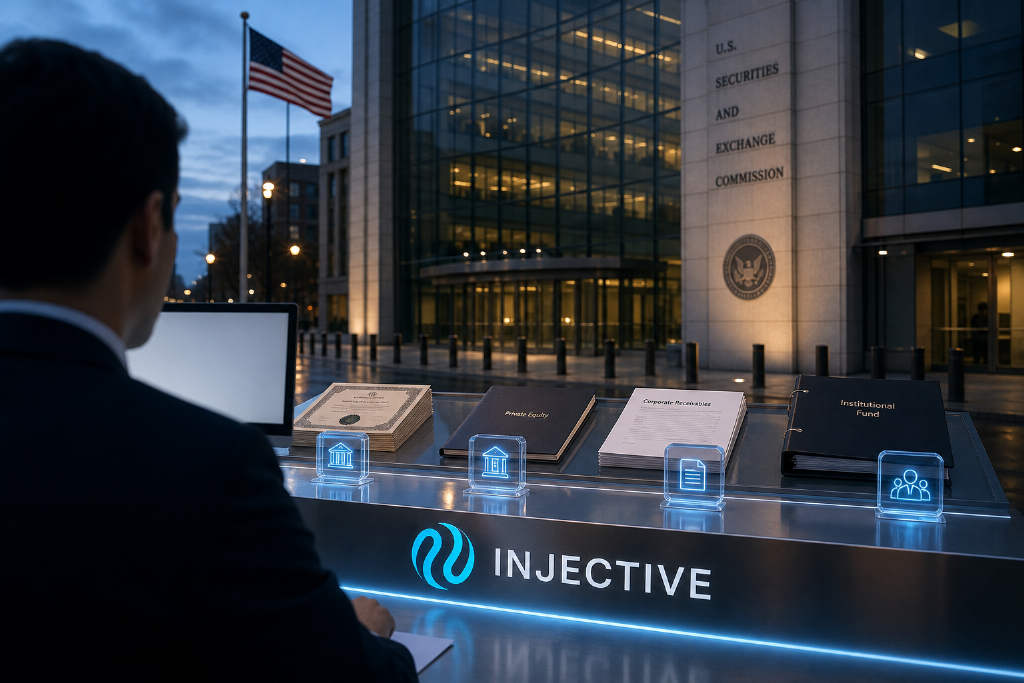
Injective says institutional arm has secured SEC transfer agent registration

Injective said its institutional services arm has registered with the U.S. Securities and Exchange Commission as a securities transfer agent, a status the company described as a first for a Layer 1 blockchain. The registration allows the unit to provide regulated ownership recordkeeping, transfer, distribution, and shareholder management services for securities. According to Injective, the approval covers four tokenized asset categories already live on the network: institutional funds, publicly listed equities, private company shares, and corporate receivables. The company also said the framework lets those processes run on distributed ledger infrastructure while remaining compliant with U.S. securities rules. Separately, Injective has launched markets tied to digital asset treasury companies, public stocks, and private company shares including SpaceX and OpenAI, and it has rolled out the tokenized asset issuance platform Injective Mint Alpha. In July, POSCO International and LG CNS selected Injective for a trade finance pilot focused on tokenizing receivables generated from international trade and handling transfer, management, and settlement.

440
Injective says institutional arm has secured SEC transfer agent registration
Policy and Re
2026-08-01 00:58:50

WuBlockchain weekly: SEC signals standalone crypto rules, Morgan Stanley lists spot ETH and SOL ETPs

WuBlockchain’s weekly roundup pulled together 10 of the crypto stories that mattered most this week, led by a fresh signal from U.S. Securities and Exchange Commission Chair Paul Atkins that the agency is prepared to write its own crypto market structure rules if Congress does not pass the CLARITY Act. Atkins said legislation would offer a more durable framework, while the SEC has already placed rules for crypto issuance, custody, and trading on its 2026 agenda. The list also highlighted Morgan Stanley Investment Management’s launch of spot Ethereum and Solana ETPs, both listed on NYSE Arca with 0.14% fees and staking plans, as well as BNY’s move to put fund transaction processing and shareholder records on blockchain rails while keeping its traditional transfer agency system. Corporate treasury strategy remained a major theme, with Strategy reporting a second-quarter net loss of $8.22 billion tied to bitcoin fair-value changes and saying future fundraising will no longer be used exclusively to buy BTC. Other items in the roundup included Robinhood’s latest earnings call, a new OSC survey showing 25% of Canadians now hold crypto, MiCA compliance among top stablecoins, digital asset treasury firms pivoting toward AI data centers, weak July bitcoin spot activity, and Binance Research’s finding that the first half of 2026 was defined by broad on-chain contraction rather than sector rotation.

1220
WuBlockchain weekly: SEC signals standalone crypto rules, Morgan Stanley lists spot ETH and SOL ETPs
RWA
2026-07-31 10:31:16

RWA weekly: 10 European financial institutions launch RL1 as Ondo unveils Ondo Network

Real-world asset markets kept expanding in the week covering July 24 to July 31, 2026, even as stablecoin settlement activity remained weak. Data from RWA.xyz showed on-chain RWA market capitalization reached $36.82 billion as of July 31, up 2.43% from a month earlier, while the number of holders climbed to 1.4469 million, a 40.81% monthly increase and the largest monthly gain on record. In stablecoins, total market capitalization was largely unchanged at $296.63 billion, but monthly transfer volume dropped 29.29% to $5.07 trillion, extending a sharp slowdown in on-chain settlement demand. Regulation also moved across several jurisdictions. South Korea advanced work on a comprehensive digital asset bill that would cover stablecoin issuance and exchange standards, while lawmakers are also set to review an opposition proposal to scrap a crypto tax scheduled for 2027. Kenya lowered the minimum paid-up capital requirement for stablecoin issuers by 40% to about $2.32 million, and Zimbabwe approved seven crypto and tokenization projects for its regulatory sandbox. On the industry side, the Bank for International Settlements-led Project Agorá completed a live cross-border payment test worth about $1 million across six currencies with five central banks and 28 commercial banks. In Europe, 10 financial institutions formed the Regulated Layer One cooperative, or RL1, to build tokenized asset infrastructure for regulated markets. Ondo Finance also introduced Ondo Network, a new execution layer that replaces the prior Ondo Chain direction.

1490
RWA weekly: 10 European financial institutions launch RL1 as Ondo unveils Ondo Network
POSCO Interna
2026-07-27 12:59:27

POSCO International tests blockchain trade finance system with LG CNS and Injective

POSCO International is working with LG CNS and Injective on a blockchain-based trade finance pilot that tokenizes real accounts receivable on-chain. The South Korean trading company said the test showed the technology can be used in live trade scenarios, and it plans to move the system into production later this year. The platform is designed to create a shared ledger for buyers, sellers, and financing institutions, replacing fragmented invoice records and cutting repeated checks in cross-border trade. The tokens in the pilot represent debt claims tied to unpaid receivables rather than equity in the company. POSCO International has not disclosed the volume processed in the test or any data on cost savings.

1190
POSCO International tests blockchain trade finance system with LG CNS and Injective