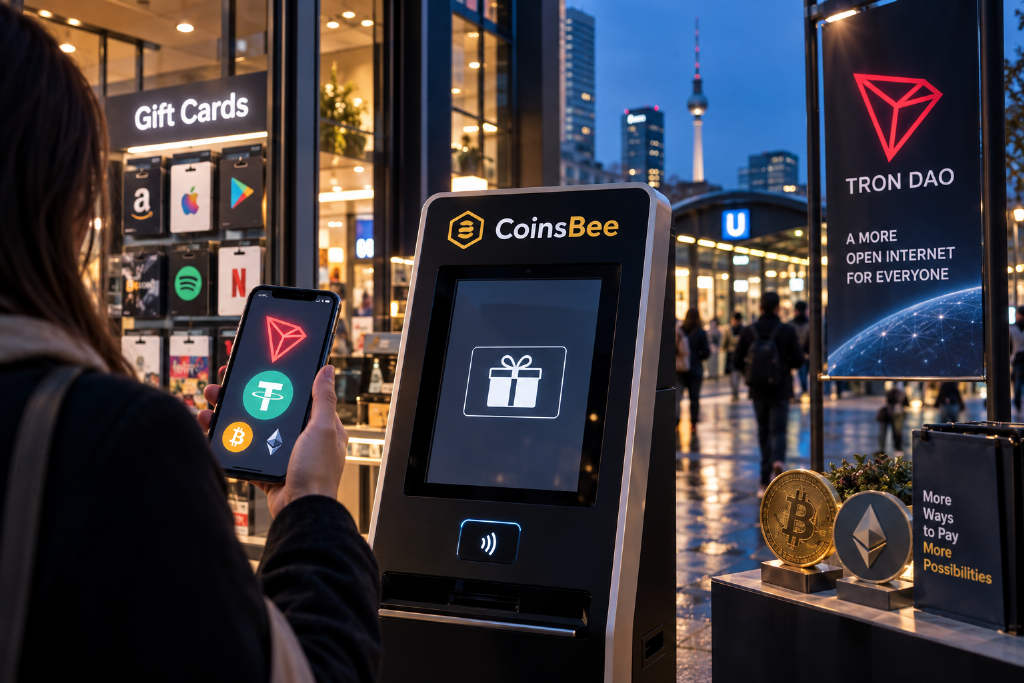
TRON2026-09-21 13:32:57CoinsBee says TRON-based USDT payments were about 1.8x Bitcoin over the past 90 daysCoinsBee, a global crypto gift card platform, said payment data from the 90 days ending Sept. 1, 2026 showed USDT on the TRON network as the most-used on-chain payment option on its platform. By transaction count, TRON-based USDT payments were about 1.8 times Bitcoin and 1.9 times Ethereum. Within USDT payments on CoinsBee, TRON accounted for 44.6% of payment count and 64.5% of transaction value, indicating a higher average transaction size. The company also said TRON-based USDT increased its share of total CoinsBee payments to 16.23%, up from 9.92% in 2025, a rise of 64%. During the same period, the brands most frequently purchased by U.S. users through TRON-based USDT included Amazon, Apple, AT&T, PlayStation, and Uber, spanning retail, mobile services, gaming, and food delivery. CoinsBee and TRON DAO plan a joint promotion from Sept. 21 to Oct. 5, offering a 2% discount for users who pay with USDT on the TRON network.420
Binance Pay2026-09-14 08:11:07Binance Pay expands business payment capabilities with three on-chain solutionsBinance Pay has expanded its business payment capabilities, according to an official announcement cited by ChainCatcher. The company introduced a set of on-chain solutions designed for wallets, trading platforms, dApps, payment service providers, merchants, and digital platforms. The new offering includes On-ramp as a Service, Pay On-chain, and AgentPay, which is built on x402. Binance said businesses can use its infrastructure to give users access to crypto asset purchases, on-chain fund transfers, and programmable payments. The announcement frames the rollout as an enterprise-facing expansion of Binance Pay’s service stack, with the product set aimed at a broad range of crypto and digital commerce participants rather than only end users.860
Binance2026-09-14 08:00:59Binance Pay expands business offering with new on-chain payment toolsBinance Pay has expanded its business payment capabilities with a new set of on-chain solutions aimed at wallets, trading platforms, dApps, payment service providers, merchants and digital platforms, according to an official announcement cited by Odaily. The rollout includes On-ramp as a Service, Pay On-chain and AgentPay, which is built on x402. Binance said the products are designed to let businesses use its infrastructure to offer users crypto asset purchases, on-chain fund transfers and programmable payment functions. The update broadens Binance Pay’s enterprise-facing toolkit and adds more payment and settlement options for companies building crypto services on top of Binance’s infrastructure.900
TRM Labs2026-09-13 13:05:56TRM Labs says most x402 payment volume did not come from AI agentsA report from blockchain intelligence firm TRM Labs found that most transaction value on Coinbase’s x402 payment protocol was not generated by AI agents. The study examined 198.9 million settlements processed by known x402 facilitators on Base, Solana, and Polygon since May 2025, covering about $52.7 million in value. After removing self-payments and other anomalous fund flows, TRM identified roughly $25.62 million as potential commercial transactions. Of that amount, only 0.6% to 7.5% was attributed to AI agents by value. TRM said overall protocol volume is not enough to measure agentic commerce because ordinary scripts, scheduled tasks, and self-transactions can leave the same on-chain footprint. The report also noted that its own model may undercount single-purpose agents because it classifies addresses that repeatedly pay the same service as scripts. During the period covered, USDC accounted for 99.6% of settlement value, equal to about $52.47 million. The report comes as Binance, Coinbase Base, Amazon, and Stripe continue building agent payment infrastructure around x402 and related products.890
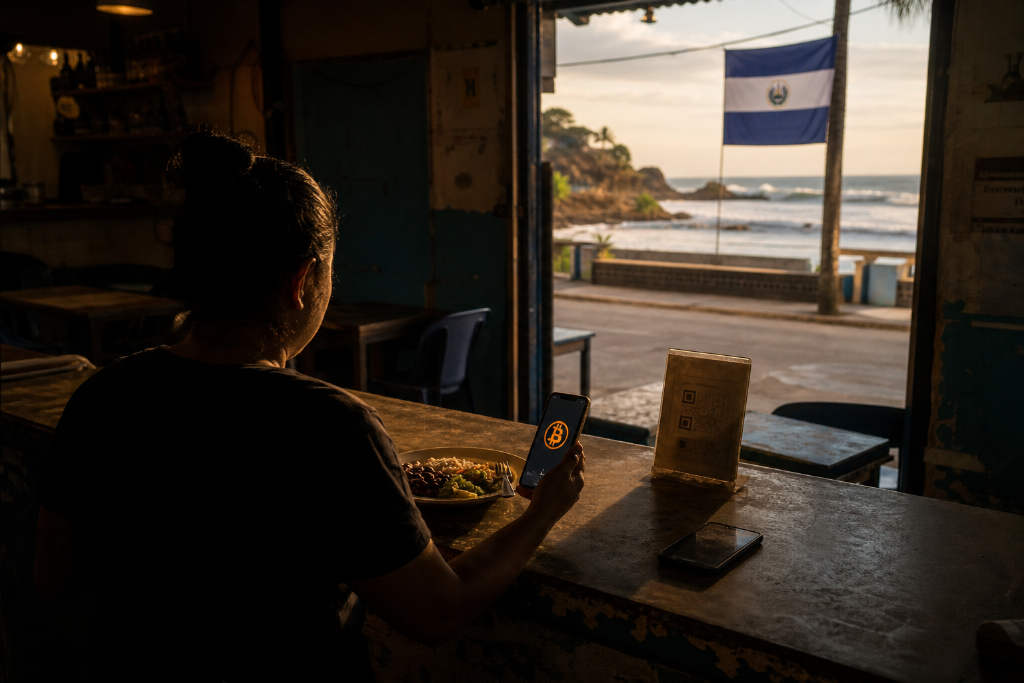
El Salvador2026-08-26 01:04:34Bitcoin payments fade at El Salvador’s Bitcoin Beach, core developer saysBitcoin Core contributor Jon Atack, who has lived in El Salvador since 2022, says everyday BTC payments in El Zonte, widely known as Bitcoin Beach, have dropped sharply. In a recent account cited by BlockBeats on Aug. 26, Atack said a lunch purchase he made with bitcoin was the first BTC payment the restaurant had received all month. He added that when he tried to leave a tip in sats, a staff member who had worked there for three years said they had forgotten how to use the bitcoin app and described the local payment scene as “dead.” The report also noted that some travelers still say they have successfully paid with BTC in the same area, and signs showing bitcoin acceptance can still be found around town. Even so, routine use appears to have contracted. El Zonte was one of the earliest symbols of El Salvador’s bitcoin push after an anonymous donor began distributing bitcoin in the town in 2019. The country later made BTC legal tender in 2021. According to the report, bitcoin payment activity kept cooling after a 2024 IMF loan agreement under which merchant acceptance became voluntary.1210
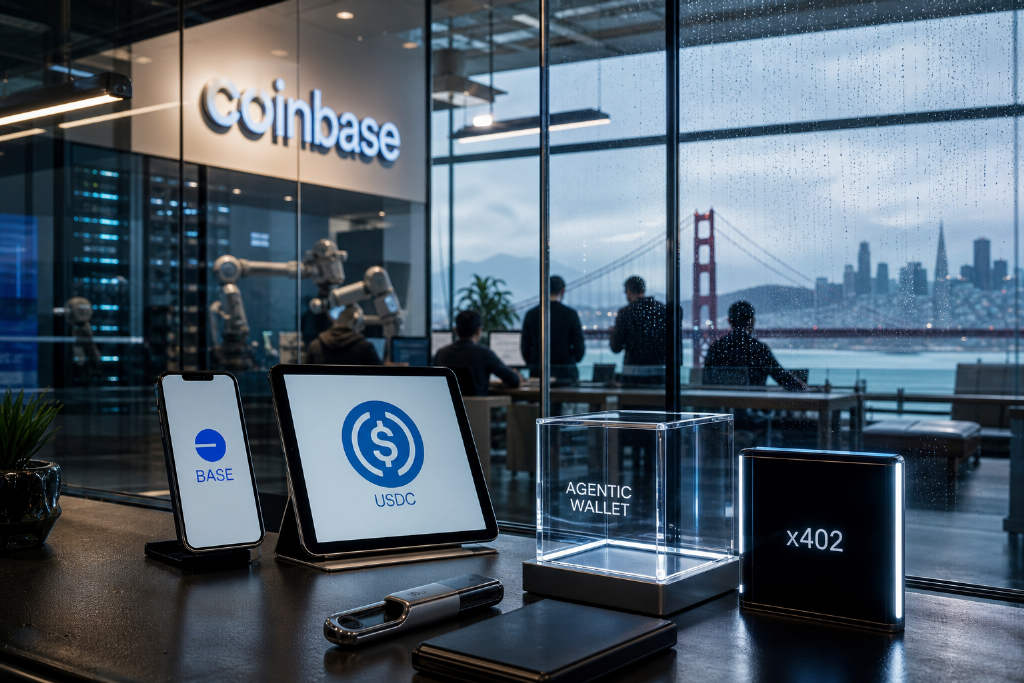
Coinbase2026-08-23 00:46:35Coinbase emerges as an early operator in AI agent payments with Base, USDC and Agentic WalletsCoinbase is being cast as an unexpected front-runner in AI agent payments, not because it built a card network, but because it assembled the pieces that let an agent hold funds and transact on its own. The article argues that while much of the market focus has stayed on Visa, Mastercard, Stripe, OpenAI and Google, Coinbase already has an operating stack in place. According to disclosures cited from Coinbase’s 2026 quarterly earnings calls, more than 90% of on-chain agent transactions took place on Base, 99% of agent business transactions were settled in USDC, and more than 97% of on-chain agent transactions used the x402 protocol. Base also accounted for 62% of the stablecoin transaction volume across the industry. The report says Coinbase’s edge comes from combining Base, the x402 machine-to-machine payment standard, Agentic Wallets launched on Feb. 11, 2026, and native wrapped assets such as cbBTC and cbETH into one ecosystem. In that setup, an AI agent can have its own wallet address, hold assets, send payments, execute transactions and collect revenue under preset permissions and risk controls. Rather than plugging agents into existing card rails, Coinbase’s approach gives them a native on-chain financial identity. That, the article says, fits machine-to-machine, high-frequency and micropayment flows better than relying on a human’s credit card.730
Stablecoins2026-08-16 06:51:00Allium data shows stablecoin use is led by domestic settlement, with Asia-Pacific at the centerAn analysis based on Allium’s geographic payment data suggests stablecoin activity is far more concentrated in domestic settlement than the market’s cross-border narrative often implies. The dataset covers $15.2 billion in on-chain transfers where both the sending and receiving countries could be identified, while noting that most blockchain transactions still cannot be tied to a specific country and are therefore outside the sample. Within the identifiable volume, domestic transfers accounted for 62.6%, or $9.5 billion. The study also found that 73.0% of all identifiable transfer volume ultimately stayed within the sender’s own region. Asia-Pacific stood out across several measures: it sent $6.23 billion, received $6.4 billion, represented 41.6% of global domestic stablecoin volume, and posted a net inflow. Indonesia, Singapore, and South Korea were among the markets with the largest positive net inflows in the sample. The article argues that institutions evaluating stablecoin payment demand should look beyond remittances alone. Based on the observable flows, domestic payment and settlement services, along with cross-border corridors inside Asia-Pacific, appear to be the most immediate areas of market demand.1140
Stablecoins2026-08-16 05:14:08Allium data shows stablecoin payments are still led by domestic settlement, with Asia-Pacific at the centerA new analysis based on Allium’s geographic payment data argues that the largest real-world use case for stablecoins is not cross-border remittance, but domestic transfers between wallets in the same country. The dataset covers $15.2 billion in on-chain transfers where both sending and receiving countries could be identified, though the author notes that this represents only a sample of total stablecoin activity because most on-chain transactions still cannot be tied to a specific country. Within that identifiable volume, domestic transfers accounted for 62.6%, or $9.5 billion. When all identifiable transactions are grouped by region, 73.0% of the value remained within the sender’s home region. Asia-Pacific led the dataset with $6.23 billion in outgoing stablecoin transfers and $6.4 billion in incoming transfers, while also generating 41.6% of global domestic stablecoin volume. Indonesia, Singapore, and South Korea were among the markets posting the strongest net inflows in the sample. The analysis points to a practical takeaway for firms evaluating stablecoin payment demand: domestic settlement services may offer a larger current market than products built only around remittances, while regional payment corridors in Asia-Pacific already show measurable bilateral demand.1120