Grayscale2026-09-09 00:22:26Grayscale says its Zcash fund has topped $500 million in AUMGrayscale said on X that assets under management for its Zcash fund, traded under the ticker ZCSH, have exceeded $500 million. The firm also said the fund currently holds more than 550,000 ZEC. In the same post, Grayscale wrote that 「privacy coins are attracting real capital」. The update highlights the latest asset figure disclosed by the company for the fund and its current ZEC holdings, based on Grayscale’s own statement shared on social media.780
Glassnode2026-09-08 07:04:00Glassnode says privacy coins are the year’s standout as most crypto sectors remain below prior highsGlassnode’s latest market breakdown shows a sharp split inside crypto performance over the past year. Bitcoin is down 36% from its October 2025 all-time high, and the median drawdown across the top 200 digital assets by market capitalization stands at 58%. Yet the privacy coin segment has moved the other way, rising 213% and becoming the only sector to push above its previous peak. The report says the market value of privacy coins in the top 200 climbed from $7.1 billion a year ago to $33.6 billion, with nearly half of that increase arriving in the past 30 days. Zcash (ZEC) drove much of the move, surging 2,496% over the period and accounting for 62% of the sector’s market cap. Monero (XMR), Dash (DASH), and Horizen (ZEN) also outperformed Bitcoin over the last 90 days. Glassnode adds that the latest 30-day rally has been broad, with 91.5% of the top 200 assets posting gains, the widest monthly rebound in that dataset. Even so, only 25 assets are up on a one-year basis, which points to a market where gains have been concentrated rather than evenly shared.960
Zcash2026-09-08 06:50:43Wang Chun lays out Zcash’s old controversies as ZEC’s rally draws fresh criticismZcash’s rally has pushed the token into one of the market’s most closely watched trades, but the surge is now colliding with renewed scrutiny over the project’s history. On Sept. 6, ZEC broke above $1,000 and reached as high as $1,256.92, according to OKX market data. As of 14:00 on Sept. 8, it was trading at $1,128.05. From its early June low of $251.39, recorded when the Orchard vulnerability became a major market issue, the token’s peak gain approached 400% in roughly three months. At the center of the latest backlash is Wang Chun, the F2Pool co-founder and an early Bitcoin figure, who posted a string of messages criticizing Zcash and its team. He pointed to what he described as a long list of structural problems: the 20% founders’ reward and later development fund, privacy that remains optional rather than default across the network, public governance conflict involving Electric Coin Company and Bootstrap, and the Orchard flaw disclosed in May 2026. Wang argued that these issues sit uneasily with ZEC’s current valuation. The debate is not limited to commentary. Odaily also reported that trader Garrett Jin remains heavily short ZEC, holding a 3x leveraged short worth $45.11 million at an average entry of $576.3, with an unrealized loss of $22.2 million after previously closing a $106.18 million notional BTC long.1850
ZEC2026-09-07 23:34:10Taiki Maeda’s ZEC trade review centers on privacy, reflexivity and a concentrated betCrypto trader Taiki Maeda used a roughly 38-minute video to explain why he has placed most of his net worth into ZEC, and why he chose to sell after the Orchard security scare only to buy back at a higher price once the market recovered. His core argument is not simply that ZEC can keep rising, but that Zcash may be moving from the market’s old “privacy coin” label toward a more ambitious role as a privacy-focused store-of-value asset alongside Bitcoin. In Maeda’s framework, ZEC’s price matters because it may help shape fundamentals rather than just reflect them. As the token price rises, the dollar value inside Zcash’s shielded pool also rises, potentially making the privacy set more useful for larger transfers. If that improves adoption, it could strengthen the store-of-value narrative and attract more capital. He also points to Grayscale’s Zcash ETF, which began trading on NYSE Arca on Aug. 25 under the ticker ZCSH, as a new access route for traditional investors, while stressing that listing alone does not prove durable demand. The trade remains highly conditional. Maeda says the thesis depends on continued growth in shielded pool balances, sustained ETF inflows, relative strength against BTC, confidence in supply integrity after the Orchard vulnerability, and broader interest in privacy and quantum security. Without those pieces, the same reflexive dynamic could run in reverse.920
Zcash2026-09-07 02:58:24Zcash Reclaims $1,000 as Privacy Narrative and ETF Access Drive Repricing TalkZcash has climbed back above $1,000 for the first time since shortly after its 2016 launch, capping a sharp move that the source article ties to a mix of macro anxiety, renewed demand for privacy, and a new ETF access point. The piece says the token has more than doubled in recent weeks, gained over 100% in the past month, and risen about 7,300% from its 2024 low. Comparisons to early Bitcoin have spread quickly, helped by public comments from trader and NFT developer Nick O’Neill, who wrote on X that buying Zcash now is like buying Bitcoin in 2013. The report argues that Zcash is being repriced not as a new token, but as an older asset the market ignored for years. Bitwise CIO Matt Hougan told CoinDesk that Zcash offers a distinct privacy story and may fill demand from investors who want something outside the increasingly institutional Bitcoin system. The article also points to Grayscale’s spot Zcash ETF on NYSE Arca as a major structural shift, saying it gives investors exposure through standard U.S. brokerage accounts without using crypto exchanges or holding private keys directly. It also cites prior remarks from AngelList co-founder Naval Ravikant and bullish projections from trader Ansem, while noting those forecasts are speculative rather than realized outcomes.900
privacy token2026-09-07 13:20:07Privacy Coin Market Cap Surges to $33.6B, ZEC Up 2,496% in YearIn the year through Sept 6, privacy token market cap grew from $7.1B to $33.6B, a 3.7x increase. ZEC soared 2,496% and now accounts for 62% of the sector. The privacy sector is the only segment trading above its Oct 6, 2025 high, up 213%.880
ZEC2026-09-07 06:06:27ZEC Breaks Above $1,200, Reaching Its Highest Level Since 2018Zcash (ZEC) climbed above $1,200 on Sept. 7 based on Binance ZEC/USDT spot market data, marking its highest level since 2018 and putting privacy coins back in focus. Binance historical data cited in the report shows ZEC rising from about $856 on Sept. 1 to above $1,200 within six days, a gain of more than 40% that outpaced major crypto assets such as Bitcoin and Ether over the same period. The move was described as a series of breakouts rather than a one-day spike, with ZEC clearing $900 and $1,000 before extending higher. The report also said ZEC has gained more than 2,300% over the past year. Historical pricing showed the token was still below $50 in early September 2025, compared with roughly $1,200 now. Attention has also broadened to the wider privacy-coin segment, with DASH and ZEN posting double-digit gains earlier and seeing clearer capital inflows alongside ZEC. At the same time, the piece noted that after such a sharp advance, short-term volatility risk has increased, and whether $1,200 can flip from resistance into support is now a key level to watch.770
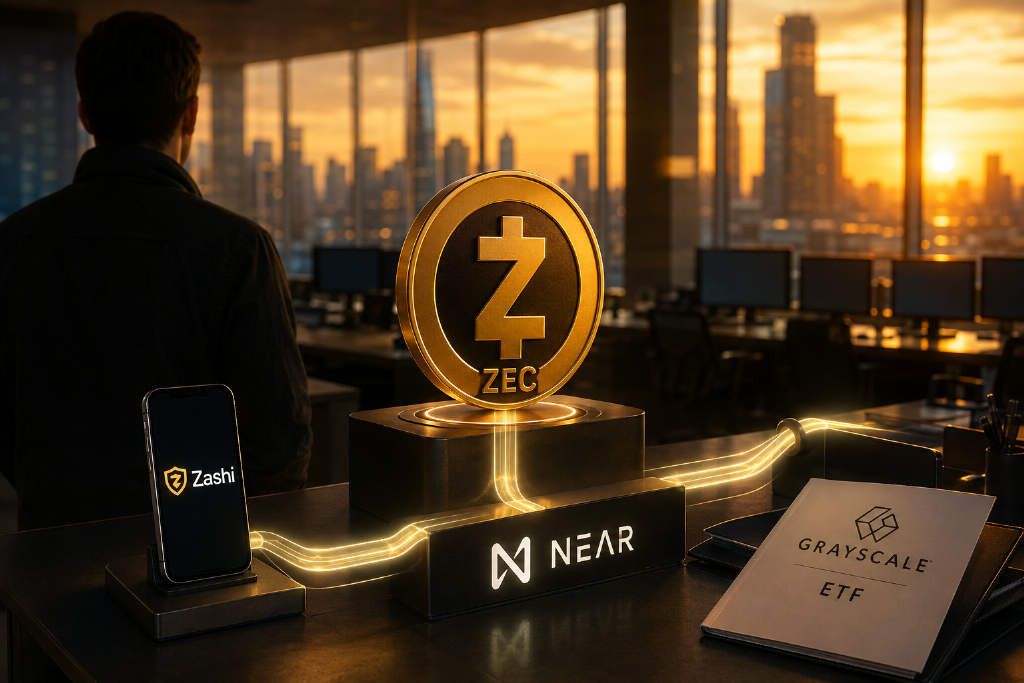
ZEC2026-09-07 05:47:00NEAR Intents draws attention as ZEC rally shifts focus to the rails behind the tradeZcash (ZEC) surged to $1,200 on Sept. 6, marking a 370% gain over three months, while Grayscale’s spot ZEC ETF, ZCSH, pulled in more than $460 million in assets within two weeks of launch. That move has pushed market attention beyond ZEC itself and toward the infrastructure handling its cross-chain flow. At the center of that discussion is NEAR Intents, which powers swap and payment routes inside Zashi, the self-custody wallet built by Electric Coin Company. Since Zashi added Zashi Swaps in October 2025 and later launched CrossPay, users have been able to move into shielded ZEC from assets such as BTC, SOL and USDC, then move out from shielded ZEC into assets on other chains. Both directions route through the NEAR Intents settlement layer. The bullish case rests on NEAR Intents’ Fee Switch, activated on Feb. 23, 2026, under which protocol-level fees are collected in NEAR and 100% of protocol fees are used to buy back NEAR on the open market. Still, the data points to a more restrained picture than social media narratives suggest: while cumulative fees reached about $45 million, DefiLlama shows only about $5.51 million as protocol revenue available for buybacks. ZEC-linked pairs currently account for nearly 40% of volume on NEAR Intents, making the thesis meaningful, but also concentrated.860