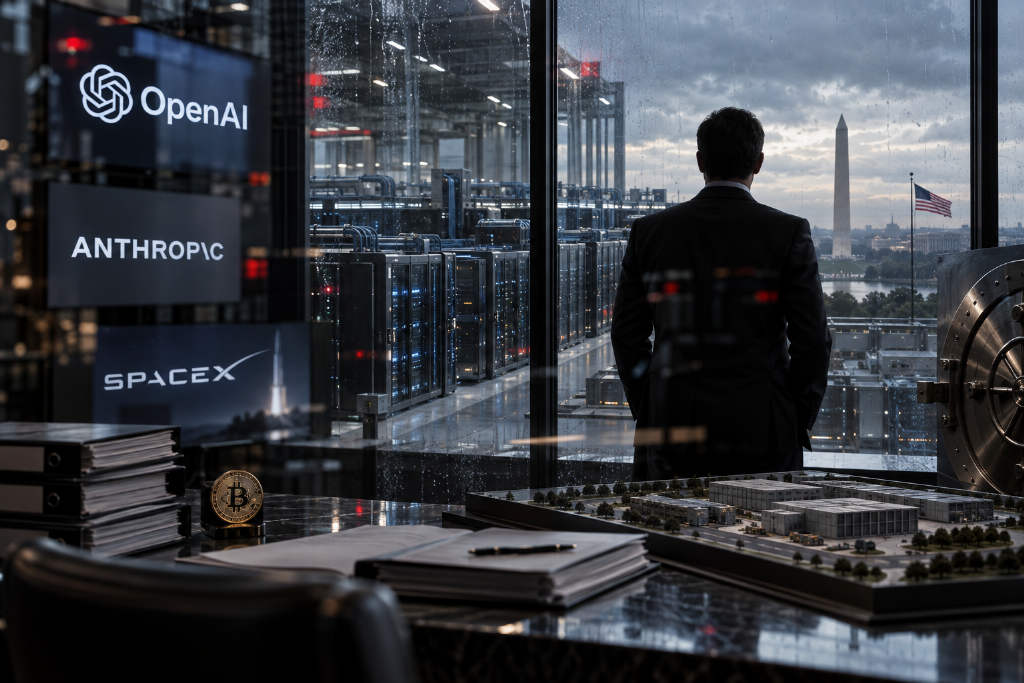
Arthur Hayes says AI "safety first" is really demand destruction for compute, with both U.S. policy outcomes bullish for Bitcoin
Arthur Hayes argued in a new essay, "Safety First," that the recent "safety first" posture promoted by Anthropic, OpenAI, and SpaceX should not be read as a human-welfare-first decision. His claim is that the shift reflects economics: the market still wants AI, but it wants AI at "China prices," or intelligence that is 100 times cheaper than what is available now. In Hayes' framing, that means lower spending on training, more focus on efficiency, and eventually less customer spending on compute. He tied that idea to a broader debt structure built around AI infrastructure. Hayes wrote that three major AI labs are not generating profits, yet their demand for compute underpins more than $1 trillion in investment-grade debt and hundreds of billions of dollars in lower-quality debt. He cited Nick Nameth's analysis to argue that insurers, private equity firms, and affiliated captive reinsurers are carrying much of that risk, with policyholders ultimately exposed. For crypto investors, Hayes said both possible policy responses point in the same direction. If the U.S. government becomes the buyer of last resort for compute, it would print money to support unproductive assets. If it instead rescues insolvent insurers, it would still need to print money to absorb bad AI debt. In both cases, he said, the result is more money supply and a tailwind for Bitcoin.