SMH

Policy Regula
2026-09-09 04:55:00

Oil Nears $100, Treasury Buybacks Loom, and AI Compute Trade Keeps Running

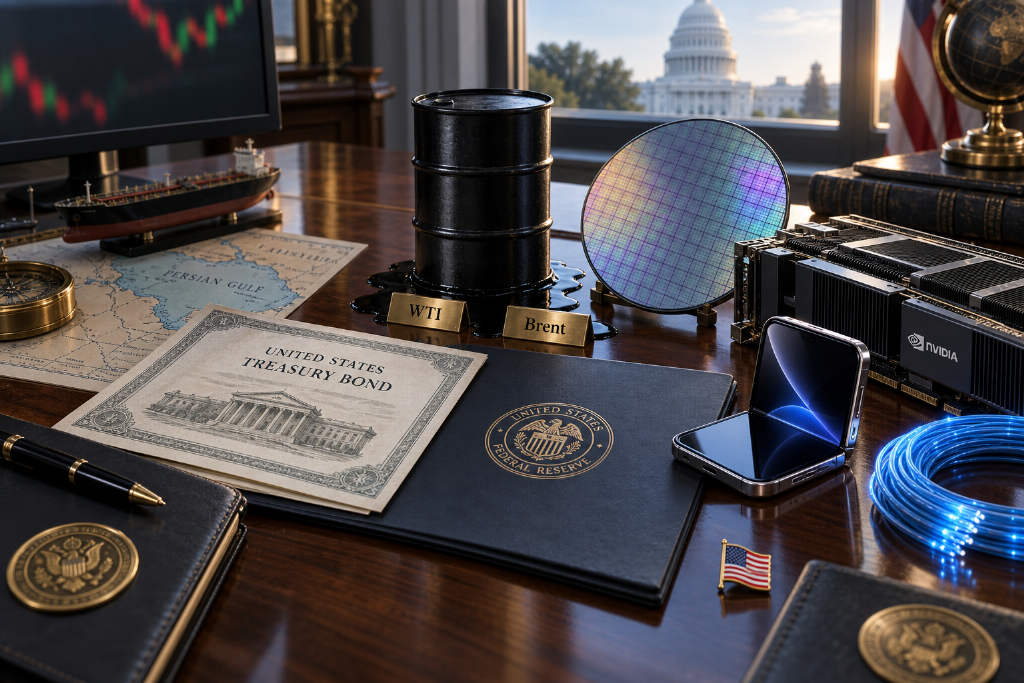
PANews’ latest Wall Street morning roundup tracks a market pulled in several directions at once: rising oil, persistent pressure in long-dated U.S. bonds, and a fresh wave of enthusiasm around AI compute infrastructure. U.S. stocks fell for a second straight session, with the Dow down 1.18%, the S&P 500 off 0.58%, and the Nasdaq lower by 0.32%, as geopolitical tensions in the Middle East drove WTI crude close to $94 and Brent close to $100. Higher energy prices also fed rate fears, with money markets pricing the probability of a Federal Reserve rate hike this month at more than 60%. At the same time, traders were waiting for the U.S. Treasury’s announcement on the maximum size of upcoming 10- to 20-year bond buybacks. Morgan Stanley, Wrightson ICAP, Barclays and Bloomberg strategist Brendan Fagan all outlined different scenarios for how the buyback signal could affect long-end yields. Elsewhere, gold fell for a third straight session while copper hit fresh highs on supply constraints and demand from AI data centers, grid upgrades and electric vehicles. Technology remained the market’s most active pocket. Semiconductor, optical networking, cloud and storage names attracted inflows as OpenAI and IREN added to the case that AI compute demand is still accelerating. Apple’s upcoming product event also stayed in focus, with the pricing of a foldable iPhone, possible increases for the Pro lineup, and launch timing for standard iPhone 18 models all under close scrutiny.

1040
Oil Nears $100, Treasury Buybacks Loom, and AI Compute Trade Keeps Running
RootData
2026-09-07 10:08:14

RootData data shows most stock perpetuals trading above last post-market reference during weekend closure

Stock-linked perpetual contracts on exchanges appeared to price in equity market moves while traditional markets were closed for the weekend, according to a ChainCatcher report citing RootData. Most of the widely watched names listed in the data were trading above their last post-market reference levels. Direxion Daily Semiconductor Bull 3X Shares (SOXL) was quoted at $125.65, up 7.59% from its previous post-market reference of $116.79. Sandisk (SNDK) stood at $1,785.09, up 3.07%, while Micron Technology (MU) traded at $1,043.54, up 2.84%. Other names in the list also showed gains. iShares Semiconductor ETF (SOXX) rose 2.62% to $532.09, Intel (INTC) added 2.46% to $98.16, and SK Hynix (SKHY) climbed 2.08% to $179.44 versus its previous closing reference. VanEck Semiconductor ETF (SMH) gained 2.06% to $578.73, SpaceX (SPCX) was up 1.87% to $150.54, and AMD (AMD) increased 1.58% to $483.59. IREN (IREN) was the only listed name in the report to trade lower, slipping 1.59% to $43.96 from a prior post-market reference of $44.67.

810
RootData data shows most stock perpetuals trading above last post-market reference during weekend closure
Memory ETF
2026-08-24 05:40:16

What a Memory ETF Is: DRAM’s Holdings, Fees and Risks Explained

Artificial intelligence demand has pushed memory stocks closer to the center of the semiconductor trade, and that has brought more attention to memory-focused exchange-traded funds. In its latest guide, ABMedia outlined how these products work and why the U.S.-listed Roundhill Memory ETF, ticker DRAM, has become one of the names most often mentioned in this niche. The report says memory ETFs target companies tied to DRAM, NAND and high-bandwidth memory, or HBM. DRAM, launched in April 2026 and listed on Cboe, is described as an actively managed ETF with roughly 23 holdings. Its portfolio is heavily concentrated in Samsung Electronics, Micron and SK hynix, which together account for about 70% based on the issuer’s recent data. The fund also uses swaps to build exposure and holds U.S. Treasuries as collateral. ABMedia also compared DRAM with broader semiconductor ETFs such as SMH and SOXX. While those funds spread exposure across the chip sector, DRAM is a much narrower bet on the memory cycle. That focus comes with a higher fee ratio of about 0.65%, versus roughly 0.35% for SMH and 0.33% for SOXX, along with greater concentration and price volatility.

1140
What a Memory ETF Is: DRAM’s Holdings, Fees and Risks Explained
Odaily
2026-08-23 01:59:50

QQQ logs $10.9 billion in August inflows as money rotates out of semiconductors and software

The Kobeissi Letter said in a post on X that the Invesco QQQ Trust, which tracks the Nasdaq-100, has taken in $10.9 billion in net inflows so far in August. That figure is already more than double the $4.9 billion recorded in all of July and above the previous monthly record of $9.2 billion set in March 2022. Based on the current pace, QQQ is on track to post its biggest monthly net inflow on record. At the same time, the VanEck Semiconductor ETF (SMH) has seen $2.8 billion in net outflows so far this month, putting it on pace for the largest monthly outflow in its history. The iShares Expanded Tech-Software Sector ETF (IGV) has also posted about $610 million in net outflows during the same period and may be heading for a third straight month of net redemptions. The Kobeissi Letter said the shift points to capital rotating away from semiconductor and software names and into the broader technology trade.

1380
QQQ logs $10.9 billion in August inflows as money rotates out of semiconductors and software
13F
2026-08-19 12:46:00

Q2 13F filings show Wall Street is still in AI, but far more selective

Second-quarter 2026 13F filings point to a shift in how institutional investors are approaching the AI trade. The broad theme has not broken down, but the easy phase of buying almost any AI-linked stock appears to be fading. Reuters’ review of 6,371 filings found that nearly 44% of institutions cut holdings in the Magnificent Seven, while about 42% initiated or added positions. In semiconductors, roughly 48% were net buyers versus 34.5% net sellers. Software showed the opposite pattern, with net sellers at 28.2% and net buyers at 26.3%. The more detailed signal comes from how major funds repositioned. Berkshire Hathaway sharply increased its Alphabet stake, lifting combined Class A and Class C holdings from about 57.84 million shares at the end of Q1 to around 106 million by the end of Q2. Tiger Global cut a range of large-cap tech names, including Alphabet, Broadcom, TSMC, Microsoft, Meta and NVIDIA, while adding AMD, Applied Digital, Cerebras, Cipher Digital, Core Scientific and more Intel. Third Point exited NVIDIA, Broadcom, KLA, Lam Research, SMH and Meta, but added Alphabet, TSMC, Keysight and Flex while also moving into media, finance and industrial names. Duquesne dropped Broadcom and Micron, but opened positions in Alphabet, AMD and Palo Alto Networks and raised TSMC and STMicroelectronics. Taken together, the filings suggest that Wall Street is no longer trading AI as one crowded block. Investors are increasingly weighing valuation, positioning, expectations and payoff instead of buying the theme indiscriminately.

1180
Q2 13F filings show Wall Street is still in AI, but far more selective
AI investing
2026-08-15 13:25:25

Situational Awareness 13F shows how an AI-heavy, unhedged book unraveled

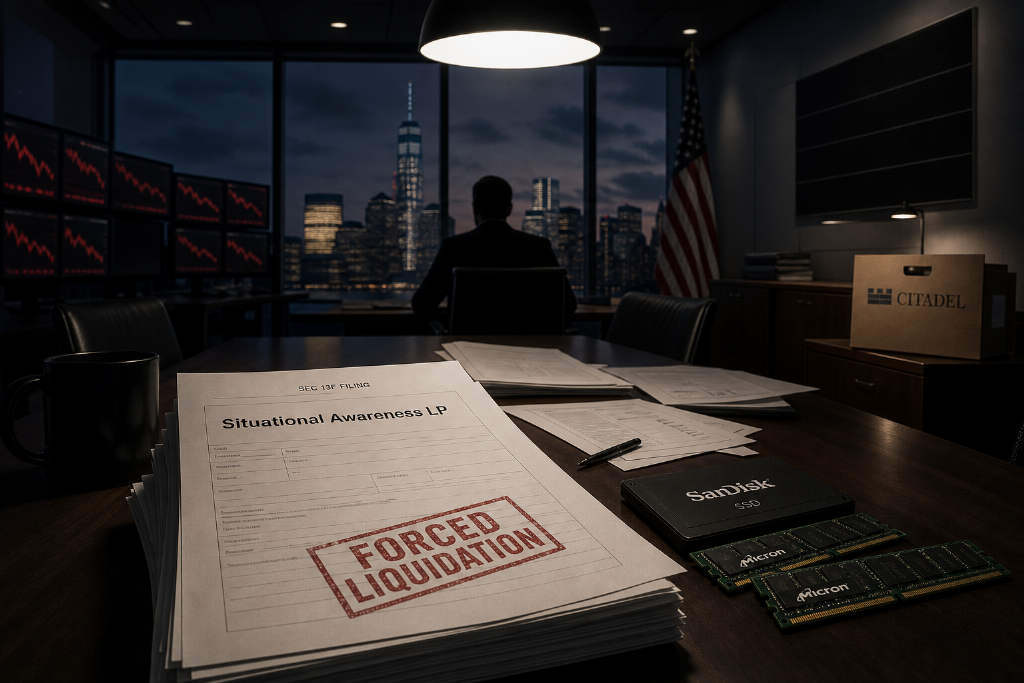
Situational Awareness LP, the fund run by Leopold Aschenbrenner, has disclosed its quarterly 13F filing for positions held as of June 30, offering the clearest view yet into the portfolio that preceded its recent collapse. The filing shows a nominal portfolio worth about $20.24 billion spread across 26 positions, but the diversification was mostly superficial: the fund had concentrated more than half of its disclosed exposure in SanDisk and Micron, with much of the rest tied to the same broad thesis around AI infrastructure, including power, advanced manufacturing, cloud compute, data centers, and related capacity buildout. The report also highlights a decisive shift from the prior quarter. In Q1, the fund had held more than $8 billion in put options tied to major chip and storage names and related vehicles, including SMH, NVDA, ORCL, AVGO, AMD, and ASML. By Q2, those downside hedges were gone. At the same time, Micron and SanDisk call options were closed and replaced with large outright equity stakes. According to Odaily, that move turned what had been a hedged structure into an effectively unprotected long book just before a broad selloff in AI and storage names. Weeks earlier, the fund had already suffered major losses as AI-linked stocks retreated and leverage amplified the drawdown, forcing large-scale liquidation of public-market holdings. Odaily said most of the stock portfolio was later sold at a discount to Citadel, the firm founded by Ken Griffin.

680
Situational Awareness 13F shows how an AI-heavy, unhedged book unraveled
MGBX
2026-08-04 07:51:18

MGBX to list GSUSDT, SMHUSDT and PYPLUSDT perpetual contracts on Aug. 4

MGBX said it will list three perpetual contract pairs — GSUSDT, SMHUSDT and PYPLUSDT — at 18:00 SGT on Aug. 4, 2026, with trading opening at the same time and leverage of up to 25x. The exchange’s notice also included brief background on the underlying names tied to the products. It described Goldman Sachs as a long-established financial institution founded in 1869 and known as a leading global investment bank. For SMHUSDT, the notice said the contract tracks the price of the VanEck Semiconductor ETF, which it described as one of the world’s largest and most liquid semiconductor exchange-traded funds. The announcement also noted that PayPal was spun off from eBay in 2015 and focuses on online transactions, offering electronic payment solutions for merchants and consumers.

1900
MGBX to list GSUSDT, SMHUSDT and PYPLUSDT perpetual contracts on Aug. 4
JZL Capital
2026-08-03 12:30:56

JZL Capital weekly: Fed split widens as ETF outflows keep pressure on BTC

JZL Capital’s weekly note for July 27 to Aug. 2 said markets were driven by a more divided Federal Reserve, softer headline inflation led by energy prices, widening dispersion across Chinese and U.S. equities, and renewed pressure on Bitcoin from spot ETF outflows. The July Federal Open Market Committee kept the federal funds rate at 3.50% to 3.75% by a 9-3 vote, with three officials explicitly backing a 25 basis point hike, which the report described as a hawkish pause rather than a neutral hold. In the U.S., June PCE slowed to 3.7% year over year from 4.1%, while core PCE eased only to 3.3% from 3.4%, suggesting headline disinflation came mainly from energy instead of a broad cooling in core pressures. In equities, the report said investors increasingly rewarded cloud revenue growth, earnings delivery and free cash flow, pointing to Microsoft’s 21.75% weekly rise and Azure’s 43% growth. In crypto, BTC fell from $65,400 to around $63,114 during the week, while U.S. spot BTC ETFs posted about $61.5 million in net outflows, reinforcing a market structure that JZL said is now constrained more by weak spot demand and internal selling pressure than by macro risk alone.

2030
JZL Capital weekly: Fed split widens as ETF outflows keep pressure on BTC