SOX2026-07-30 12:30:00Philadelphia Semiconductor Index Falls Into Technical Bear Market as Memory Chip Selloff DeepensA fresh selloff in memory-chip names has pushed the Philadelphia Semiconductor Index (SOX) firmly into technical bear market territory, according to the figures cited in an Odaily article. The index peaked at 14,634.72 on June 22, putting the 20% bear-market threshold at 11,707.78. SOX closed at 11,673.89 on July 17, breaking that line, and later fell to 10,447.49. The article argues that the current downturn in memory-related stocks is tied less to a simple valuation pullback and more to a broader deleveraging cycle in South Korea’s equity market. It points to heavy retail positioning in Samsung and SK Hynix through margin financing and single-stock leveraged ETFs. Margin balances reportedly climbed from KRW 27.4 trillion at the start of January to a peak of KRW 38.6 trillion on June 24. To judge when selling pressure may be nearing exhaustion, the article highlights three indicators: the stabilization of margin balances, a return of forced liquidations to more normal levels, and a decline in VKOSPI, South Korea’s volatility gauge. It also notes that KOSPI has triggered nine circuit breakers this year, which it describes as a sign that deleveraging may be in its middle-to-late stage rather than complete.1950
semiconductor2026-07-28 12:44:35Chip sell-off pushes SOX into a bear market and drags bitcoin miners lowerSemiconductor stocks posted their worst week in more than a year, and the fallout spread to publicly traded bitcoin miners. According to Techub, citing CryptoBriefing, the Philadelphia Semiconductor Index, or SOX, fell about 4.3% on July 16 and slid roughly 20% from its June peak, meeting the common definition of a bear market. The retreat wiped out more than $1 trillion in market value across the sector. Bitcoin mining stocks moved lower alongside the chip complex. MARA and Riot Platforms each fell about 5%, reflecting how closely miners have become tied to broader AI and infrastructure trades. In recent years, listed mining firms have increasingly been viewed through the lens of AI data center demand rather than only bitcoin production, which has strengthened their correlation with semiconductor and large-cap technology names. The report said investors are questioning whether massive spending on AI infrastructure can translate into matching revenue growth. Upcoming earnings from major technology companies including Alphabet and Tesla are now seen as the next key signal for the market.1860
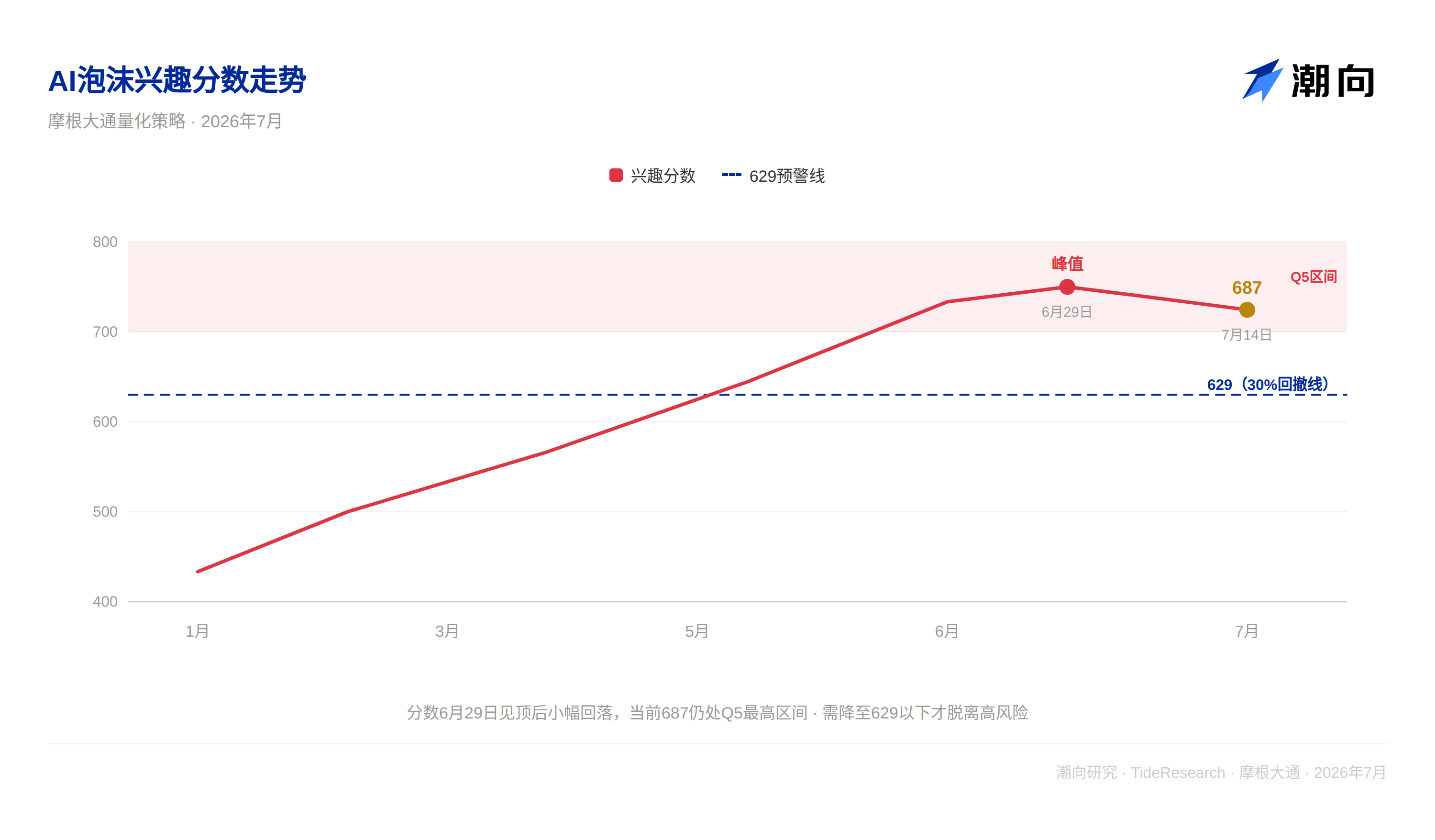
JPMorgan2026-07-17 08:03:11JPMorgan says AI semiconductor dip-buying remains risky before mid-AugustJPMorgan’s quantitative team says the market’s AI fear cycle has not fully run its course, arguing that buying the dip in AI semiconductor names before mid-August still carries elevated risk. The call is based on the bank’s “AI Bubble Interest Score,” a metric that tracks the volume of negative global media coverage around an AI bubble narrative rather than price action itself. The score peaked on June 29 and has started to decline, but it still stands at 687, which JPMorgan places in the highest historical quintile. In that range, the Philadelphia Semiconductor Index, or SOX, has historically posted an average 20-day return of -0.7%, with a 53.8% probability of a drawdown. JPMorgan outlined three thresholds for risk to cool: 629, 560 and 418. The report says the first stage of entry could be considered near 629 and the second near 560, while a meaningful easing in the narrative may not arrive until around Aug. 12. The note also draws a distinction between Japan, where AI positioning appears closer to clearing, and the U.S., where sentiment around an AI bubble remains the more dominant force.1130
SOX2026-07-17 05:48:36SOX Slides Nearly 19% From Peak as AI Semiconductor Trade Faces Sharp PullbackThe Philadelphia Semiconductor Index, or SOX, has fallen about 19% from its late-June 2026 record high of 14,638 to 11,867.50, while Japanese memory maker Kioxia has dropped by half from its June peak. The sell-off has spread across semiconductor subsectors, hitting memory names such as Micron, Sandisk, Samsung Electronics, and SK hynix, as well as optical communications stocks including Lumentum, Coherent, and Applied Optoelectronics. On X, analyst Serenity argued the weakness looks less like a collapse in AI semiconductor fundamentals and more like the final phase of deleveraging and margin-driven liquidation, noting that Micron still fell 5% even after announcing a long-term memory supply agreement with Qualcomm. Trader 3X Long Labubu said the 50-day EMA is now the key technical line to watch, with SOX sitting near the lows seen on June 9 and July 7. He expects range-bound trading before the Magnificent Seven earnings reports, as investors debate AI capex levels and the timing of returns on that spending. Hedge fund manager and early Nvidia investor Gavin Baker, along with market commentator bubble boi, remained constructive, with the latter pointing to August as a possible starting point for the next leg higher if AI capex keeps accelerating.1840
JPMorgan2026-07-06 03:29:47JPMorgan Warns on Position Deleveraging After SOX Posts Record 88% Quarterly SurgeJPMorgan said in its latest global semiconductor weekly that the Philadelphia Semiconductor Index, or SOX, gained 88% in the second quarter, marking the strongest single-quarter performance in the index’s history. Despite the sharp rally, the bank signaled that the pace of gains may have run too far, too fast. According to the note cited by Chaoxiang Research and carried by ChainCatcher, the more important issue now is position deleveraging rather than chasing additional upside. The update points to a more cautious institutional stance as risk management starts to take priority after an exceptionally strong move in the semiconductor segment.1250
S&P 5002026-06-19 15:34:54The Kobeissi Letter Says Semiconductor Weight in S&P 500 Hits Record 18.8%The Kobeissi Letter said on X that the semiconductor sector now accounts for about 18.8% of the S&P 500’s total market value, a record high. The share has more than tripled since 2022, while the SOX index has risen about 546% over the same period.490
S&P 5002026-06-19 15:34:54The Kobeissi Letter Says Semiconductor Weight in S&P 500 Hits Record 18.8%The Kobeissi Letter said on X that semiconductors now account for about 18.8% of the S&P 500’s total market capitalization, a record high. The share has more than tripled since 2022, while the SOX index has gained about 546% over the same period.450