Bitcoin2026-08-12 22:29:34Bitcoin BIP-54 specification is complete, while F2pool declines early activation supportBitcoin’s proposed soft fork BIP-54, known as “Consensus Cleanup,” completed its specification in May 2026, according to the report cited by Odaily. The proposal is designed to fix four consensus rule boundary issues and does not add new Bitcoin features. On Aug. 10, F2pool co-founder Wang Chun said he does not support BIP-54. He added that if the proposal clears the standard BIP-9 process and secures the required majority, F2pool will upgrade its mining nodes, but it will not signal support ahead of time. BIP-54 has already been tested in Bitcoin Inquisition, a Signet-based testing environment. Mining pools MARA and ViaBTC have voluntarily produced compatible coinbase transactions there. The report also said final activation parameters have not been set and voting on Bitcoin mainnet has not been completed. It contrasted BIP-54 with the earlier BIP-110 proposal, which sought to limit certain non-financial data in Bitcoin transactions, failed to win enough miner support, and stalled around block height 961635. BIP-54 does not restrict general script functionality.1860
Bitcoin2026-08-12 22:29:49Bitcoin BIP-54 spec completed as F2Pool says it will not signal early supportThe specification for Bitcoin soft fork proposal BIP-54, known as "Consensus Cleanup," was completed in May 2026, according to ChainCatcher. The proposal is designed to fix four edge-case issues in Bitcoin’s consensus rules and does not add new functionality to the network. F2Pool co-founder Wang Chun said he does not support BIP-54, though he added that the mining pool would upgrade its mining nodes if the proposal secures the required majority through the standard BIP-9 activation process. He also said F2Pool would not send an early support signal. BIP-54 has already been tested in Bitcoin Inquisition, a Signet-based testing environment. Mining pools MARA and ViaBTC have voluntarily produced compatible coinbase transactions there. The proposal’s final activation parameters have not yet been set, and voting on Bitcoin mainnet has not been completed. The report also noted that BIP-110, an earlier proposal that sought to restrict some non-financial data in Bitcoin transactions, failed to win enough miner support and stalled near block height 961635. Unlike BIP-110, BIP-54 does not seek to restrict general script functionality.1920
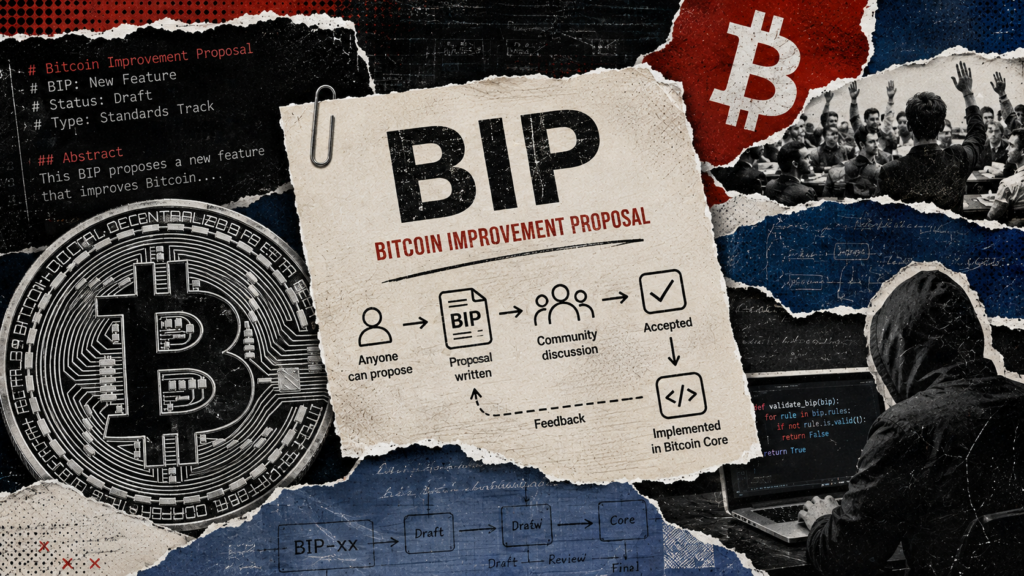
Bitcoin2026-08-11 02:53:03BIP submissions are open to anyone, but BIP-110 shows how hard approval really isBitcoin’s BIP-110 soft fork stalled within hours after launch last weekend, with the minority chain producing just one more block before freezing and drifting farther behind the main chain. Roughnecks, which had rallied support for the proposal, later said it would stop mining and asked other miners to step back for now. Ocean, the pool that served as the main signaling base, saw its hash rate fall from about 36 EH/s to 1.25 EH/s over the weekend, leaving it far below the proposal’s 55% lock-in threshold. The episode has also drawn attention to a basic point about Bitcoin Improvement Proposals, or BIPs: almost anyone can submit one. Under BIP 3, which took effect in 2025 and replaced BIP 2 after nine years, a proposal starts with discussion on the bitcoindev mailing list, moves into a formal draft, and then goes to the bitcoin/bips repository as a pull request. Editors check scope and formatting, assign numbers, and merge qualifying drafts, but they do not judge whether an idea is good policy. What decides whether a BIP advances comes later. The article breaks that process into three hurdles: editorial acceptance, rough consensus across developers and users, and then actual network activation. BIP-110, while formally registered and technically implementable, ran into the harder part — winning broad support and economic adoption.1810
BIP-1102026-08-11 01:01:56BIP-110 Stalls as Support Falls Short; Editor Removes Luke Dashjr's BIP Editorial PowersAccording to ChainCatcher, the BIP-110 soft fork has stalled, with thousands of nodes isolated after signaling support peaked at just 2.53% — far below the 55% threshold. The Bitcoin BIP editorial team, acting on Monday just two days after the events, stripped Luke Dashjr of his editorial permissions. Dashjr had been the lead proponent of the proposal. Editor Mark Erhardt moved for his removal, citing conflicts of interest, minimal contributions, involvement in a contentious fork, and a breakdown in coordination. Supporters argue Dashjr used his editorial role to favor BIP-110, assigning it a number before mailing-list discussions and merging pull requests quickly, while contributing under 1% since April 2024. The forced chain remains stuck at height 961,633. Ocean, the only mining pool that had signaled before the fork, has now resumed non-BIP-110 work. Four minutes before the removal was confirmed, Dashjr announced he was pausing his duties as Ocean chairman and CTO to focus on Bitcoin open-source projects. He continues as lead maintainer of Bitcoin Knots. Bitcoin’s price was unaffected by the news.1850
Bitcoin2026-08-10 22:40:11Bitcoin BIP editors remove Luke Dashjr after BIP-110 fork stallsBitcoin’s BIP editors removed Luke Dashjr from the role on Monday, two days after the BIP-110 soft fork he backed split thousands of nodes onto a chain that has not produced a block since Aug. 8. The move was carried out by revoking his GitHub permissions and deleting his name and email from BIP 3, even though the BIPs repository has no written process for appointing or dismissing editors. Bryan Bishop confirmed the change on the Bitcoin Development Mailing List, while Jon Atack merged pull request #2248 to strike Dashjr from the list of editors. Erhardt, also known as Murch, had opened the motion a day earlier, citing four reasons: conflict of interest, minimal contribution, support for a contentious fork, and a collapse in coordination with the rest of the editors. Dashjr rejected the accusations, calling them false and saying he had followed the BIP process consistently for years. The discussion drew backing from BIP editor Olaoluwa Osuntokun, Bitcoin Core contributors Matt Corallo, Antoine Poinsot, and Anthony Towns, libsecp256k1 maintainer Jonas Nick, and Casa co-founder Jameson Lopp. Some participants supported the outcome while criticizing the speed and the lack of formal governance rules. Meanwhile, the BIP-110 enforcing chain remained stuck at height 961,633, signaling dropped to zero in the current difficulty period, and Bitcoin’s market price showed little reaction.1900
BIP-542026-08-10 13:13:00Wang Chun: ViaBTC Would Support BIP-54 if BIP-9 Miner Threshold Is MetViaBTC founder Wang Chun said on X that he personally does not support Bitcoin Improvement Proposal 54 (BIP-54). However, if the proposal is advanced strictly through the BIP-9 activation mechanism and secures the required absolute majority of miner signal support, ViaBTC will update its mining nodes to support the upgrade. Until that happens, ViaBTC will not participate in BIP-54 signaling. BIP-54 is a protocol improvement proposal recently discussed in the Bitcoin community, aimed at increasing network capacity by adjusting consensus-related rules, though its activation method and necessity have sparked some controversy. BIP-9 is a soft-fork activation mechanism based on miner signaling, requiring miners to signal support through block headers and triggering an upgrade once a preset threshold is met. Wang's statement indicates that although ViaBTC holds reservations about BIP-54 itself, it is willing to follow Bitcoin's established consensus upgrade process. The key point is that activation must receive sufficiently broad network consensus rather than being pushed through unilaterally.1960
Bitcoin2026-08-10 08:56:23BIP-110 falls behind Bitcoin main chain as debate shifts from soft fork to possible PoW changeBitcoin entered the BIP-110 enforcement window at block height 961632 on Aug. 9, creating a live split between the main chain and a minority chain run by nodes enforcing the proposal. Those nodes began rejecting non-compliant blocks, including ones carrying non-monetary data transactions. But after a day, the BIP-110 chain had produced only blocks 961632 and 961633 and trailed the main chain by more than 200 blocks, leaving it far from the longest-chain consensus. The outcome matched the weak support seen before activation. Miner signaling was only about 2%, well below the 55% threshold cited in the article. Even so, supporters led by Bitcoin developer Luke Dashjr have continued discussing a new proof-of-work algorithm for the BIP-110 chain, a move that would take the dispute beyond a soft fork and into hard fork territory. In Bitcoin Knots Discord discussions, participants considered options including RandomX, KT256, BLAKE3, BLAKE2 variants, Scrypt and Autolykos v2. The fight has now widened into a governance dispute over whether miners, nodes or the broader community determine Bitcoin’s direction. Critics including Michael Saylor, Adam Back and F2Pool co-founder Wang Chun rejected the BIP-110 case, while proposal author Dathon Ohm and Dashjr argued that large mining pools had forced the chain into this position.8810
Bitcoin2026-08-10 08:11:00Bitcoin’s BIP-110 soft fork stalls after two blocks in eight hoursPANews reported that Bitcoin Improvement Proposal BIP-110 entered its mandatory signaling phase on August 9 but quickly ran into a wall. The minority chain tied to the proposal produced only two blocks in roughly eight hours, both mined by Roughnecks, after signaling support fell far short of the activation threshold. In the last difficulty period before activation, only 51 blocks signaled support, or about 2.53% of the 2,016-block window. Roughnecks and later PyBLOCK then paused support, while developer Luke Dashjr drew public criticism over the dispute.2610