Bitcoin2026-08-09 08:46:03Adam Back pushes back on BIP-110 claims, says spam limits cannot be forced by soft forkA dispute around Bitcoin Improvement Proposal 110, or BIP-110, is drawing attention in the Bitcoin community after the proposal sought to restrict non-financial data stored on the Bitcoin blockchain. Supporters of the proposal have been looking to push the rule change through a user-activated soft fork, or UASF, but miner backing is still well short of the activation threshold mentioned in the report. The debate has raised questions over whether it could turn into a broader governance split inside the Bitcoin network. Blockstream CEO Adam Back criticized arguments made by BIP-110 supporters in a post on X. He said the claim that “Bitcoin supports spam” is wrong and argued that no Bitcoin participant likes spam data on the network. Back also said Bitcoin cannot achieve absolute censorship at the mathematical level. In his view, BIP-110 has multiple flaws, would not operate effectively, and has therefore failed to win network consensus. He added that trying to push through rule changes without consensus could end in a split resembling Bitcoin SV, or BSV.2000
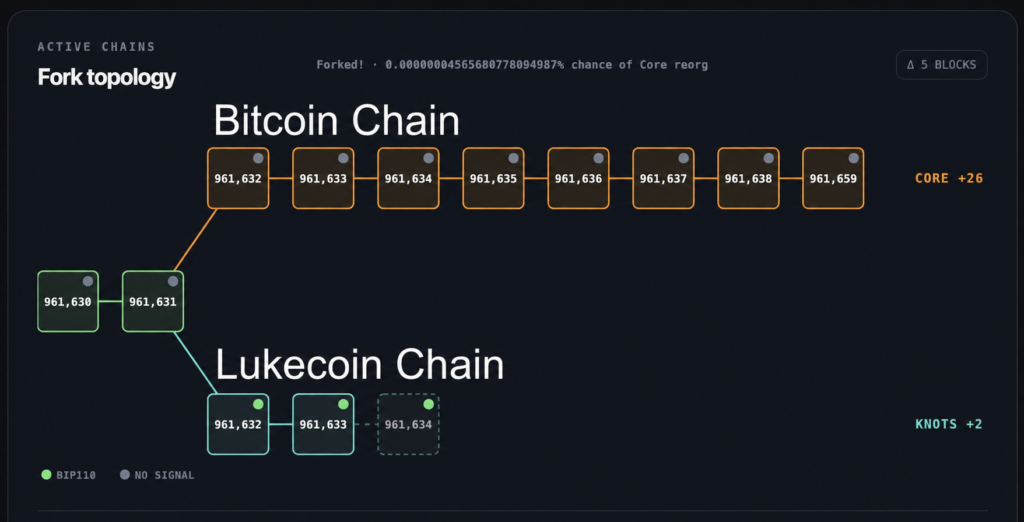
Bitcoin2026-08-09 02:20:50Bitcoin’s BIP-110 enters mandatory signaling phase, but supporters fall onto a minority chain 26 blocks behindBitcoin split into two branches at block 961,632 after BIP-110’s mandatory signaling phase went live, according to BlockTempo. The break was not a balanced network split but a sharp divergence in which BIP-110 nodes rejected non-signaling blocks and ended up following a minority chain. Miner support was reported at just 2.53% in the final signaling window before the split, far below the proposal’s 55% threshold. By 10 a.m. Taiwan time on Aug. 9, Bitcoin’s main chain had reached block 961,659, while the BIP-110 chain was stuck at 961,633, having produced only one additional block after the fork point. BIP-110, written by pseudonymous developer Dathon Ohm, proposes a temporary soft fork called “Reduced Data Temporary Soft fork” aimed at limiting non-financial data storage on Bitcoin for roughly one year. The proposal would restrict most new output scripts to 34 bytes, cap OP_RETURN outputs at 83 bytes, limit some data pushes and witness elements to 256 bytes, temporarily restrict certain Taproot functions, and exempt UTXOs created before activation. Critics including Adam Back, Jameson Lopp, and Michael Saylor have argued that the proposal lacks technical and ecosystem consensus and could create compatibility and chain-split risks. Market reaction was limited, with BTC trading around $65,000 and showing no clear volatility after the split.1940
BIP-1102026-08-09 01:47:54Bitcoin's BIP-110 Soft Fork Enters Mandatory Signaling Phase With Miner Support Far Below 55%Bitcoin's contested BIP-110 soft fork has moved into a mandatory signaling phase. The signal window opened at block height 961,632 at around 03:35 Beijing time on Sunday (19:35 UTC), according to CoinDesk. The proposal is meant to temporarily prevent non-financial data from being written to the Bitcoin blockchain. However, backing from miners is weak: the share of supporting miners is far below the 55% threshold the plan requires for activation. Market observers are closely watching whether the fork chain can attract more nodes and gain influence, or whether it will lose relevance for lack of hash power and ecosystem support. Several heavyweights in the industry have come out against the plan, including Strategy chairman Michael Saylor and Blockstream CEO Adam Back. They worry BIP-110 could break Bitcoin's existing consensus and create an unnecessary split. The signaling period is set to last until block height 965,664, roughly four weeks, before the community has to decide whether to activate the fork.1580
Bitcoin2026-08-09 01:36:39Bitcoin BIP-110 enters a four-week countdown as miner support stays near zeroNodes enforcing BIP-110 began applying a mandatory signaling rule at Bitcoin block height 961,632, putting the proposal into a decisive signaling window that is expected to end in roughly four weeks at block 965,664. Current data shows miner signaling support has fluctuated between just 0.3% and 2.6%, and no major mining pool has publicly backed the proposal. Most nodes running the enforcement rules appear to come from users of Bitcoin Knots, and those nodes are now rejecting blocks that do not carry the required signal, effectively isolating themselves from Bitcoin’s main network. If miner support reaches the 55% threshold during the signaling period, BIP-110’s data-limit rules would activate at block 965,664 and remain in place for about one year, covering roughly 52,416 blocks. Analysts cited in the report said the setup differs from the 2017 Bitcoin Cash split because BIP-110 does not have broad miner backing or exchange infrastructure. Without enough hashpower and node participation, a breakaway chain could face severe block production delays, with block times potentially stretching from the 10-minute target to hours or even days.1820
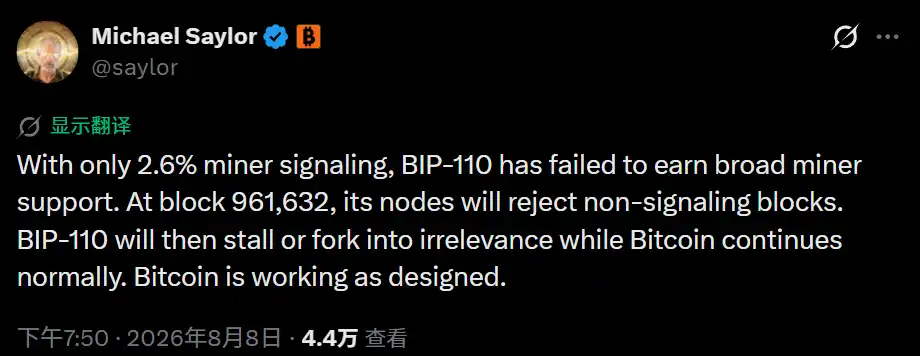
BIP-1102026-08-08 11:58:42BIP-110 Backed by Only 2.6% of Miners, Saylor Sees Stagnation or IrrelevanceAccording to BlockBeats, on Aug. 8, Michael Saylor, founder of Strategy, said that only 2.6% of miners have signaled support for BIP-110, meaning the proposal has not gained broad support. In the same post, Saylor pointed out that at block height 961,632, nodes would reject blocks that do not signal in favor of BIP-110. He went on to say that after that point, BIP-110 would either stall or fork into an irrelevant existence, while Bitcoin itself would continue to run normally. 'Bitcoin is working as designed,' Saylor wrote. BIP-110 is a temporary soft fork proposal designed to add seven consensus restrictions over roughly a one-year period. Those restrictions include limiting new script public key lengths, placing caps on certain pushed data and witness item sizes, and disabling some Taproot extension paths. The proposal intends to substantially reduce arbitrary non-payment data that can be embedded in transactions, such as inscriptions and runes. This, in turn, would reduce the load on nodes, suppress spam data, and help Bitcoin stay focused on its role as money.1770
BIP-1102026-08-07 13:35:56BIP-110 Forced Signal Window Nears as Miner Support Sits at 2.59%Bitcoin developer Chris Guida has rebased a 2017 PoW change by Luke Dashjr onto Bitcoin Knots as a contingency soft fork. BIP-110, which would restore the 83-byte OP_RETURN consensus limit, requires 55% miner signaling to lock in early. With 47 of 1,818 blocks signaling support, the current rate is just 2.59%, with the forced window set to begin at block 961632.1900
bitcoin2026-08-06 13:06:55Bitcoin's BIP-110 Moves to Enforcement Phase as Miner Support Sits at 2.45%Bitcoin's BIP-110 will enter its enforcement phase after block 961,632, when nodes running the proposal will reject blocks that do not signal support. On-chain monitoring shows only 41 of 1,674 blocks counted in the current cycle carry BIP-110 signaling, putting miner support at roughly 2.45%. The proposal, formally named Reduced Data Temporary Softfork, aims to tighten certain data rules in Bitcoin transactions over roughly one year, capping the size of data elements used by Ordinals inscriptions and several token protocols. It is distributed mainly through Bitcoin Knots; Bitcoin Core has not adopted it. Major pools including Foundry, Antpool, F2pool and Viabtc have not signaled support. If BIP-110 nodes proceed as planned, the network could see two separate transaction histories, while most miners and Bitcoin Core users are expected to keep using existing rules. Australian exchange Hardblock says activation is expected around Aug. 7-8 and may temporarily pause trading, deposits and withdrawals. Lightning Network tool and analytics provider Amboss has flagged fork risk for early August, and Australian exchange Bitaroo plans to freeze deposits and withdrawals as the enforcement window approaches.2460
BIP-1102026-08-05 01:03:59BIP-110 Soft Fork Heads for Activation: Timeline, Thresholds and Chain-Split RiskBIP-110, a Bitcoin soft fork, is moving toward activation, with mandatory signaling starting around August 9 at block 961,632. Lock-in is expected in late August at block 963,648, followed by activation of new transaction rules in early September at block 965,664. The proposal sets a 55% signaling threshold and enforces restrictions over 52,416 blocks, about one year, targeting large data pushes, oversized output scripts, undefined witness versions, and Taproot annex. UTXOs created before activation are exempt, and standard monetary uses stay compatible. Most businesses, including those using bitcoin as a store of value or relying on third-party payment providers, do not need to act. Full-node operators can choose whether to run BIP-110 nodes. The key risk is a chain split: miners should pick the likely winning branch or pause, while exchanges and custodians should raise confirmation requirements, monitor both chains, and delay final settlement to prevent double spending and false confirmations. If no split occurs, no special operations are required.2800