UMA

Policy and Re
2026-07-22 09:20:00

Why Chinese-speaking users may need a local prediction market, and how yoyo market is trying to fill Asia’s gap

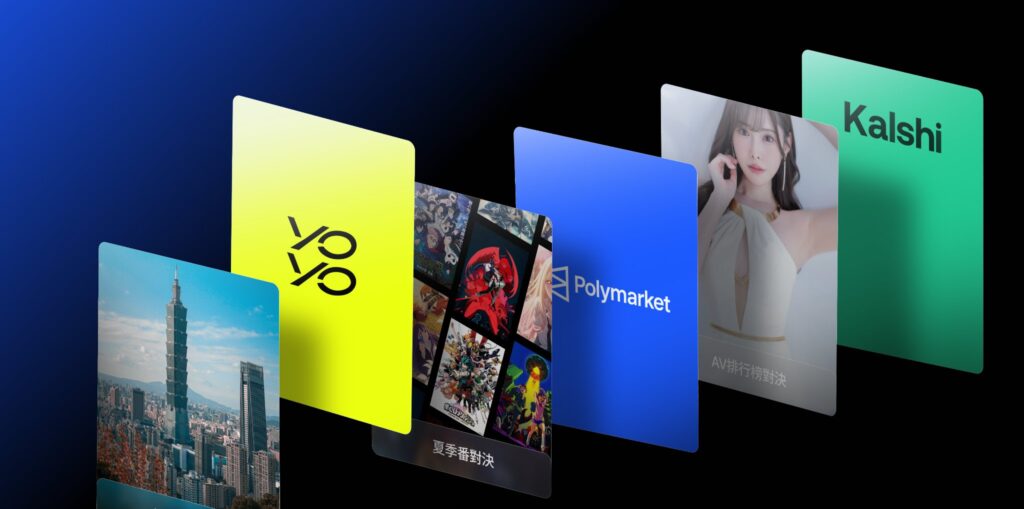
BlockTempo argues that prediction markets have already proven their value in the West, but the sector still lacks a platform built around the interests and access conditions of Asian users. The report points to Polymarket and Kalshi as the two dominant names in the market, yet says both remain centered on U.S. topics, U.S. regulation, and U.S.-based users. For Chinese-speaking participants, that leaves a gap in both relevance and accessibility. The article frames prediction markets as tools that turn prices into probability signals. It cites a16z economist Scott Duke Kominers’ description of them as “probability sensors,” and says the model can outperform traditional polling by updating in real time, rewarding participants who research deeply, and supporting niche topics. It also highlights the sector’s recent growth, including an estimated $24 billion in monthly industry volume in April 2026 and long-term projections of $1 trillion by 2030 from Bernstein and Eilers & Krejcik. Against that backdrop, yoyo market is presented as a platform designed for Asia-Pacific users. According to the report, the company was founded in 2025, recently opened a Hong Kong branch, and is backed by Longling Capital, Impa Ventures, and Hermitage Capital. Its pitch rests on three points: markets tailored to local interests such as East Asian sports, K-pop, weather and regional events; a simpler mobile-first interface; and a compliance strategy that avoids elections, politics, and military conflict while the company seeks a CFTC license.
580
Why Chinese-speaking users may need a local prediction market, and how yoyo market is trying to fill Asia’s gap
ETH
2026-07-20 01:30:00

24-hour crypto roundup: BANK jumps 93.81%, KB Financial launches digital asset fund

Crypto markets and industry headlines moved on several fronts on July 20. Among the top 10 tokens by CEX trading volume, BANK posted the strongest 24-hour gain at 93.81%, while BTC slipped 0.2% and ETH rose 0.42%. OKX’s 24-hour gainers list was led by NAVX, PUMP, and YB, and GMGN’s on-chain meme rankings showed activity centered on Robinhood Chain and BSC tokens. Outside token performance, several non-crypto developments also drew attention. Spain beat Argentina 1:0 after extra time in the World Cup final, claiming its second title since 2010. ChangXin Technology said winning subscribers in its share offering must complete payment on July 20, with funds from offline investors due by 16:00 on the T+2 settlement day and online investors required to ensure enough subscription funds remain in their accounts by day-end. In business and policy-related updates, Trump Media & Technology Group said its paid data product Truth API will go live on Aug. 1, offering banks and algorithmic trading firms real-time access to posts from 10 influential Truth Social accounts, including Donald Trump. South Korea’s KB Financial Group also unveiled a 100 billion won strategic investment fund focused on digital assets and artificial intelligence, while the U.S. CLARITY Act remained stalled in the Senate one year after passing the House.

870
24-hour crypto roundup: BANK jumps 93.81%, KB Financial launches digital asset fund
Prediction Ma
2026-07-19 09:00:55

Testing Four Event Contract Platforms: How Polymarket, Kalshi, Robinhood and TurboFlow Differ on Pricing, Settlement and Exit

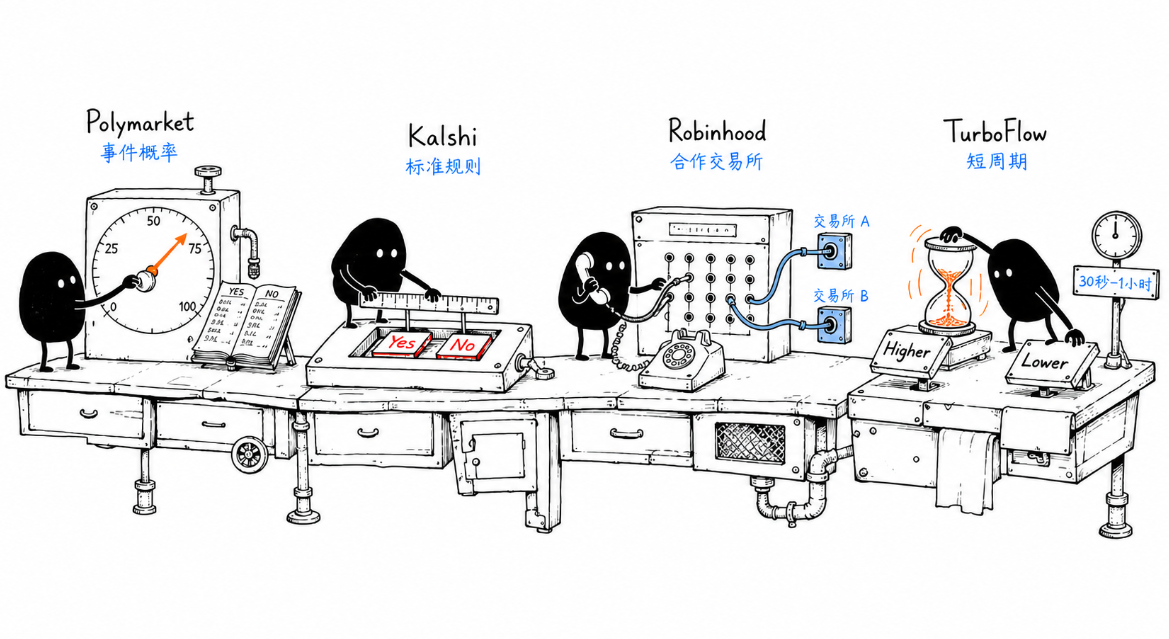
Event contracts are gaining traction across both crypto and traditional finance, but the mechanics that shape outcomes often sit in the fine print. A review article written by MetaHub Research and compiled and translated by PANews breaks down four platforms — Polymarket, Kalshi, Robinhood and TurboFlow — by looking at how they quote prices, settle trades, structure fees and let users exit positions. The comparison shows a clear split between order-book markets and automated market maker models. Polymarket and Kalshi rely primarily on order books, while Robinhood acts as a front-end access point to partner exchanges. TurboFlow, in contrast, offers short-duration higher/lower event contracts priced through its propAMM model, with returns locked in once an order is confirmed. The article also notes that contract prices in binary markets are often read as implied probabilities, but those figures reflect market pricing at a given moment rather than any guaranteed real-world likelihood. Across all four products, the review argues that users should focus less on platform branding and more on contract-specific terms. Settlement source, time zone, boundary conditions, dispute procedures, fees, liquidity and abnormal-event handling can all materially affect the result. Its core takeaway is that understanding event contracts means checking five steps in order: question design, price formation, trade exit, outcome confirmation and fund settlement.

730
Testing Four Event Contract Platforms: How Polymarket, Kalshi, Robinhood and TurboFlow Differ on Pricing, Settlement and Exit
Event Contrac
2026-07-16 02:00:00

How event contracts work: A comparison of Polymarket, Kalshi, Robinhood and TurboFlow

Event contracts are built around verifiable questions with predefined outcomes, deadlines and settlement terms, but the user experience can differ sharply across platforms. In its latest market analysis, Foresight breaks the category into five checkpoints: how the question is defined, how pricing is formed, whether positions can be exited early, who confirms the result, and how funds are settled. The report compares four widely discussed products. Polymarket runs continuous event markets through an order book and uses UMA in result confirmation. Kalshi focuses on standardized yes/no contracts with clearly displayed market rules and order-book execution. Robinhood offers access to event contracts through partner exchanges, meaning pricing, settlement and special terms are ultimately determined by the exchange carrying the contract. TurboFlow, by contrast, is presented as an on-chain trading ecosystem that combines prediction markets and perpetuals, while the product reviewed here is its event contract offering: fixed-window higher/lower contracts priced through a propAMM model. Foresight also highlights the main risks that apply across the sector, including principal loss, rule interpretation mistakes, liquidity gaps, settlement and data issues, fees, and technical or compliance constraints. The key point is straightforward: platform branding does not replace contract-level due diligence.

680
How event contracts work: A comparison of Polymarket, Kalshi, Robinhood and TurboFlow
AI agents
2026-07-13 11:02:14

GenLayer pitches a blockchain-based “internet court” for disputes between AI agents

As AI agents start shopping, trading, hiring and paying on users’ behalf, one unresolved question is moving closer to the center of the stack: who handles the disputes when those transactions go wrong? Forbes reports that GenLayer, a blockchain project run by the Cayman Islands-based GenLayer Foundation, has launched an “internet court” designed to resolve conflicts between software agents through AI-assisted adjudication. The system is built around pre-agreed contracts, escrowed payments and a jury process made up of blockchain validators running different models such as Claude, GPT and Gemini. If two sides disagree, the network reviews evidence and issues a decision within minutes. GenLayer says the approach is aimed at smaller claims where hiring lawyers makes little economic sense. The project has backing from 26 crypto and AI companies, including OKX, MetaMask and BNB Chain. According to GenLayer Labs co-founder and CEO Albert Castellana, the network is already live in testing, handling about 350,000 transactions a day and generating 20,000 to 25,000 decisions. The team plans a broader public launch later this year, along with a token meant to attract more validators. The effort arrives as AI-driven commerce expands, arbitration groups publish standards for agent interactions, and traditional courts begin hearing cases tied to AI agents operating across online platforms.

690
GenLayer pitches a blockchain-based “internet court” for disputes between AI agents