XLE

Policy Regula
2026-09-10 05:01:00

Treasury buyback move fails to calm bond sell-off as oil tops $100 and U.S. stocks extend losses

U.S. stocks fell for a third straight session as rising oil prices, weak long-end Treasury sentiment and pressure on rate-sensitive equities drove trading. Brent crude settled at $101.21 a barrel and WTI at $96.05 after the U.S.-Iran conflict escalated, while CTA positioning in both contracts jumped sharply, according to Bridgeton Research Group under Kpler. The U.S. Treasury raised its long-bond buyback cap to $6 billion, below market expectations of $7 billion to $10 billion, and the bond market sold off anyway. A $39 billion 10-year Treasury auction cleared at a record 4.834% with a bid-to-cover ratio of 2.71, pushing the 10-year yield to about 4.85% and the 30-year above 5.30%. In equities, storage, optical communications and AI-linked names outperformed. Meta rose after unveiling its personal AI agent Muse, while Apple slipped after introducing the foldable iPhone Duo. Investors are now watching the European Central Bank decision, U.S. August PPI data and a $22 billion 30-year Treasury auction.

160
Treasury buyback move fails to calm bond sell-off as oil tops $100 and U.S. stocks extend losses
AI stocks
2026-08-18 21:12:38

AI Stocks Drop as Oil, Yields and Middle East Tensions Reprice Risk

U.S. equities opened lower on Aug. 18, with AI and semiconductor names leading the decline. Micron briefly fell nearly 7%, TSMC ADR lost about 4%, and NVIDIA, Broadcom and Meta also weakened. The move followed rising oil prices, higher Treasury yields and renewed Middle East tensions, not a single earnings report or an abrupt collapse in AI demand. Reuters reported that U.S.-Iran talks stalled and Brent crude climbed back near $90 a barrel. That in turn revived inflation concerns and pushed long-dated Treasury yields higher, with the 30-year yield touching about 5.29%, the highest since 2007, while the 10-year yield held around 4.71%. Energy stocks rose instead, with XLE up more than 1% intraday. Still, the article says there is not enough evidence that AI infrastructure demand has turned. U.S. industrial output for July rose 0.2%, semiconductor production increased 2.4%, and Microsoft and Amazon’s latest results still point to strong cloud demand. Gold and silver did not rally either, suggesting investors were focused more on yields and the dollar than on classic safe-haven flows. The piece highlights three numbers to watch next: Brent above $90, the U.S. 10-year yield, and AI companies’ revenue, orders and free cash flow.

600
AI Stocks Drop as Oil, Yields and Middle East Tensions Reprice Risk
Hyperliquid
2026-07-24 14:28:10

ARK analyst says Hyperliquid’s HIP-3 RWA volume has overtaken crypto on a weekly basis

ARK Invest analyst Lorenzo said Hyperliquid has reached a new point in its market mix, with real-world asset trading on HIP-3 exceeding crypto-native volume for the first time in a single week. According to the figures cited in the post, RWA accounted for 54% of total platform volume, and 61% of that RWA activity came from single-stock products. The article argues this shift points to a broader change in Hyperliquid’s positioning, from a crypto perpetuals venue to a round-the-clock multi-asset derivatives platform spanning equities, indices, commodities and FX. The write-up also stresses that the RWA products in question are synthetic perpetual contracts rather than tokenized securities. Traders get price exposure, typically margined in USDC, but do not receive actual stock ownership, voting rights or legal claims on the underlying assets. It distinguishes that model from true securities tokenization and notes the two paths carry different infrastructure, legal and operational requirements. At the same time, the piece flags a math issue in the original comparison between Hyperliquid’s HIP-3 RWA volume and the rest of the DEX perpetuals market, and says the claim cannot be directly derived from the numbers presented. It further examines what the trend could mean for HYPE, USDC and Circle, while outlining the current HIP-3 market map, where activity is concentrated in stocks, commodities and indices, with much of the volume attributed to the trade[XYZ] deployment.

4730
ARK analyst says Hyperliquid’s HIP-3 RWA volume has overtaken crypto on a weekly basis
Technology st
2026-07-19 03:19:25

Tech ETF XLK Sees $8.7 Billion Outflow in a Month as Sector Sell-off Continues

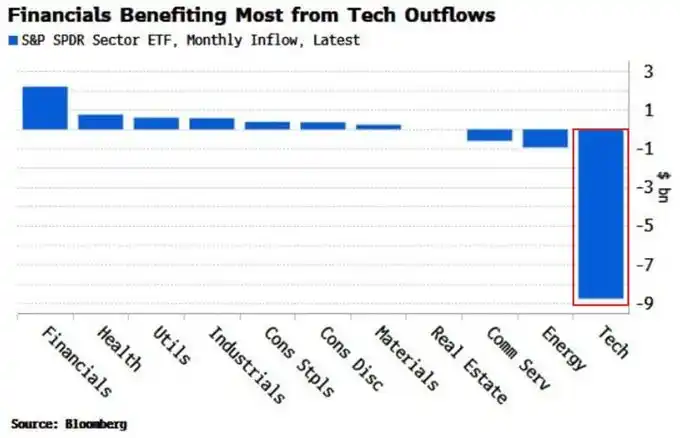
Technology stocks remained under pressure over the past month, according to a July 19 post from The Kobeissi Letter, with sector-level fund flow data showing the largest withdrawals among S&P 500 industry exchange-traded funds. The Technology Select Sector SPDR Fund (XLK) recorded net outflows of $8.7 billion during the period, the biggest outflow among all sector ETFs in the index. Energy Select Sector SPDR Fund (XLE) and Communication Services Select Sector SPDR Fund (XLC) also posted net outflows, at $1 billion and $500 million, respectively. In contrast, the Financial Select Sector SPDR Fund (XLF) attracted $2.1 billion in net inflows, the highest among all sectors over the same stretch. On performance, XLK fell 5.4% in the past month, making it the worst-performing sector ETF in that group. The Kobeissi Letter said the technology sector is going through a period of consolidation.

1240
Tech ETF XLK Sees $8.7 Billion Outflow in a Month as Sector Sell-off Continues
Bybit
2026-07-15 09:32:16

Bybit lists SMH, XBI and XLE U.S. equity perpetual contracts

Bybit has added three new U.S. equity perpetual contracts: VanEck Semiconductor ETF under SMHUSDT, SPDR S&P Biotech ETF under XBIUSDT, and Energy Select Sector SPDR ETF under XLEUSDT. The exchange said the newly listed contracts support leverage of up to 20x. Alongside the launch, Bybit is also offering a limited-time fee promotion. During the promotional period, maker fees are set at 0%, while taker fees are discounted by 50%. The update was reported by Odaily.

1160
Bybit lists SMH, XBI and XLE U.S. equity perpetual contracts