‹ BackNewschainalysis

chainalysis

Why a long-dormant Bitcoin OG moved $1 million through a custodian and then burned it remains unexplained
WuBlockchain roundup: BitMine adds 53,501 ETH, Strategy buys 4,603 more BTC
Dormant Bitcoin Wallet Moved 20 BTC to Exchange, Took It Back, Then Burned the Coins
Policy and Re
2026-08-31 10:55:47

AI-driven impersonation scams are overtaking code exploits as a core crypto security threat

Impersonation and AI-assisted fraud are becoming one of the most serious security problems in crypto, shifting attention away from code bugs alone and toward identity, access control, and accountability. Chainalysis said at least $14 billion in on-chain funds flowed into crypto scams in 2025, though not all of that activity was tied to AI. Within a subset of cases linked on-chain to AI vendors, the average scam operation was about $3.2 million, compared with roughly $719,000 for scams without those links, a correlation the company did not describe as causal. Executives interviewed across the sector pointed to a broad change in attack methods. Binance Chief Security Officer Jimmy Su said smart-contract security has improved enough that attackers now focus more on people around protocols, credentials, and governance systems, citing Binance security team assistance in stopping a $1.2 million governance attack on BrainTrust. Binance Research also said access control failures accounted for about two-thirds of the $621 million lost to DeFi exploits in April 2026 alone. The report also highlights unresolved attribution issues, mixer-related tracing gaps, and a new frontier in AI agents that can pay, register for services, and potentially transact on users’ behalf. Several executives argued that the missing layer is not transaction verification itself, but trustworthy identity and responsibility behind those actions.

920
AI-driven impersonation scams are overtaking code exploits as a core crypto security threat
Chainalysis
2026-08-30 18:11:48

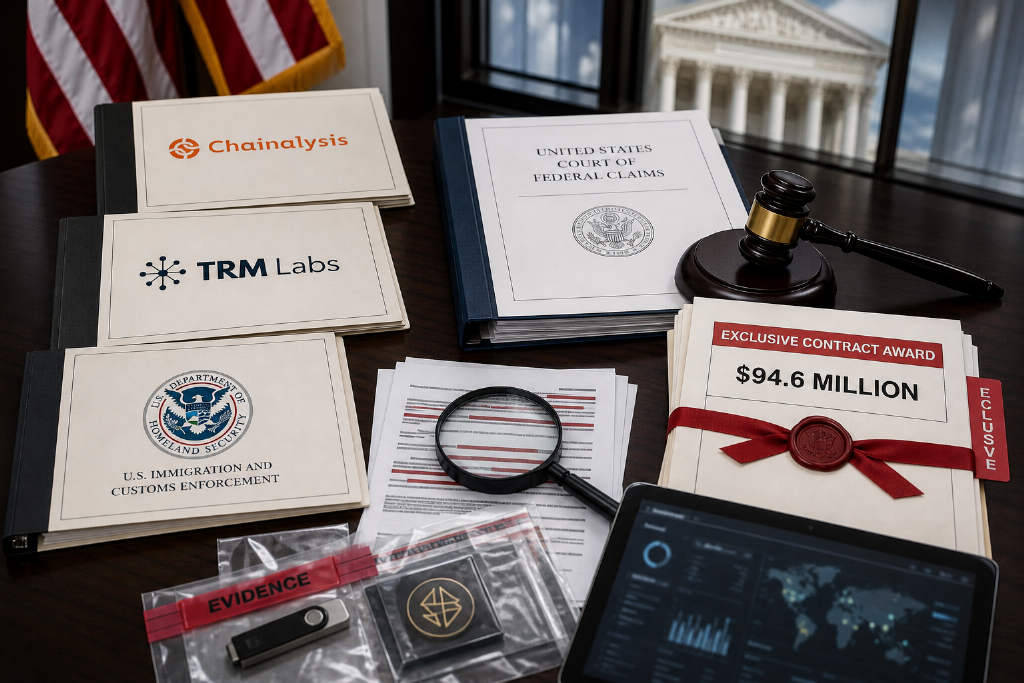
Chainalysis Sues ICE Over $94.6M Sole-Source Contract to TRM Labs

Blockchain analytics company Chainalysis has sued ICE before the U.S. Court of Federal Claims, alleging that the agency unlawfully awarded a $94.6 million sole-source contract to competitor TRM Labs. The contract provides forensic software and support for Homeland Security Task Force investigations, with a performance period running from July 1, 2026 to June 30, 2027. Chainalysis says it is the largest U.S. government blockchain-analysis contract awarded to date. In the complaint, Chainalysis says ICE issued an RFI on May 28 with 18 questions covering a proprietary fraud-victim database, AI-agent data retrieval, automated notices to virtual asset service providers to execute voluntary freezes, and cooperation with stablecoin issuers. Less than two weeks later, the final Statement of Need omitted many of those requirements, while ICE's market research used the RFI standard to conclude Chainalysis could not meet its needs. The suit also says “sextortion” appeared as one of three mission areas in the Statement of Need even though the RFI never mentioned it, and that some requirements closely match TRM’s proprietary product architecture. Chainalysis says it was the only company to submit a capability statement, yet ICE completed its market research the next day and named TRM the only supplier able to meet all requirements. ICE, according to the complaint, did not ask Chainalysis any follow-up questions.

910
Chainalysis Sues ICE Over $94.6M Sole-Source Contract to TRM Labs
Chainalysis sues ICE over $95 million blockchain analytics contract awarded to TRM Labs
IRS
2026-08-28 10:02:28

IRS crypto enforcement is shifting toward wallets, with 86% of taxable onchain activity outside 1099-DA forms

The U.S. Internal Revenue Service is increasingly looking past tax forms and toward wallet-level tracking in crypto, according to a Forbes column by CoinTracker head of tax strategy Shehan Chandrasekera. Citing Chainalysis estimates, the piece says global taxable onchain activity will reach at least $457 billion in 2025, and 86% of that sits outside the visibility of reporting forms such as Form 1099-DA. That share includes self-custody wallets, decentralized exchanges, DeFi protocols, staking and lending income, and peer-to-peer payments. These channels generally do not involve brokers that would issue IRS forms. Chandrasekera did not say the IRS has announced a new formal “wallet enforcement” policy. Instead, he framed it as a practical shift created by rules already in effect. One key issue is that 1099-DA forms for tax year 2025 are expected to report gross proceeds while leaving cost basis fields, including Box 1g, mostly blank. Brokers will not begin reporting cost basis alongside proceeds until transactions after Jan. 1, 2026. That means taxpayers may need to restore cost basis themselves on Form 8949 or risk mismatches that could trigger automated CP2000 notices. The article also points to wallet-by-wallet cost basis tracking under Rev. Proc. 2024-28 and notes the IRS has long used blockchain analytics tools and programs such as Operation Hidden Treasure to identify unreported crypto income.

860
IRS crypto enforcement is shifting toward wallets, with 86% of taxable onchain activity outside 1099-DA forms