defi

Stellar
2026-09-03 07:27:46

USDT0 Goes Live on Stellar Network for Cross-Border Payments and DeFi

The Stellar Development Foundation has announced the launch of USDT0 on the Stellar network. Built on LayerZero's OFT (Omnichain Fungible Token) standard, USDT0 maintains a 1:1 reserve with USDT, enabling users to access global liquidity instantly without needing wrapped tokens or third-party tools. The integration allows Stellar users to transfer value with fees under $0.01 and finality in approximately 5 seconds, spanning over 170 countries. USDT0 is already live on the decentralized exchange SushiSwap, and more DeFi protocols are expected to integrate in the future, expanding payment applications in emerging markets in Latin America, Africa, and Asia-Pacific. This move aims to support cross-border payments and DeFi use cases on the Stellar network.

60
USDT0 Goes Live on Stellar Network for Cross-Border Payments and DeFi
SEC
2026-09-03 06:39:09

SEC Chair Paul Atkins says proposed crypto rules are meant to draw innovation back to the U.S.

U.S. Securities and Exchange Commission Chair Paul Atkins said the agency’s proposed "Regulation Crypto Assets" framework is designed to create a clearer path for issuing crypto assets and raising capital in the United States, while helping reverse the migration of developers and issuers overseas. Speaking to Fox Business on Sept. 3, Atkins said the SEC has relied too heavily on enforcement in the past, leaving firms uncertain about whether a token would be treated as a security, what registration path might apply, and how capital could be raised without violating securities laws. The proposal, formally released on Aug. 18, would create two tailored registration exemptions for cases where a crypto asset itself is not a security but the initial offer or sale arrangement could qualify as an investment contract. One exemption would allow eligible startup projects to raise up to $5 million over four years, while another would permit issuers to raise up to $75 million in any 12-month period, subject to financial statements and ongoing reporting in the latter case. The draft also includes an investment contract safe harbor and keeps federal anti-fraud and anti-manipulation provisions in force. Atkins separately backed the CLARITY Act, saying legislation is still needed to provide longer-term regulatory certainty.

00
SEC Chair Paul Atkins says proposed crypto rules are meant to draw innovation back to the U.S.
a16z Crypto
2026-09-03 06:33:05

a16z Says Finance Needs More Than Throughput From Blockchain Networks

Transaction speed is no longer the main dividing line for blockchains targeting finance, according to a new article by a16z Crypto, translated by Luffy and published by Foresight News. The piece argues that while throughput and cost once dominated the discussion, financial institutions now need to know whether blockchain networks can meet the standards expected of trading infrastructure in real markets. The article breaks that standard into three core requirements. First is predictability: transactions must be admitted and confirmed within known time windows under rules that market participants can understand in advance. Second is ordering: if a single builder or proposer can decide which trades enter a block and in what sequence, the system risks reproducing the same information asymmetries seen in traditional finance, including behavior associated with maximal extractable value, or MEV. Third is privacy before execution: pending orders should not be visible in ways that expose trading intent before a trade is completed. a16z Crypto says developers are working on mechanisms such as “strong chain quality,” deterministic ordering rules, fully homomorphic encryption, and encrypted mempools. In its view, high throughput remains necessary, but it is only the starting point. What finance needs is a blockchain that offers dependable access, clear execution rules, protection against interference, and auditable transparency after trades are completed.

00
a16z Says Finance Needs More Than Throughput From Blockchain Networks
LayerZero
2026-09-03 06:33:05

LayerZero unveils ATLAS, a headless exchange engine that pushes trading venues to the front end

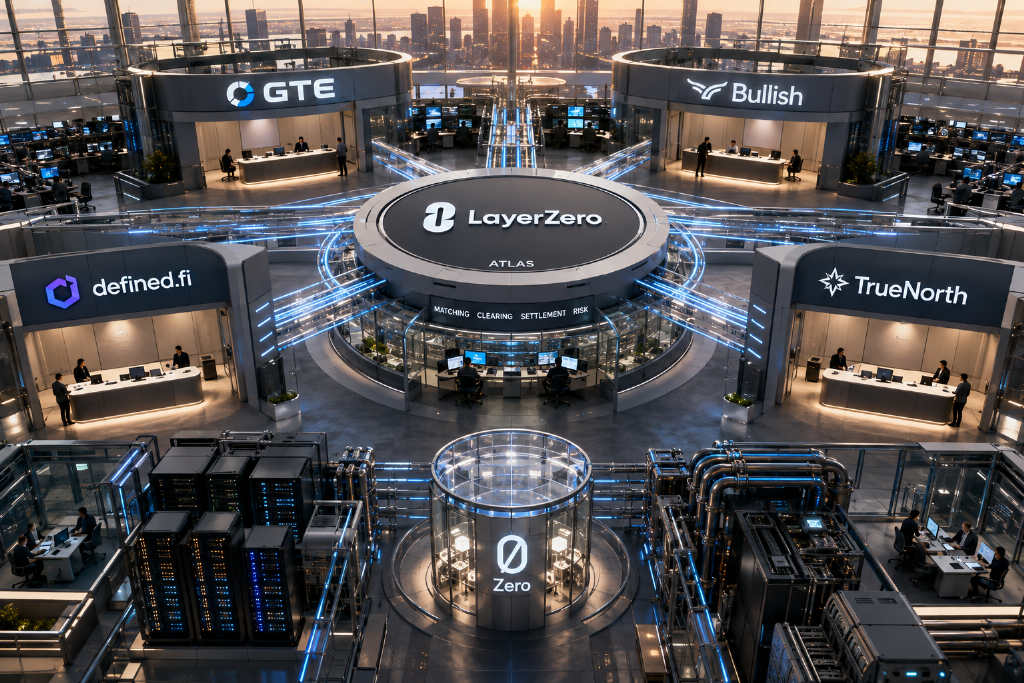
LayerZero has introduced ATLAS, short for Aggregated Trading Liquidity and Settlement, as a headless exchange engine built on Zero. Announced on Aug. 25, 2026, the system is designed to take over matching, clearing, settlement, and risk management, while exchanges, brokers, wallets, and other venues keep the customer relationship and distribution layer. LayerZero said ATLAS is scheduled to launch later in 2026. The model also rewires fee distribution. Open ATLAS venues can receive rebates ranging from 20% to 65% based on a mix of ZRO staking and total trading volume. After those rebates, 25% of the remaining fees go to market creators and 75% is used to buy and burn ZRO. Based on the structure disclosed so far, Alea Research said ZRO’s effective capture of gross fees would range from 26.25% to 60%, depending on venue rebates. LayerZero said early Open ATLAS venues include GTE, Bullish, defined.fi, and TrueNorth. The company also reported a 965-microsecond median latency for perpetuals, with p95 latency of 1.418 milliseconds and p99 latency of 2.641 milliseconds in a simulated public deployment environment. ATLAS is set to be configured for 200,000 transactions per second at launch, with each trade verified on-chain through zero-knowledge proofs.

00
LayerZero unveils ATLAS, a headless exchange engine that pushes trading venues to the front end
a16z Crypto
2026-09-03 06:06:08

a16z Crypto Says Finance Needs More Than Throughput From Blockchains

a16z Crypto argues that higher throughput alone no longer answers the central question for blockchains targeting financial markets. As trading, stablecoin issuance, and tokenized assets move on-chain, financial institutions need networks that can deliver predictable execution, resilient transaction access, clear ordering rules, and pre-trade privacy. The piece says recent infrastructure upgrades have eased earlier limits around congestion, cost, and transaction capacity, with some commercial networks now processing tens of thousands of transactions per second. That progress shifts the conversation away from raw speed and toward whether blockchains can meet the operational standards expected in real markets. The article focuses on three requirements. First, compliant transactions must have reliable paths into the chain without a single operator controlling access. Second, transaction ordering must follow rules that participants can understand in advance, rather than discretionary decisions by block builders that can open the door to MEV and information asymmetry. Third, sensitive order information should remain protected before execution, even if post-trade disclosure varies by market structure. In a16z Crypto’s view, blockchains are closer to supporting financial markets than before, but only if they pair performance with execution certainty, ordering discipline, and privacy protections that hold up under stress.

00
a16z Crypto Says Finance Needs More Than Throughput From Blockchains
nonfarm payro
2026-09-03 06:15:08

August payrolls may shift September rate odds, but inflation still holds the Fed’s center of gravity

The U.S. Bureau of Labor Statistics is set to release the August nonfarm payrolls report on Sept. 4 at 8:30 a.m. Eastern Time, the last full employment report before the Federal Reserve’s Sept. 15-16 policy meeting. Expectations cited in the source put job growth at about 58,000, with a Reuters median at roughly 56,000 and the unemployment rate seen holding at 4.1%. That would amount to only a modest rebound after July payrolls unexpectedly fell by 23,000 and May and June were revised down by a combined 103,000. The report arrives in a policy setting that looks very different from the old “bad news is good news” playbook. Inflation remains above the Fed’s 2% long-run target, while higher energy prices and supply-chain pressure have added fresh upside risks. TradingKey author Yulia Zeng argues the market is not looking for the weakest possible labor print, but for orderly cooling: slower hiring, a steady jobless rate and easing wage pressure. In that setup, payrolls could change how urgent a September move looks, but not settle the direction of policy on their own. That call may depend on whether wage data and the Aug. CPI report, due Sept. 11, cool alongside employment.

00
August payrolls may shift September rate odds, but inflation still holds the Fed’s center of gravity
U.S. Treasury
2026-09-03 05:56:14

Bloomberg Strategist Says U.S. Treasury Is Becoming a “Shadow Central Bank”

U.S. Treasury bill financing is expanding in a way that is making the Treasury look increasingly like a money issuer and pulling it deeper into Federal Reserve territory, according to Bloomberg macro strategist Simon White. White said on Sept. 2 that the shift is structurally inflationary, weakens the Fed’s policy independence, and raises risks for market stability as well as real returns on stocks and bonds. He pointed to Treasury bills making up 22.7% of outstanding U.S. debt, or 24.1% excluding the Fed’s holdings, above the Treasury’s informal 20% cap. White argued that as fiscal deficits widen, policy rates will no longer be only a monetary-policy tool; they will also become a key anchor for fiscal stability. In his view, that creates a growing conflict for the Fed, since higher rates would lift the government’s funding costs and effectively tighten fiscal policy at the same time. White also said Treasury bills are increasingly acting like “shadow money” in the repo system, where their near-zero haircuts and repeated rehypothecation allow them to behave more like liquidity for final settlement than a standard short-term funding instrument. He said that dynamic expands the supply of quasi-money and may contribute to broader price pressures over time.

00
Bloomberg Strategist Says U.S. Treasury Is Becoming a “Shadow Central Bank”
Arc
2026-09-03 06:00:37

Arc’s Sept. 16 mainnet debut sets up a first-day fight between meme launches and DeFi liquidity

Circle is set to open the public mainnet of Arc on Sept. 16, introducing a Layer 1 network built around stablecoin-based finance with USDC used for gas and sub-second final settlement. The network, maintained by a permissioned validator set, arrives with backing from 11 founding validators including BlackRock, DTCC, Galaxy, ICE, Mastercard, Standard Chartered and Visa. Circle has also said more than 100 institutions and ecosystem teams are already involved while the chain remains in its private mainnet phase. Attention is now shifting to where the first wave of onchain activity will land. Fomo has said it will support trading on day one, while edgeX plans to launch a 24-hour USD/JPY FX perpetual and more than 150 perpetual markets covering U.S. equities, commodities and crypto, all margined and settled in native USDC. Circle also expects Aave, Uniswap, Aerodrome, Morpho and several capital service firms to be live around launch, though Aave V4 on Arc still requires governance approval. At the same time, meme infrastructure is already taking shape. Projects such as Tolly, Warp and Arcpad are competing for token issuance flow, each with different mechanisms for pricing, LP ownership and fee distribution. With USDC acting as both gas token and quote asset, Arc’s launch could send initial funds into meme pools, stablecoin pools and lending markets at the same time, making Sept. 16 the first real test of how the network’s liquidity will form.

00
Arc’s Sept. 16 mainnet debut sets up a first-day fight between meme launches and DeFi liquidity