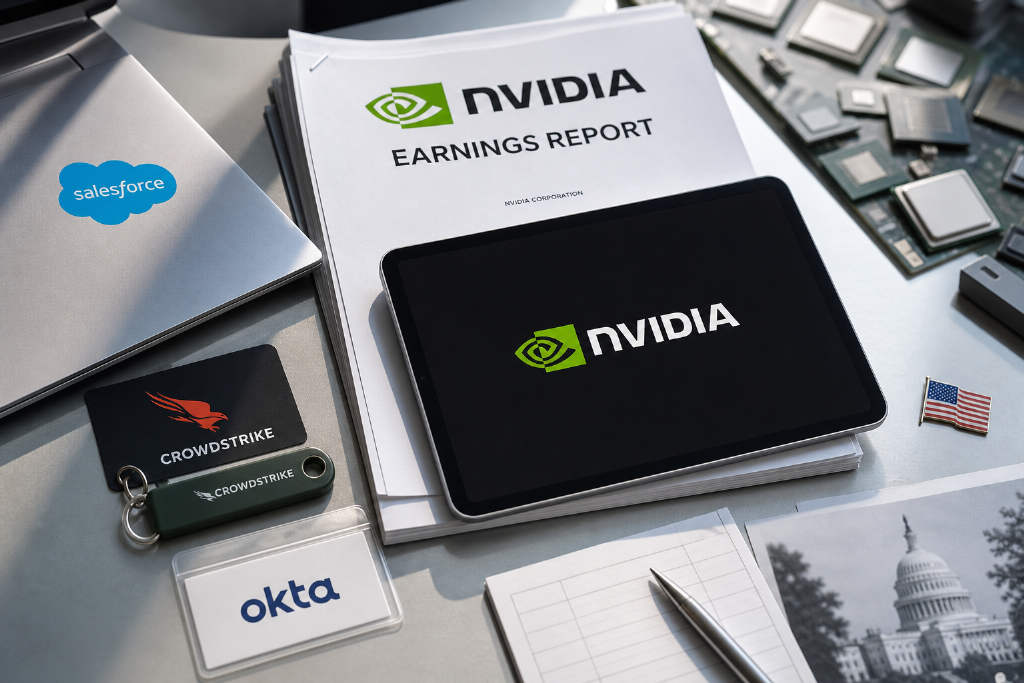
Tom Lee2026-08-30 04:23:44Tom Lee Says Nvidia’s Post-Earnings Gain Breaks a Longstanding PatternBitMine Chairman Tom Lee said on CNBC that Nvidia’s strong earnings drove the stock higher, breaking a pattern in which upbeat results did not necessarily move the share price. He said the move suggests investors still care about fundamentals. He also pointed to strength in Salesforce, CrowdStrike and Okta, which he said showed a positive market response to AI downstream trades. Tom Lee said weakness in Meta, Amazon, Alphabet, AMD and Micron may reflect investors selling other tech stocks to fund Nvidia purchases. He added that Nvidia’s earnings expectations have been raised sharply, while the share price has not fully caught up and its valuation remains low as the P/E ratio keeps contracting. Separately, he said data-center construction is becoming a political issue in the U.S. midterm elections, with some Republican-led states and states that support data centers now considering pauses on related projects.1020
Morgan Stanle2026-08-18 08:32:35Morgan Stanley says Workday buyout talk points to a software sector cheap enough for PE againMorgan Stanley said in an Aug. 16 software note that reported talks between Silver Lake and Workday may be sending a broader valuation signal across software. Workday, a global leader in human capital management and financial management software with a market capitalization of about $50 billion, could become one of the largest software take-private deals in recent years if a transaction is completed. According to Morgan Stanley analyst Adam Wood, even with a 30% to 40% takeover premium, the valuation would still be only about 5x 2027 sales and roughly 16x 2027 free cash flow, both below historical averages. The bank argued that this matters beyond a single company. It said software take-private activity has been sparse over the past year as tighter credit and ongoing debate around AI weighed on confidence. Morgan Stanley also pointed to a separate trend in AI pricing, saying open-weight models are pressuring token prices but may not destroy returns for hyperscalers, which could still generate about 20% to 60% ROIC on owned compute under lower-price assumptions. Investor sentiment in software remains divided, based on a survey of more than 150 investors, though bullish respondents still outnumbered bearish ones. The report also highlighted concerns over Netcompany’s cash flow quality and examined SpaceX’s $60 billion all-stock acquisition of Cursor as another signal in software and AI infrastructure valuation.550
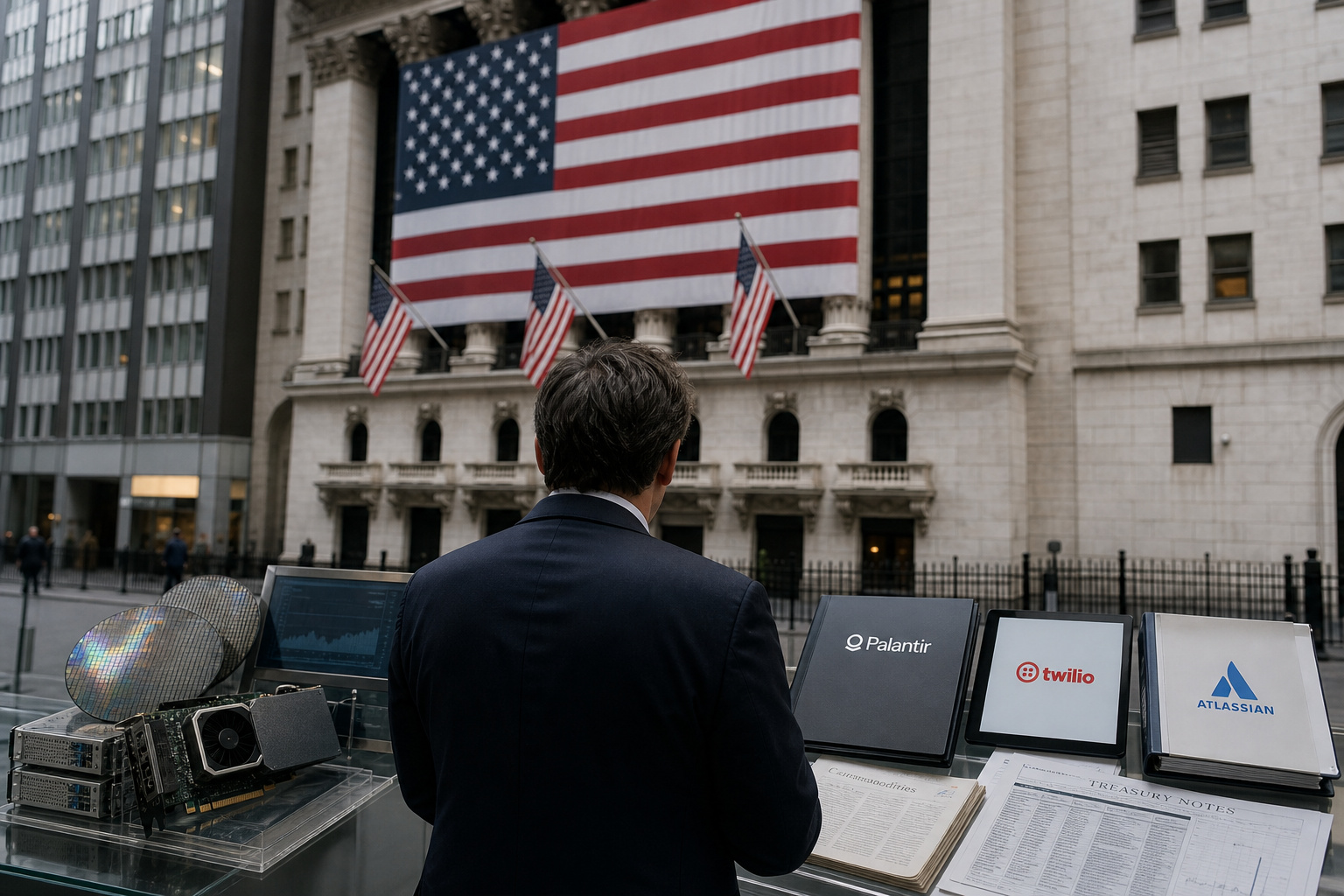
Goldman Sachs2026-08-12 06:58:46Goldman Sachs' Peter Callahan Says Software AI Narrative Is ShiftingGoldman Sachs' TMT trading specialist Peter Callahan said on August 12 that the AI narrative within the software sector is shifting after the latest earnings season. While the market previously feared generative AI would erode traditional software companies' moats, data infrastructure and developer tools companies are now seeing the pendulum swing from "AI headwinds" to "AI tailwinds." Firms including Cloudflare, Palantir, Datadog, Twilio, and Atlassian have drawn more attention, while traditional SaaS application vendors still need to prove they can establish a similarly clear AI-beneficiary logic. Callahan attributed the change to AI commercialization extending from model training into inference, agents, and automation applications. Cloudflare disclosed that non-human traffic has surpassed human traffic and projected that machine-generated web requests will keep growing rapidly if current trends hold. The implication is that AI is not necessarily just a replacement for software companies; platforms carrying data, APIs, web traffic, security, and developer tools may see growing agent counts and call frequencies become new demand sources. The software sector is now showing clear divergence: whether AI is a tailwind increasingly depends on whether a company sits in the application or infrastructure layer, and whether it can directly monetize AI-related traffic growth. (Source: BlockBeats, Jinshi)2090
U.S. stocks2026-08-11 10:45:58TMT Breakout says U.S. tech money is rotating from AI semis into softwareTMT Breakout said the key shift in the current U.S. tech rally is a repricing inside the AI trade, with capital starting to move away from crowded AI semiconductor names and toward software, internet, and cloud companies whose earnings are easier to verify after results. The report said the Nasdaq-100 ETF was down about 30 basis points on the day and trading volume continued to slow as the market moved into the later stage of earnings season, but that cooling has not happened evenly across tech. According to the report, investors are now looking again for companies where earnings growth is accelerating, the narrative is improving, and valuations have already pulled back. It cited PLTR, TWLO, and TEAM as software names that continued to attract buyers after earnings, showing that the market is willing to reprice more predictable growth. By contrast, follow-through in AI semiconductors has been weaker, and even companies with decent results or guidance have struggled to keep drawing incremental capital. TMT Breakout also pointed to a macro backdrop of higher oil prices, rising Treasury yields, and renewed sensitivity to inflation and rates, saying companies that can show cash flow, orders, or demand evidence after earnings are in a better position to hold investor attention.1920
Microsoft2026-07-30 11:40:28Microsoft’s capex reset wins over the market, while Meta’s spending surge eats into cash flowWhiteLine Daily, published by WuBlockchain, argues that Microsoft has not actually reduced spending, even though its 2026 capital expenditure figure appears lower. The drop mainly comes from an accounting change: the company extended the estimated useful life of data centers and office buildings from 15 years to 25 years, which shifts more future data center leases from finance leases to operating leases. Because finance leases count toward capex and operating leases do not, Microsoft’s 2026 capex figure moved from about $190 billion to $175 billion, while management still said actual investment plans were unchanged and FY2027 capex would continue to rise year over year. The report says investors are willing, for now, to accept that explanation because Microsoft’s earnings release came with supporting numbers. Azure grew 43%, next-quarter guidance was about 45%, commercial RPO reached $678 billion, Copilot paid seats topped 30 million, quarterly operating cash flow was $55.4 billion, and free cash flow came in at $19.6 billion. At the same time, the piece notes that not all RPO converts into near-term revenue and that Microsoft’s cloud gross margin fell to 65%. Meta, by contrast, still posted healthy ad growth, but much of its cash generation was absorbed by capex and rising costs. WhiteLine Daily says that in a high-rate environment, the near-term AI trade still looks more like sector rotation than a broad new bull run.1750
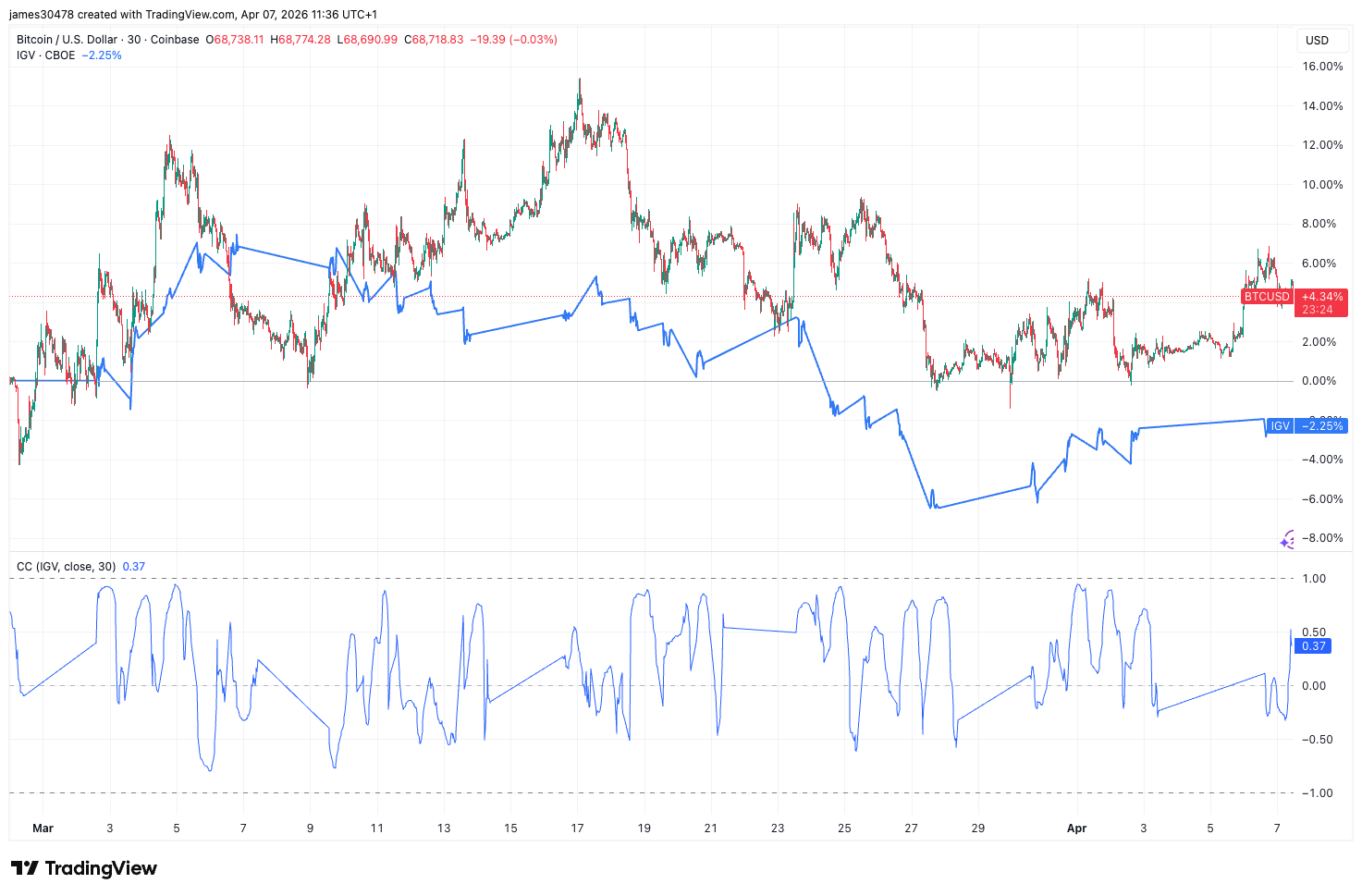
Bitcoin2026-07-24 10:20:15Bitcoin Slips Toward $71,000 as Software Stocks Rally and Correlation WobblesBitcoin fell nearly 2% to around $71,400 after the U.S. open, while software stocks extended gains. Traders are watching whether the recent break in bitcoin’s correlation with the software sector will persist.550
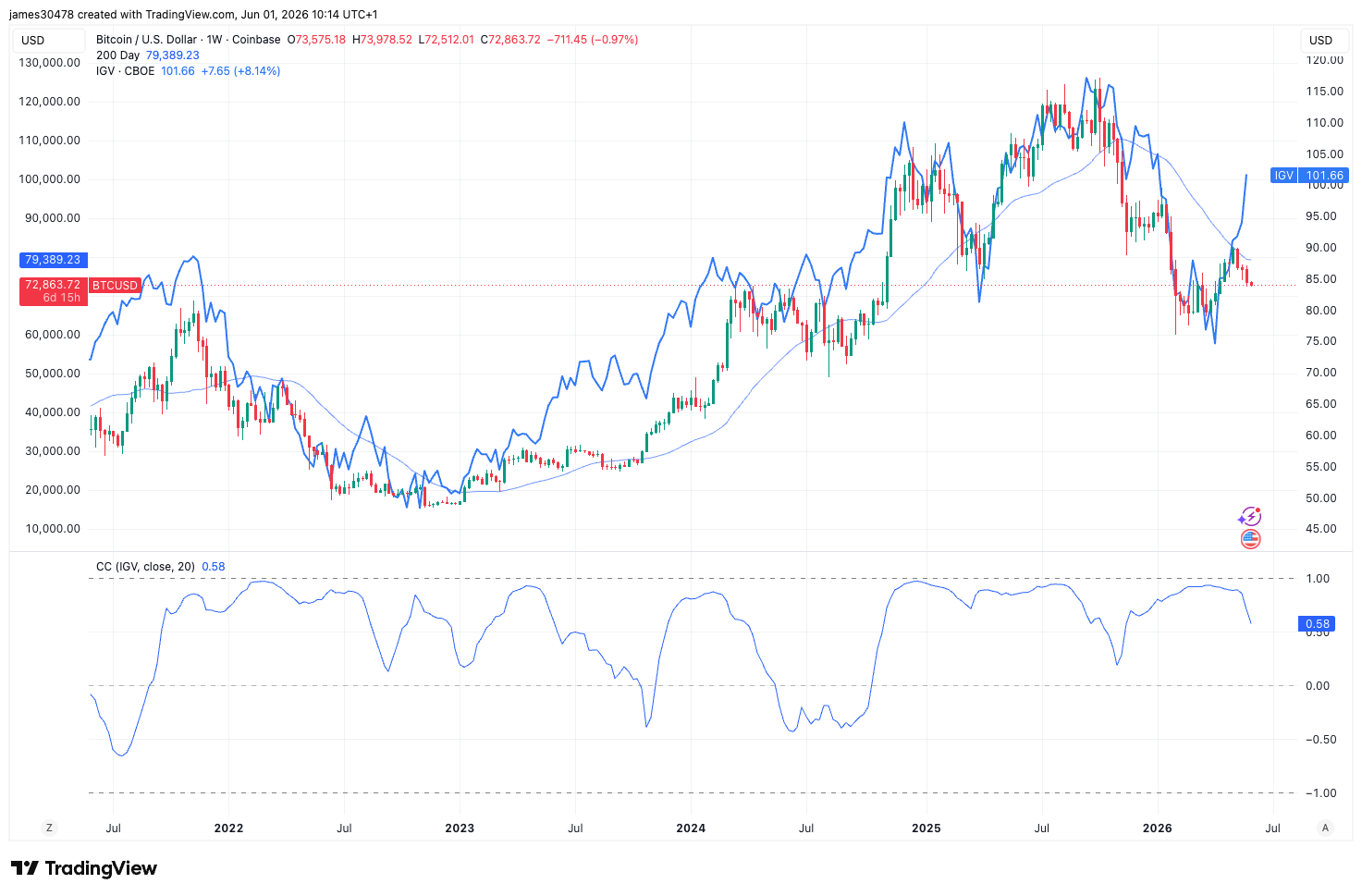
Bitcoin2026-07-24 10:20:15Bitcoin and Software Stocks Decouple: History Suggests Major Crypto Rally AheadThe 20-day rolling correlation between Bitcoin and the IGV software ETF dropped to 0.58, a low not seen since 2023 and 2024. Both prior instances preceded massive Bitcoin rallies. IGV has reclaimed its 200-day moving average while Bitcoin remains well below it.620
Bitcoin2026-07-24 09:20:17Bitcoin Breaks From Software Stocks After Iran War, Correlation Briefly Falls to 0.13Since Feb. 28, bitcoin has risen more than 5% and climbed back above $69,000, while software ETF IGV has dropped over 2%. Their correlation briefly fell from nearly 1.0 to 0.13.220