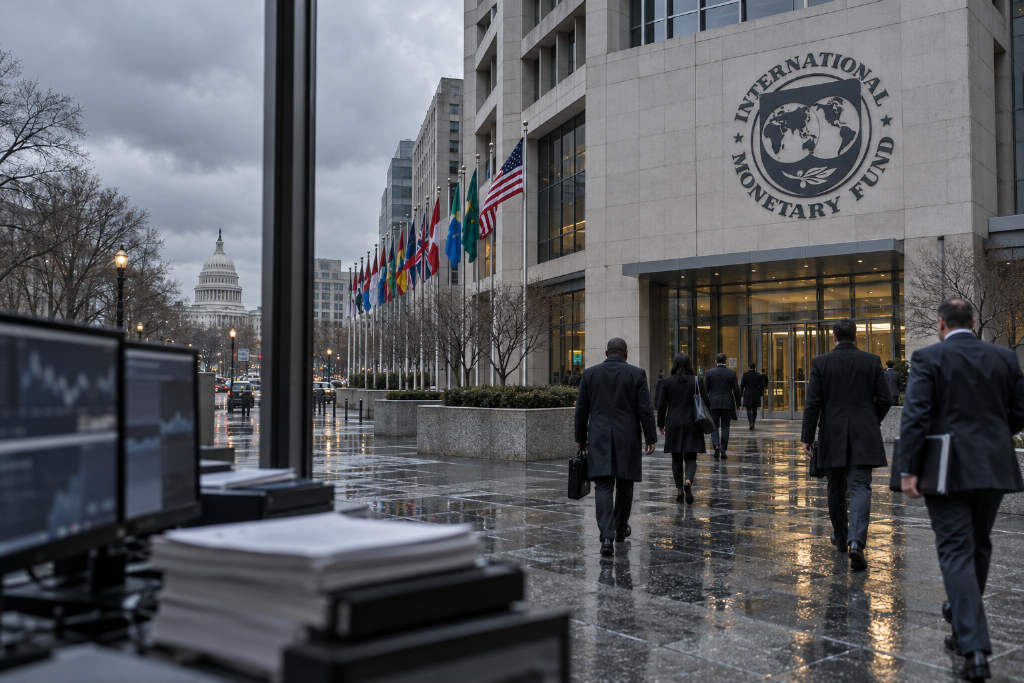
IMF2026-10-06 14:25:46IMF warns fast-growing hedge funds could pose risks to macro-financial stabilityThe International Monetary Fund said in its Global Financial Stability Report that hedge funds should be watched more closely for their potential impact on macro-financial stability. According to the IMF, the rapid growth in global hedge fund assets could amplify price dislocations and liquidity strains. In severe negative shocks, those pressures could escalate into broader systemic risk. The fund said regulators should respond by improving data collection, strengthening risk monitoring, and putting prudent supervisory measures in place. The comments were cited by ChainCatcher in a brief report published on Oct. 6.20
IMF2026-10-09 01:32:23IMF warns tokenized markets could amplify liquidity stress as tokenized stocks show weaker trading depthThe International Monetary Fund said in a new analysis that tokenized finance is expanding quickly but still faces three core constraints: weak liquidity, poor interoperability, and incomplete regulatory frameworks. As tokenized assets grow and become more connected to traditional finance, the IMF said existing vulnerabilities could be magnified, including fire sales, liquidity runs, and broader contagion. The fund said tokenized real-world assets had about $65 billion in outstanding value as of July this year, less than 0.02% of the roughly $300 trillion global capital market universe. Within that total, tokenized credit accounted for $30.4 billion, money market funds for $17.5 billion, and tokenized equities for about $2.3 billion. Tokenized repos posted the largest trading volumes at roughly $300 billion to $350 billion a day, though that still represented only about 2.5% of the roughly $13 trillion daily U.S. repo market. The IMF also found that tokenized stocks, while popular for 24/7 access and fractional ownership, were markedly less liquid than their traditional counterparts. More than half of trading took place outside regular U.S. stock market hours, around 80% of trades involved less than one share, and realized volatility was about 1.5 times that of the corresponding traditional assets.20
Verda2026-10-01 13:59:17Verda says stablecoin liquidity in Latin America is concentrated among 16 firmsBlockchain data analytics firm Verda said in a report that stablecoin liquidity in Latin America is heavily concentrated in the hands of a small group of institutions. According to the report, the region’s stablecoin liquidity depends on just 16 companies. Verda said that level of concentration could create systemic risk for the regional financial ecosystem and leave it exposed to potential instability. The report also said excessive concentration makes the broader system especially vulnerable if any of those key participants faces a risk event. The item was cited by Crypto Briefing and republished by Techub.260
BIS2026-10-01 12:36:47BIS says 73% of circular AI investment ties come from computer and cloud infrastructure firmsThe Bank for International Settlements said in a new report that 73% of circular investment relationships in artificial intelligence are tied to computer and cloud infrastructure companies. According to the report, these arrangements can help secure scarce inputs and reduce information gaps between participants. At the same time, the BIS warned that such structures may add opacity and create macro-financial risks. The report also said that tightly connected cross-investment networks could amplify systemic risk. The findings point to the concentration of AI-related investment links in a narrow part of the technology stack while highlighting the trade-off between access to critical resources and broader financial stability concerns.240
Sky Ecosystem2026-09-30 10:47:08Sky Ecosystem’s USDS Supply Tops $10 BillionUSDS, the stablecoin issued under the Sky Ecosystem, has surpassed $10 billion in total supply after adding $237 million over the past week. The update, cited by Techub News from Crypto Briefing, points to rising institutional integration in the DeFi sector as a driver behind the increase. At the same time, the analysis flagged a key risk: reliance on major partners could expose the stablecoin to broader systemic vulnerabilities. The move puts USDS above the $10 billion mark, a notable threshold for a DeFi-linked stablecoin, while keeping attention on the concentration risks tied to its growth model.350
AI2026-09-26 06:59:14Columbia Business School report says AI data centers need $3.7 trillion in revenue to justify spendingA report from Columbia Business School says the economics behind artificial intelligence infrastructure carry unusually large revenue demands. According to the report, that scale highlights potential systemic risk and points to a broader economic transition tied to the buildout of AI capacity. The study says AI data centers would need to generate a combined $3.7 trillion in revenue to support their heavy capital expenditure commitments. It also argues that the sector must deliver rapid growth while adapting to infrastructure requirements. The report was cited by Crypto Briefing and relayed by Techub News.270
Federal Reser2026-09-25 20:45:33Fed Governor Michelle Schmid says AI ecosystem may need too-big-to-fail assessmentFederal Reserve Governor Michelle Schmid said regulators need to assess whether the artificial intelligence ecosystem has grown large enough to be considered "too big to fail." Her remarks focused on the expanding use of AI across the financial system and the need for supervisors to understand the risks that could come with that shift. Schmid said that as AI becomes more deeply integrated into financial activities, regulators must examine its potential systemic risk rather than treat it as a narrow technology issue. She also stressed that understanding the size of the AI ecosystem and the degree of interconnection within it is critical for safeguarding financial stability. The comments point to a regulatory concern that AI may become important not just as a tool used by financial firms, but as a connected ecosystem whose scale could matter for the broader system.250
Bridgewater A2026-09-20 13:09:01Bridgewater’s Greg Jensen says AI compute giants should face too-big-to-fail bank-style oversightBridgewater Associates Co-Chief Investment Officer Greg Jensen said major AI compute companies should be regulated like banks deemed too big to fail, arguing that such oversight would help guard against systemic risk. At the same time, he acknowledged a trade-off: tighter rules could restrain innovation and slow the growth of leading firms. The remarks were cited by Techub News, which referenced Crypto Briefing. The brief item did not include additional details on which companies Jensen had in mind or what specific regulatory framework he was proposing. It focused on the central comparison between concentrated AI compute power and financial institutions whose failure could pose wider risks. Jensen’s comments, as presented in the report, frame AI infrastructure leaders as entities whose scale may justify closer scrutiny, while also recognizing that heavier regulation can carry costs for competition and expansion.370