AI Startups2026-09-08 09:24:11Nine AI startups reportedly hit unicorn status within months as investors price founders before productsMarsBit, citing a report from the WeChat account IT Juzi, said at least nine AI startups in China and overseas had crossed the unicorn threshold within six months of being founded as of early September 2026. The list spans China’s Yuyong Technology, Kunlunxing Robotics, AGILINK and Naive.ai, as well as River AI, Hark, AMI Labs, Recursive Superintelligence and Atoms abroad. The report argues that many of these companies were funded before products, revenue or commercial validation were in place, with capital instead assigning value to founder track records, technical direction and ecosystem positioning. Cases highlighted include Yuyong Technology reaching an about $2 billion valuation roughly three months after registration, AGILINK becoming the only company in the group already generating revenue, AMI Labs raising what the report described as Europe’s largest seed round, and River AI securing $1.1 billion within about two months of surfacing. The piece says the current market is rewarding scarcity first and waiting for proof later, while warning that delivery risk, ecosystem dependence and lofty expectations could make the next 12 to 24 months decisive for these companies.820
ByteDance2026-09-08 01:15:36Bloomberg: ByteDance is building a real-time spatial video model under Zhang Yiming’s oversightByteDance is developing a real-time spatial video model that could be released as early as October, according to Bloomberg, which cited people familiar with the matter. The report said founder Zhang Yiming is personally overseeing the effort. Built on Seedance, the model is designed to generate content while responding to a user’s voice and movements, creating an interactive virtual world in real time. ByteDance plans to pair the system with Pico headsets. People familiar with the matter said the model can generate content in the cloud at roughly 20 frames per second, with latency of about 0.05 seconds. Shifting most of the computing workload to the cloud would reduce the processing demands on the headset itself. The report added that ByteDance is not treating world models as a new direction. Chinese outlet 36Kr reported in June that world models are one of ByteDance’s four major AI priorities for 2026, with a goal of releasing at least one version before year-end to benchmark against Google Genie 3. According to the report, Genie 3 can already generate 720p interactive worlds at 20–24 fps and run continuously for several minutes.740
Westlake Univ2026-09-07 12:19:10Code World Model splits simulation from rendering as Tim Sweeney joins the discussionResearchers from Westlake University AGI Lab and Nanyang Technological University have introduced Code World Model, a world-model framework that puts a language model-driven coding agent in charge of maintaining executable world state while a separate video model handles visual generation. The paper argues that current video world models are good at continuing observations, but that is not the same as running a world with goals, rules, memory, and long-range causal consequences. To bridge executable state and image generation, the team uses a proxy representation that carries frame-level spatial constraints and is rendered into proxy video before being fed into the video model together with structured text. The prototype uses MiniMax-H3 as the video backbone with rank-128 LoRA across 50 transformer blocks, totaling about 596 million trainable parameters. Training was run on 8 NVIDIA H800 GPUs for 3 epochs and 3,534 optimization steps. The gameplay dataset includes 157 recordings, about 5.6 hours of source video, and 9,420 training clips sampled every 2 seconds. Each RGB target contains 124 frames at 1344×768 and 24 FPS, with matching proxy sequences at 336×192. During inference, GPT-5.6 Sol acts as the coding agent and GPT Image 2 generates the appearance anchor. In online discussion around the work, a commenter speculated about future Unreal Engine versions, and Epic Games CEO Tim Sweeney replied: 「I don’t know either!」830
AIGC labeling2026-09-07 10:12:29One Year Into AIGC Labeling, Credit Layering Is Emerging as World Models Outpace Old RulesChina’s AIGC labeling regime has reached its first anniversary with enforcement now clearly in place. On Sept. 1, the Beijing Cyberspace Administration said 68 key companies had completed mutual recognition of visible and invisible labels, with 597 billion pieces of generated information marked on the production side and more than 800 million AI items carrying labels on the distribution side. At the same time, a new technical challenge is taking shape. Reports from Sept. 2 said Fei-Fei Li-backed World Labs had launched Atlas in San Francisco, a system that can turn six photos into a one-minute 1440p video and posted a 94% win rate over Seedance 2.5 in an official blind test under a specified camera-motion setup. The article argues that current regulation was built for earlier AIGC formats such as text and images, where visible tags and C2PA metadata still offer traceability, while world-model video may erode both watermark visibility and machine detection after editing and transcoding. It also maps four possible business layers forming around the new rule set: provenance infrastructure, compliance audits, credit scoring inside platforms, and verification tools for reading labels after the fact.970
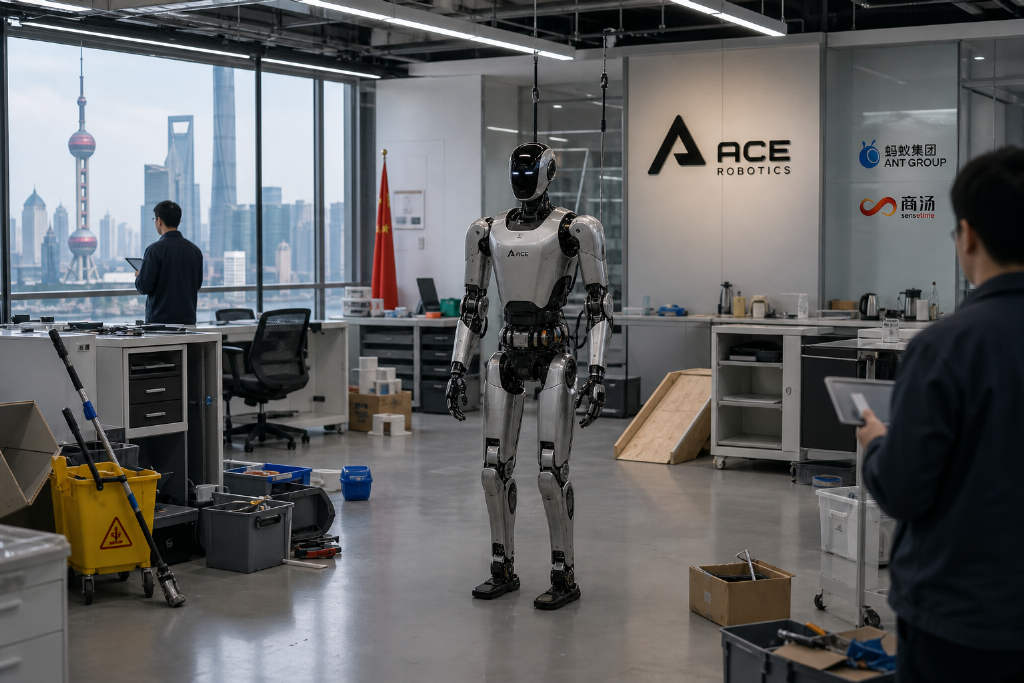
Embodied AI2026-08-23 14:33:24ACE Robotics chairman says embodied AI could hit a 'ChatGPT moment' by 2027Humanoid robots can already handle staged tasks such as walking, dancing, and boxing, but reliable work in messy real-world settings remains a major hurdle. ACE Robotics Chairman Wang Xiaogang told Reuters that embodied intelligence could reach its "ChatGPT moment" by the end of next year, with progress driven by world models and better environmental data capture. Founded in July 2025, the Chinese startup builds AI models for humanoid robots and is backed by Ant Group and SenseTime. It raised more than $100 million in the first half of 2026 and, according to Reuters, aims to seek an IPO as soon as regulations allow. Wang said the industry has accumulated only about 100,000 hours of data over the past few years, far too little to train embodied foundation models. Other groups are pursuing related work, including HumanoidExo, a wearable exoskeleton introduced in October to collect human motion data. Boston Dynamics and Alibaba have also rolled out new robot-focused AI systems this year.760
Inherent2026-08-23 02:52:14Inherent unveils Faraday, an AI scientist agent built on a 27B Qwen modelInherent, a London-based AI startup founded by several former Google DeepMind researchers, has introduced Faraday, a research agent designed to independently reproduce results from scientific papers. The company says Faraday outperformed OpenAI GPT-5.5 and Anthropic Claude Opus 4.8 in its Replica benchmark, even though the system is built on a much smaller 27-billion-parameter Qwen 3.6 model. Replica starts with 310 tasks drawn from 100 machine learning and AI for Science papers across fields including natural language processing, materials science, and weather forecasting. Instead of answering paper-related questions, the agent must recreate research figures under limited time and compute, without access to the original charts. Inherent says its larger aim is to train an AI Scientist, not just a tool for literature search. That includes teaching what the company calls “research taste” — deciding which questions matter, which experiments are worth running, and how to allocate limited resources. To pursue that, Inherent uses long-horizon reinforcement learning and human validation of its evaluation process. The startup recently emerged from stealth with a $50 million seed round and plans to expand its team to around 20 to 25 people by year-end, with world models also on its roadmap.1130
Goldman Sachs2026-08-22 15:29:58Goldman Sachs says AI is moving into execution, with competition shifting to workflows and world models gaining groundGoldman Sachs said its latest Silicon Valley field research points to a new phase for artificial intelligence: moving from systems that can answer questions to systems that can execute work. Based on meetings held on Aug. 18 and 19 with AI startups, venture capital firms, and researchers at Stanford University, the University of California, Berkeley, and the University of California, San Francisco, the bank said commercialization is moving away from seat-based subscriptions toward pricing tied to consumption, transaction volume, and outcomes. In that shift, agents are becoming workflow operators rather than support tools, while value is moving away from the model layer alone toward proprietary data, business context, and domain expertise. Goldman also said the main hurdle to enterprise deployment is increasingly about controllability and accountability rather than raw model capability. The report described a growing split between frontier and open-source models, with the former used for high-value, reliability-sensitive tasks and the latter for lower-cost, standardized workloads. It also said world models are drawing more attention than large language models in several research settings and could drive a new computing demand curve, with compute demand potentially rising about 24-fold over the next five years.490
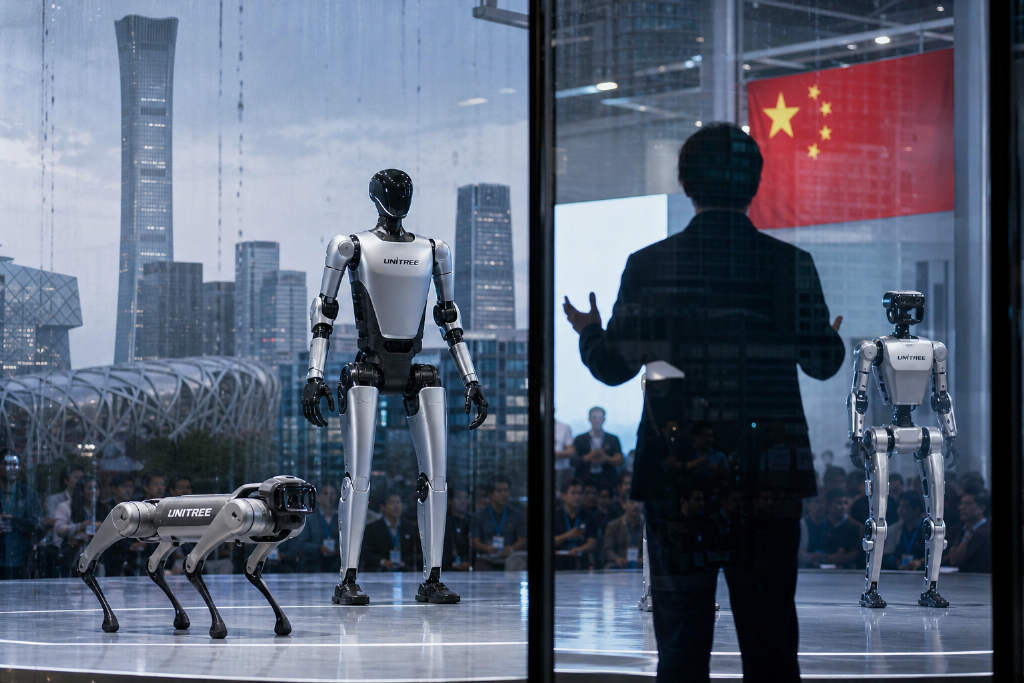
Unitree Robot2026-08-20 04:09:00Unitree founder Wang Xingxing says embodied AI could hit its ChatGPT moment in as little as two to three yearsWang Xingxing, founder of Unitree Robotics, said at the 2026 World Robot Conference that the biggest constraint on embodied intelligence is still weak generalization, and that the industry’s “ChatGPT moment” could arrive in as little as two to three years, or as long as five to ten years. Speaking a day after Unitree’s listing, Wang framed the next major milestone in simple terms: if a robot can be placed in a completely unfamiliar environment and complete roughly 80% of tasks through voice or language instructions alone, embodied AI will have crossed a key threshold. His speech also reviewed Unitree’s 10-year path from quadruped robots to humanoids and outlined a broad product lineup, including the G1 humanoid launched in 2024, the H1 platform, the GD01 mass-produced passenger-carrying transforming mech, the As2-W wheeled-quadruped robot, and the lightweight R1 humanoid. Wang said Unitree has been testing robots in auto factories and in its own facilities, but large-scale rollouts remain limited because robot efficiency and task transfer still lag. He also spent considerable time on data and model training, arguing that humanoid AI needs large volumes of human or internet data for pretraining, combined with real-robot data to align models with the physical world. Wang said the company is also exploring AI-driven self-improving robot development loops, where large models write control code, validate it in simulation, deploy it to physical machines, and refine it through model and human evaluation.1280