
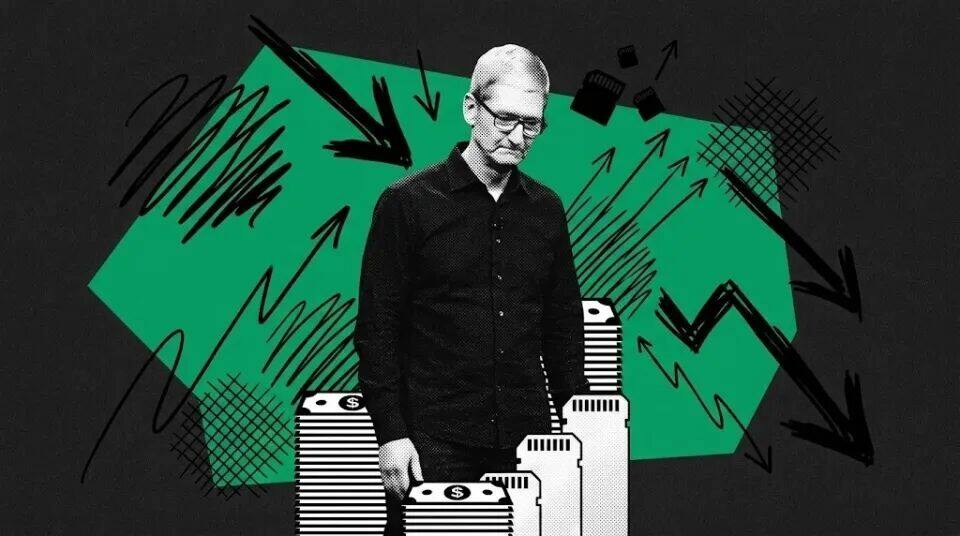
The Power Tilt: From $5 to $50
Have you ever wondered how the profit from each iPhone sale is distributed among component suppliers? A recent tweet by tech blogger @BluthCapital, voiced in the persona of Micron's CEO, went viral: 'For over a decade, Apple bought chips from us at $5, put them in a metal box, and sold them for $99. When we tried to raise the price to $7, they mocked us. Now, when we charge $50, Apple raises the product price by $250.' The tweet was accompanied by a cost structure chart for the hypothetical iPhone 18, illustrating the profit allocation.
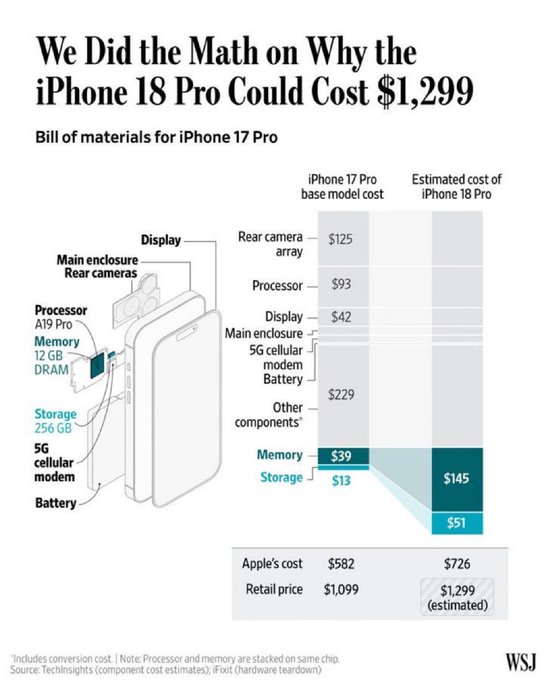
Earlier, Micron's Chief Commercial Officer Sumit Sadana told The Wall Street Journal that during memory industry downturns, some customers took advantage to depress prices, causing negative margins for suppliers. Now, the AI boom has given memory makers the upper hand. As the Chinese saying goes, 'Thirty years east of the river, thirty years west.'
Profit Bill Breakdown: Apple Takes 25%, Memory Giants Only 3.3%
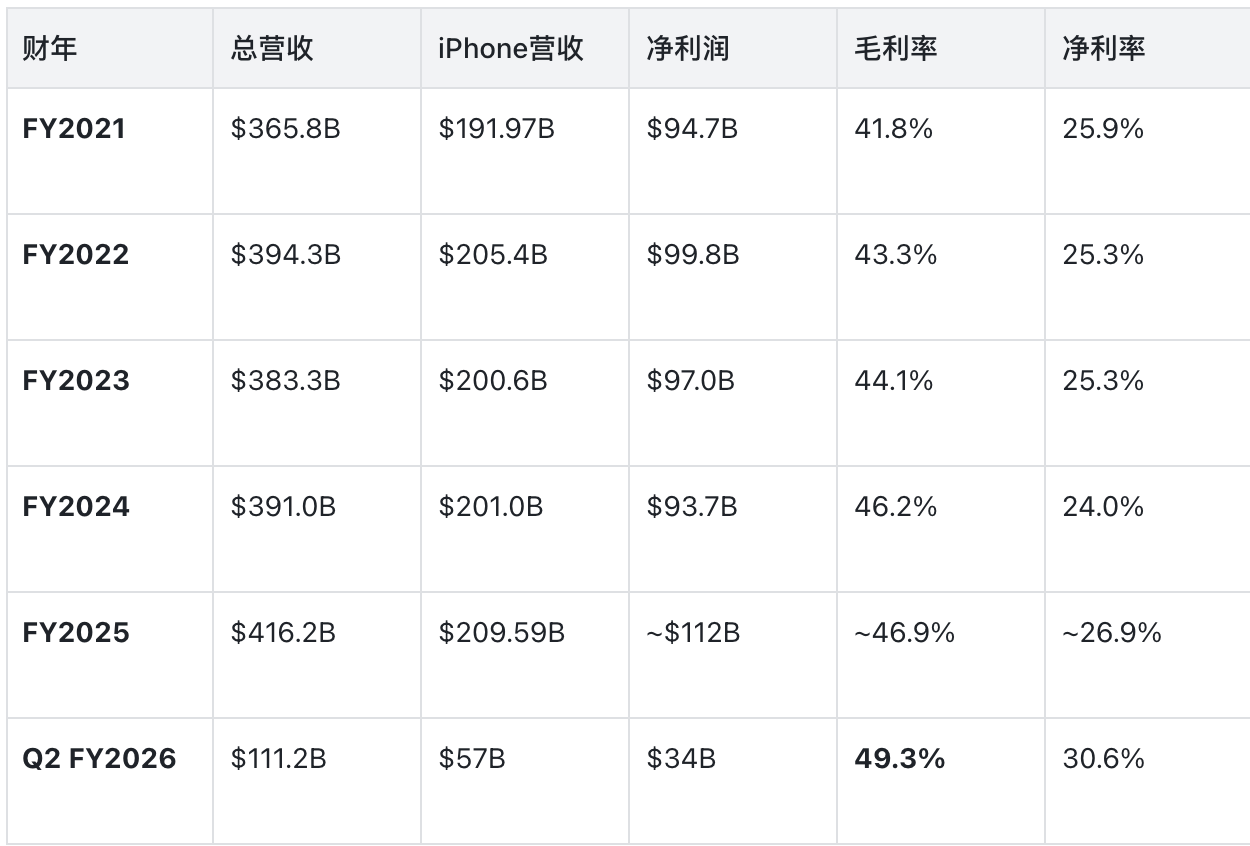
Estimates show that for each iPhone, Apple captures about one-quarter (≈25%) of the total profit, while memory giants (Micron, Samsung, SK Hynix) get only about one-thirtieth (≈3.3%). TSMC, due to its monopoly, takes 4%–5%. The remainder goes to other hardware suppliers, distribution, R&D, and taxes. Counterpoint data indicates Apple has consistently captured nearly 50% of global smartphone operating profits. In 2025, IDC reported that Apple, with 18% market share, took about 75% of the industry's total profit.
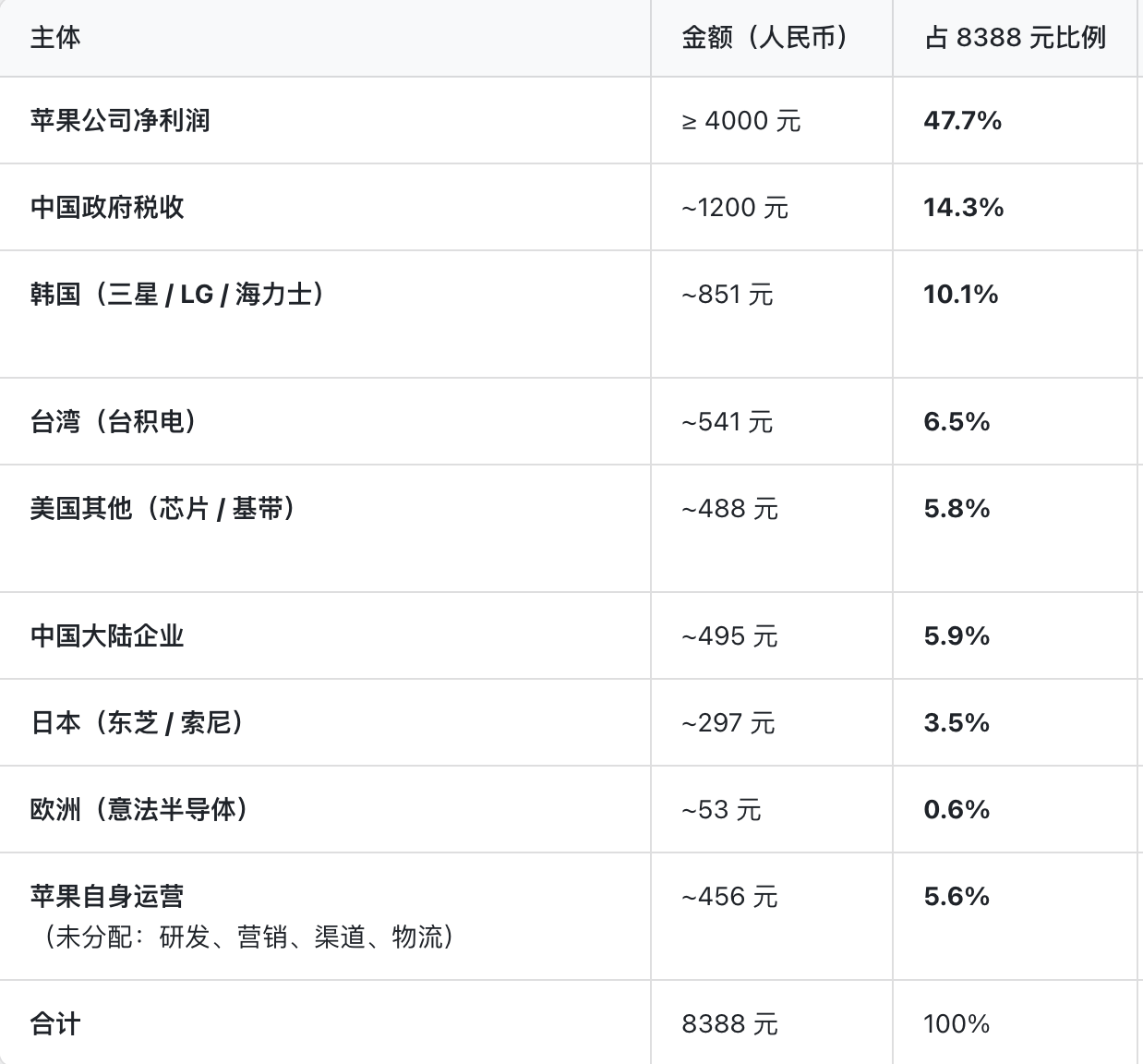
Based on Apple's Q2 2026 results, iPhone revenue was $57 billion, net profit $34 billion, with estimated shipments of 61 million units. That yields a net profit per iPhone of $320–340, a net margin of 33%–36%. Over the past five years, iPhone revenue has remained stable, while net profit grew from ~$94 billion in 2021 to ~$112 billion in 2025, with net margins around 25%. However, soaring memory costs are beginning to reshape this profit structure.
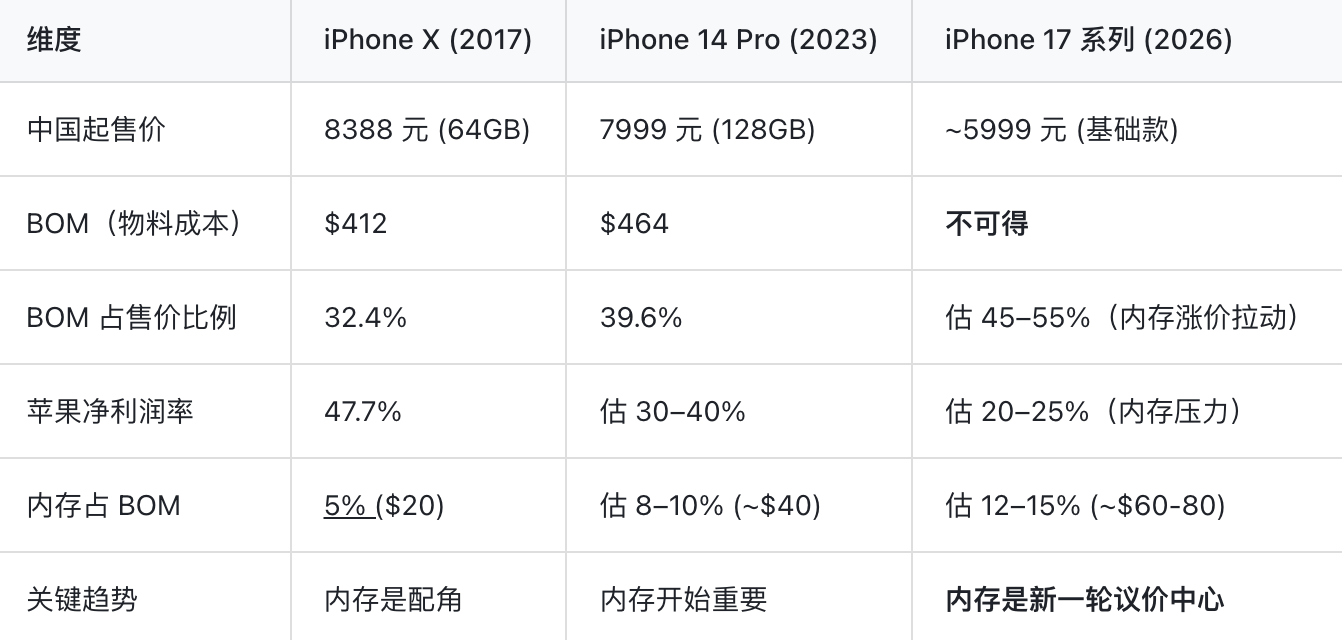
The Evolution of Memory: From 'Afterthought' to 'Critical Component'
The role of memory cost in iPhones has gone through three phases: initially an afterthought, then an important component, and now a critical part. For the iPhone X (2017), Apple's net profit margin approached 50%, while memory suppliers (Samsung, SK Hynix) earned only about 135–195 RMB per unit, or 1.6%–2.3% of the retail price of 8,388 RMB. Memory cost accounted for just ~2% of BOM, making it Apple's least concern.
By 2023, the iPhone 14 Pro's BOM cost had climbed to ~$464 (≈3,170 RMB), about 40% of the selling price, yet Apple's net margin remained ~40%. Memory's share began to rise. At that time, camera and processor price increases caused overall profit to drop 3.7% compared to the iPhone 13 Pro. Entering 2025–2026, memory cost for the iPhone 17 series jumped to 12%–15% of BOM, or $60–80. TrendForce data shows that in Q1 2026, general DRAM contract prices surged 93%–98% quarter-on-quarter, and Citi expects full-year DRAM average price growth of 88%. Memory has transformed from a trivial cost to a decisive factor in product pricing.
AI-Driven Memory Boom Forces Apple to Raise Prices Across the Board
Industry estimates suggest each AI server requires 8 times the DRAM and 3 times the NAND of a general server. Memory giants (Samsung, SK Hynix, Micron) have shifted advanced manufacturing capacity to high-margin HBM and high-end DDR5, cutting back on consumer-grade lines, leading to a shortage of general-purpose DRAM. Micron's Q3 report showed a stunning gross margin of 84.6% and revenue growth of 346% to $41.46 billion. SK Hynix recently announced plans for a U.S. IPO, seeking to raise ~$29 billion. One Nvidia Vera Rubin AI server uses as much memory as ~14,500 MacBook Neo units—a stark illustration of supply-demand imbalance.

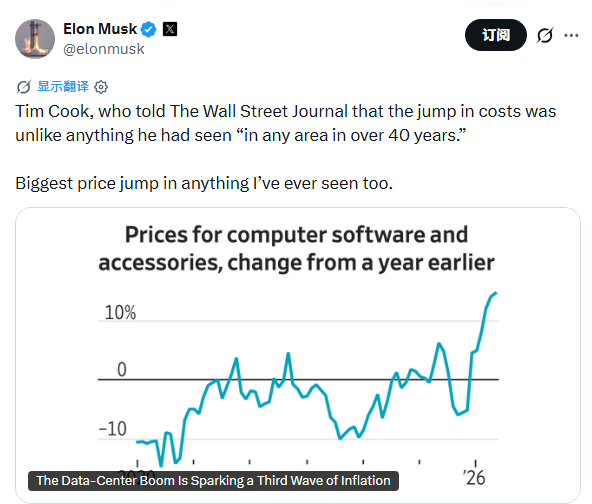
On June 17, Apple CEO Tim Cook (set to step down in September) told The Wall Street Journal, 'Memory suppliers are passing on huge price pressure. We need memory pricing and supply to return to reasonable levels for consumer products.' But less than a week later, Cook changed his tune, calling the cost shock a 'once-in-a-century flood' and announcing price hikes across Mac, iPad, HomePod, Apple TV, and Vision Pro. Apple shares fell 6% that day, erasing $263 billion in market cap—the biggest drop since April 2025. Elon Musk echoed Cook's sentiment, tweeting, 'This is the most violent price jump I've ever seen.'

Breaking the Oligopoly? Apple Eyes CXMT
Facing the triopoly of Samsung, SK Hynix, and Micron, Apple is exploring alternative suppliers. Reports indicate Apple is actively lobbying the Trump administration for approval to source memory chips from Chinese manufacturer ChangXin Memory Technologies (CXMT). CXMT is set to go public next month, and securing Apple as a customer would be a game-changer for its global standing. Whether Apple can successfully break the oligopoly, and whether the memory pie continues to grow, remains to be seen. The game of 'the customer is too big to be bullied' or 'the supplier is too big to be bullied' is far from over.