
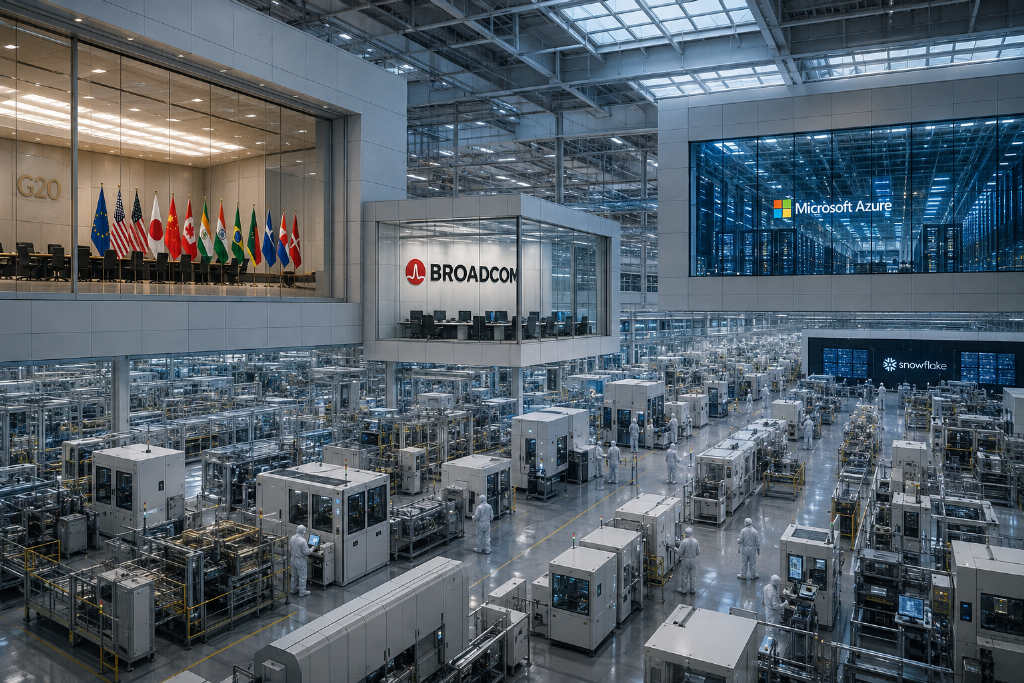
WuBlockchain's WhiteLine Daily focused its latest edition on new signals from Broadcom, Microsoft, Snowflake and the G20, arguing that AI capital spending is still expanding while the yardsticks for measuring returns are becoming more concrete.
Broadcom raises its AI chip revenue forecast
Broadcom reported FY2026 third-quarter revenue of $29.59 billion in results released early on Sept. 3 Beijing time, up 86% from a year earlier. AI semiconductor revenue came in at $16.7 billion, up 221% year over year and 54% quarter over quarter. The company said fourth-quarter AI semiconductor revenue is expected to climb to $21.7 billion.
Broadcom also raised its FY2027 AI chip revenue outlook to about $115 billion from a previous forecast of more than $100 billion. For FY2028, it said that figure could roughly double again to about $230 billion. CEO Hock Tan said the company has already secured enough supply to support that demand.
According to the report, Broadcom's custom AI accelerators are already being used by major customers including Google, Meta and OpenAI. Reuters said that as large technology companies keep increasing investment in AI infrastructure, in-house ASICs are becoming a more important compute path alongside Nvidia GPUs.
WhiteLine Daily said the higher FY2027 forecast suggests that ASIC procurement by large cloud companies has become a parallel spending track to Nvidia GPUs, meaning AI chip investment can no longer be assessed through Nvidia alone.
Microsoft gives Azure revenue figures directly for the first time
Microsoft said it will change its financial disclosure structure starting in FY2027 and, for the first time, directly disclosed Azure's revenue scale. Under the new reporting basis, Azure generated $29.4 billion in revenue in the latest quarter and $101.9 billion for the full FY2026 year.
For comparison, AWS posted $42.2 billion in revenue in its latest quarter, while Google Cloud reported $24.8 billion. The report noted that Microsoft had previously focused mainly on Azure's year-over-year growth rate, making direct comparison of actual revenue scale across the three cloud providers difficult.
Microsoft also reorganized its three existing business segments into two units: Agents and Infra, and Devices and Consumer. Agents and Infra now groups businesses including Microsoft 365, GitHub and Azure infrastructure. At the same time, some GitHub revenue previously counted under Azure will now be booked under M365 Cloud, narrowing Azure's definition more closely to cloud infrastructure and usage-based services.
WhiteLine Daily said that once Azure revenue is disclosed on a standalone basis, investors can compare the $29.4 billion quarterly figure more directly with Microsoft's AI capex and judge how much cloud revenue is being produced by those heavy investments instead of relying only on growth rates.
Snowflake lifts full-year product revenue guidance
Cloud data platform Snowflake reported FY2027 second-quarter product revenue of $1.49 billion, up 37% from a year earlier and above the company's prior guidance range of $1.415 billion to $1.420 billion. Total quarterly revenue reached $1.55 billion, also above market expectations of about $1.48 billion.
The company then raised its FY2027 full-year product revenue guidance to $6.07 billion from $5.84 billion. After the earnings release, Snowflake shares rose more than 20% in after-hours trading at one point.
CEO Sridhar Ramaswamy said AI products accounted for about half of the company's recent growth acceleration. Its AI coding assistant Cortex Code has now passed 9,100 accounts, while enterprise AI assistant CoWork has expanded to about 5,800 accounts. The company currently has roughly $9 billion in remaining performance obligations.
WhiteLine Daily said the fact that about half of Snowflake's recent acceleration came from AI shows that AI is already adding measurable revenue to SNOW, while the after-hours jump of more than 20% shows the market is repricing that growth.
G20 backs a narrower approach to AI regulation
The G20 innovation ministers' meeting concluded in North Carolina in the United States. Member countries reached consensus on a policy framework for emerging technologies and the Carolina Principles for Emerging Technologies. Their joint statement backed a more flexible, innovation-friendly regulatory approach and said policymakers should rely on existing legal frameworks first when dealing with AI, adding new regulation only when current rules cannot cover AI's own new issues. China also joined that consensus.
The report said the United States pushed this direction during the meeting. Nvidia CEO Jensen Huang urged governments to avoid writing large numbers of AI rules around "theoretical risks" and instead focus on problems that have already appeared. Executives from OpenAI, Anthropic, Meta and Google DeepMind also attended the meeting.
At the same time, the United States pushed for policy frameworks that are more favorable to innovation in AI training data, intellectual property and technology commercialization.
WhiteLine Daily said the G20 did not choose to broadly expand AI-specific regulation, which means that, at least in the near term, the policy costs facing model releases and AI commercialization have not moved higher.
Main takeaway of the day
WhiteLine Daily summarized the day with a simple thread: AI capex is still rising, and the way investors measure returns is getting more specific. ASIC revenue is still climbing upstream, Azure has begun disclosing actual revenue, and Snowflake's AI products are already lifting software growth. For now, large AI spending still has revenue support across chips, cloud and applications.