
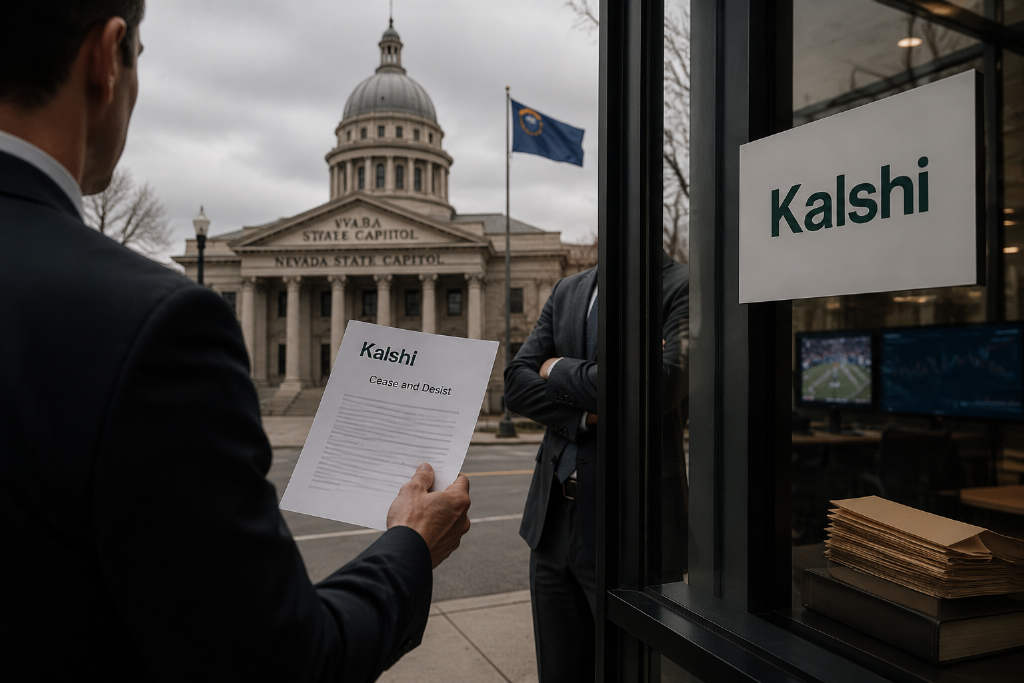
The U.S. Court of Appeals for the Ninth Circuit ruled on Aug. 28 against prediction market platform Kalshi, rejecting its bid for a preliminary injunction and holding that the company had not shown the Commodity Exchange Act, or CEA, preempts Nevada from applying its gambling laws to sports event contracts.
The decision challenges the Commodity Futures Trading Commission’s long-standing view that federal law gives it exclusive jurisdiction over this corner of the market and pushes the fight over prediction market oversight into a sharper phase.
Nevada enforcement regains force
The Nevada Gaming Control Board sent Kalshi a cease-and-desist letter in 2025, ordering the platform to stop offering election and sports event contracts in the state and warning of possible criminal or civil action.
Kalshi then sued the board and the state, asking the court to block Nevada from regulating its sports and election event contracts. A federal district court initially granted that injunction, but later dissolved it based on a ruling involving Crypto.com.
In its Friday opinion, the Ninth Circuit said: 「We conclude that Kalshi has not shown that the CEA likely preempts the application of Nevada’s gambling laws to its sports-event contracts, and the district court did not abuse its discretion in dissolving the injunction.」
The three appellate judges also said the CEA likely does not preempt Nevada gambling law as applied to Kalshi’s sports contracts.
CFTC says the court got the statute wrong
CFTC spokesperson Zach Fulton pushed back hard on the ruling, saying the Ninth Circuit misread the Commodity Exchange Act and related rules.
Fulton said: 「A derivative contract structured as a swap is a swap, regardless of the underlying, and the only exceptions in the statute are onions and motion picture box office receipts.」
He added that the Ninth Circuit 「incorrectly created a new CEA exception that does not appear in the text of the statute」 and said the case now presents a 「circuit split」 that urgently requires a Supreme Court decision.
Kalshi plans to seek further review
Kalshi spokesperson Dani Lever also objected to the outcome.
Lever said: 「Despite the Ninth Circuit’s ruling, we continue to believe current CFTC regulations do not prohibit sports contracts, and the CFTC is in the process of clarifying the relevant rules. We will seek further review.」
That next step could mean a request for en banc review before the full Ninth Circuit, or a petition for a writ of certiorari to the U.S. Supreme Court.
The fight goes beyond one company
The case is not only about Kalshi. It has become a broader jurisdictional fight between the federal government and the states over a prediction market industry described in the report as being worth tens of billions of dollars.
Concerns among U.S. states have continued to build, especially around platforms offering sports-related contracts. Governors and regulators argue those products amount to gambling and violate state gaming laws.
The CFTC, by contrast, says the CEA gives it exclusive authority over derivatives markets. CFTC Chair Michael Selig has repeatedly said the agency has exclusive regulatory power over prediction markets, including sports-related contracts, and has already sued multiple states. The agency has also put forward a draft framework for prediction market oversight in an attempt to bring the sector under a unified federal regime.
If the Ninth Circuit ruling stands, other states may have stronger grounds to regulate these products. That would leave prediction market platforms exposed to layers of state gambling restrictions even if they operate with federal approval.
Will the Supreme Court step in?
Three issues now stand out.
- The CFTC has already said the Ninth Circuit’s ruling conflicts with existing jurisdictional positions and that a circuit split has formed. If other appellate courts, including the First Circuit, continue to uphold rulings favorable to Kalshi, the odds of Supreme Court intervention could rise sharply.
- Kalshi has said it will seek further review, either through en banc rehearing at the Ninth Circuit or through a direct petition to the Supreme Court.
- States are not backing away. Lawsuits involving Kalshi remain active in New York, Washington state and Kentucky. The report specifically notes New York in July 2026. The Ninth Circuit’s ruling may also provide legal support for more state actions.
What happens next in the Nevada case now sits at the center of a larger battle over who gets to police prediction markets in the United States.