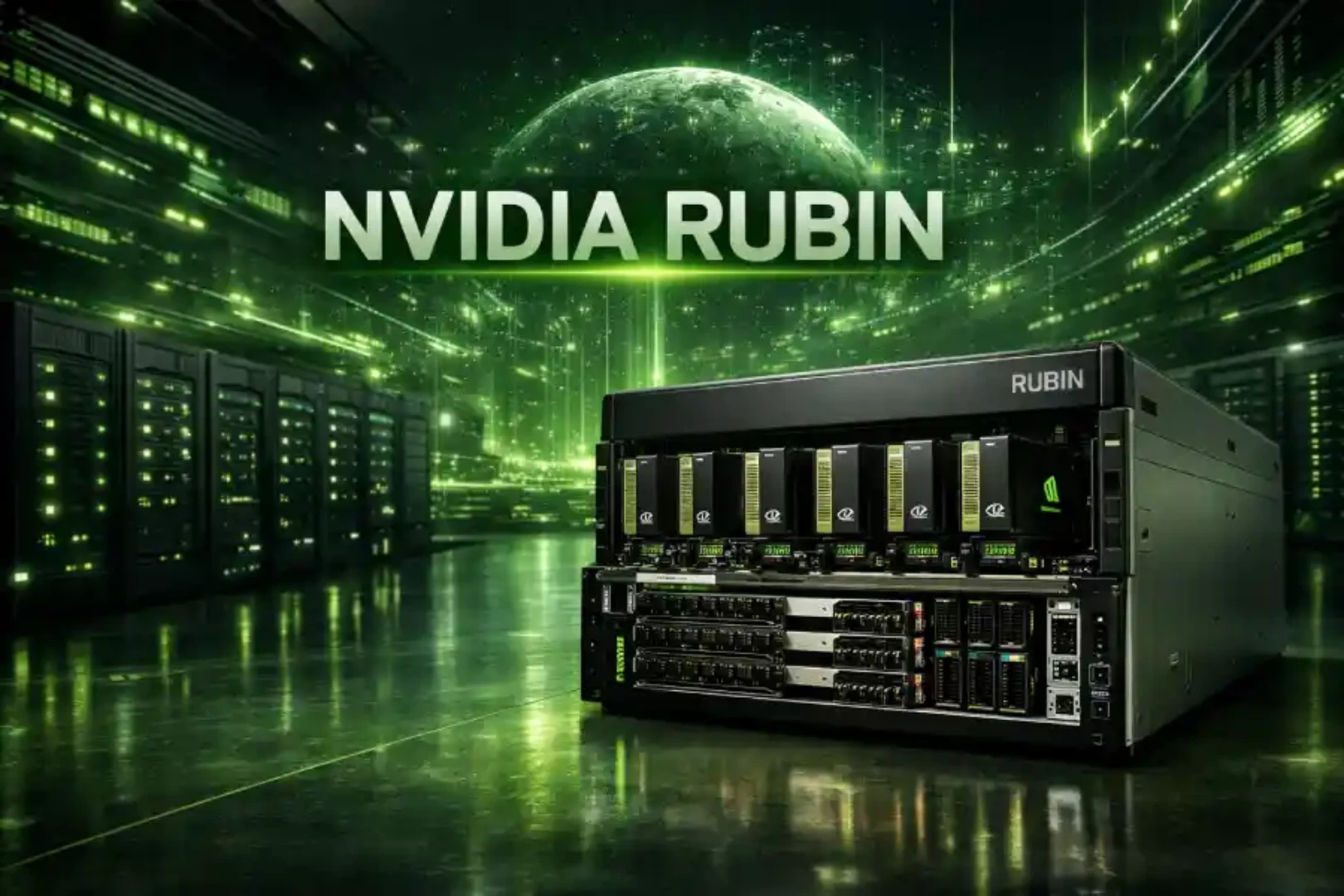
Revenue Upgrade: HBM4 Resolved Unlocks Rubin Potential
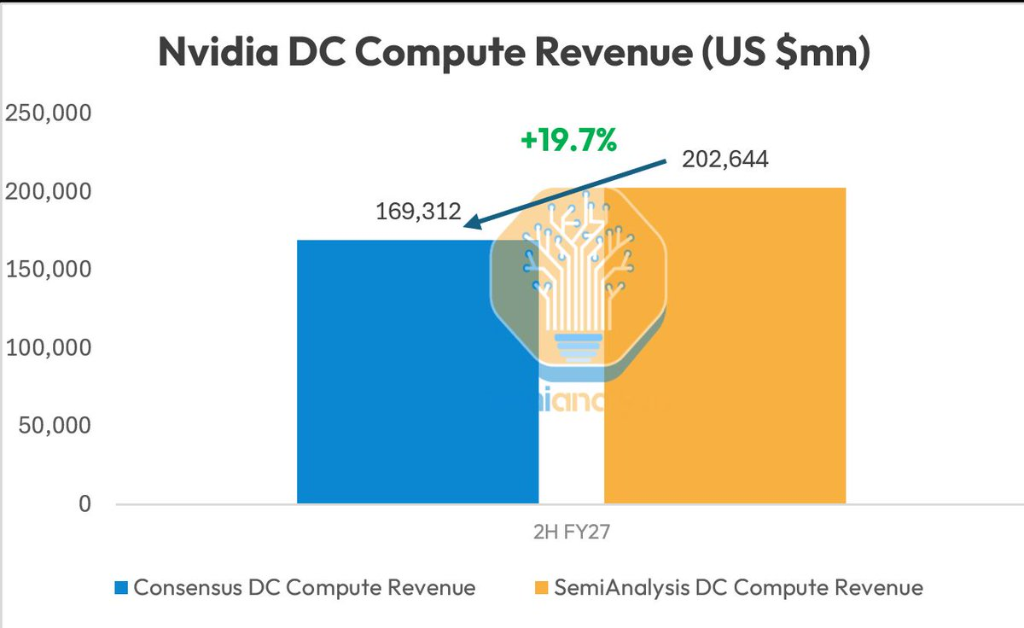
On June 30, SemiAnalysis released its latest forecast, predicting that NVIDIA's data center computing revenue for the second half of fiscal 2027 will be approximately 20% higher than the Wall Street consensus. Using its proprietary Accelerator Model, the firm attributes this upside to the resolution of HBM4 memory supply issues that previously constrained Rubin platform volume shipments, along with pre-stocked front-end wafer capacity. These developments have cleared major obstacles for a production ramp-up in the latter half of the fiscal year.
SemiAnalysis notes that its forecasting logic differs from traditional sell-side analysts: most Wall Street institutions set conservative earnings estimates to allow room for subsequent beats, while SemiAnalysis bases its conclusions on first-hand supply chain research. The model cross-validates data across material suppliers, wafer fabs, key components, server OEMs, hyperscale cloud providers, and frontier AI labs, triangulating supply-demand dynamics from multiple dimensions. The framework also covers other AI chip companies such as Broadcom, AMD, MediaTek, and Marvell, and tracks the entire AI compute chain in conjunction with a dedicated HBM Model.

Flagship Downsizing and CUDA Moat Erosion: Technical Roadmap Concerns
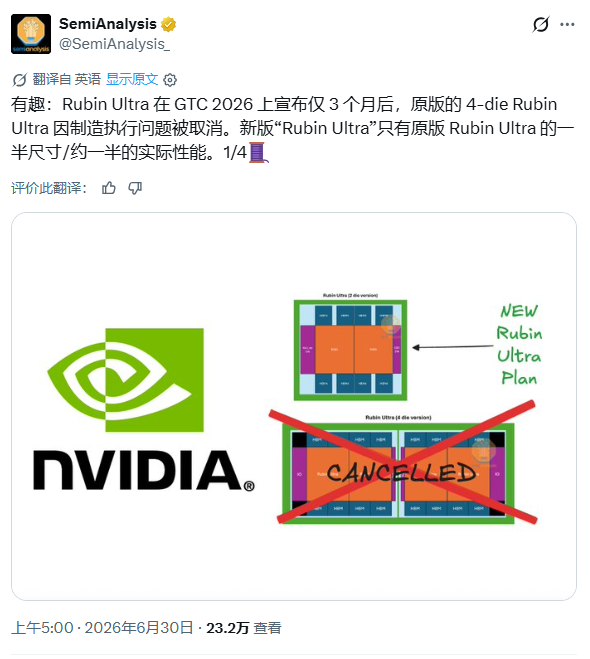
However, earlier the same morning, SemiAnalysis disclosed a bearish update: NVIDIA has canceled the original 4-chip Rubin Ultra design roughly three months after its announcement at GTC 2026. The new version of 'Rubin Ultra' has been scaled down to half the original physical size, effectively halving its performance, due to difficulties in advanced packaging manufacturing.

More concerning, customers are diversifying their compute architectures. SemiAnalysis cites Anthropic as an example: it now operates a multi-platform stack consisting of Google TPUs, Amazon Trainium, and NVIDIA GPUs. A large portion of Claude model training runs on TPUs, while Claude Code inference is increasingly deployed on Trainium, leaving NVIDIA GPUs for frontier research and general-purpose workloads. SemiAnalysis notes that a year ago it would have been hard to imagine TPUs and Trainium reaching their current scale, yet today the CUDA moat is being eroded slowly. One side sees supply bottlenecks resolved and revenue upgraded; the other sees a flagship product shrink and the ecosystem's defensiveness weaken—NVIDIA faces both ice and fire as it navigates the next chapter.