
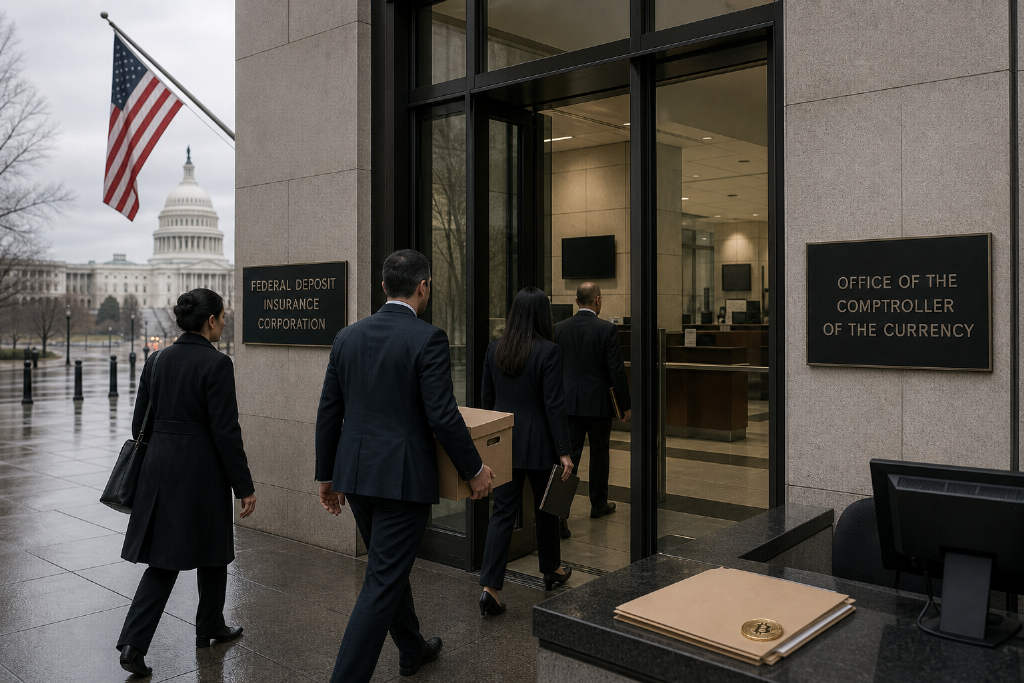
PANews’ daily roundup on Aug. 28 led with a U.S. banking policy update: the Office of the Comptroller of the Currency, or OCC, and the Federal Deposit Insurance Corporation, or FDIC, have finalized a rule requiring regulators to present evidence of material financial risk or a legal violation before they can classify a bank’s conduct as “unsafe or unsound” and pursue enforcement action.
One media commentary cited in the digest said the move marks an important step in ending crypto “debanking” in the United States.
Regulation and macro
OCC and FDIC set a higher bar for bank enforcement findings
Under the final rule, bank regulators must show that a practice has caused material financial risk or violated the law before taking enforcement action on the basis that it was “unsafe or unsound.”
Project and company updates
China’s central bank to issue AI-themed commemorative coins
The People’s Bank of China will issue gold and silver commemorative coins themed around “Sci-Tech Future (Artificial Intelligence)” on Sept. 4.
Anthropic may publish IPO prospectus after U.S. Labor Day
According to a market update cited by Jin10, Anthropic plans to release its IPO prospectus after U.S. Labor Day on Sept. 7, and may go public in the U.S. in late September or early October.
Binance to list several USDT-margined TradFi perpetual contracts
Binance Futures will launch Tempus AI (TEM) USDT perpetuals at 17:00 Beijing time on Aug. 28, 2026, followed by Merck & Company (MRK) at 17:05, IonQ (IONQ) at 17:10, MARA Holdings (MARA) at 17:15, and PDD Holdings (PDD) at 17:20. All will support up to 20x leverage.
Upbit, Dunamu, Visa, and EURC
Upbit will delist Synthetix (SNX) trading pairs on Sept. 28.
Upbit parent Dunamu has signed a strategic partnership with Visa to explore new financial services built around stablecoins and AI. The two companies plan to combine Dunamu’s digital asset technology with Visa’s global payments network to develop stablecoin payments, cross-border remittances, and AI-driven financial services, while linking stablecoins with existing global payment infrastructure.
On the AI side, the partnership will focus on agent commerce, where AI agents search for products and complete payments on behalf of users.
The digest also said Upbit will list EURC in its KRW, BTC, and USDT markets.
Moonwell suspected exploit
Base-based lending protocol Moonwell is suspected to have been attacked. The attacker allegedly manipulated the price of MAMO collateral and borrowed cbBTC from the mBTC market. Roughly 50.6 cbBTC, worth more than $4 million, has been detected leaving the protocol.
Sun Yuchen civil case said to be accepted by court
According to Weibo posts cited in the digest, Zhang Qihuai of Lanpeng Law Firm, identified in the post as “Sun Yuchen’s attorney,” said Sun had filed a civil lawsuit against Jing and Jing’s parents over a property dispute. The amount in dispute exceeds 30 million yuan, and the case has been formally accepted.
The plaintiff has applied for property preservation. After the court accepted the case, the defendant’s side raised an objection to jurisdiction, and that objection is still under court review. The case has not entered substantive trial, and there is no final judgment.
Zhang said he would participate as counsel in the matter, though the digest noted there has been no confirmation from Sun’s side of that identity.
The item also listed other notable cases Zhang has handled, including the Air China pilot resignation “zero compensation” case, the “11.21” Baotou air crash water pollution compensation case, the “8.24” Yichun air crash pilot criminal liability case, the Li Tianyi case, the Gao Yunxiang sexual assault case, the Sun Yang anti-doping procedure arbitration case, Ma Su’s defamation suit against Huang Yiqing, the traffic case involving actress Tan Songyun’s mother, the Zhai Xinxin extortion case, and the Taicang “illegal flight” air crash compensation case in Suzhou.
Ethena Foundation announces four ecosystem changes
Ethena Foundation said it is making four adjustments across the Ethena ecosystem: buying back locked tokens held by early investors, pushing closer alignment between token and equity value, launching a governance proposal for ENA buybacks funded by revenue, and removing future monthly VC unlocks.
The foundation said it has repurchased all locked tokens held by certain major seed investors who sold ENA during the past nine months. On value alignment, Ethena Foundation and Ethena Labs have signed a Master Framework Agreement under which intellectual property and value created by the protocol will belong exclusively to the foundation and be governed by ENA holders. Equity investors in the Labs entity will no longer receive residual cash flow.
A governance proposal on fee conversion is now live. Under the proposal, net revenue generated by all business lines under the Ethena brand would be used for programmatic ENA buybacks. The foundation said the proposal has been approved by the risk committee.
It also said it reached an agreement with major investors to remove future selling pressure from monthly VC unlocks by releasing tokens that had not yet vested. Team tokens will remain locked under the original vesting schedule.
Hugging Face-owned Pollen Robotics launches Microduck
Pollen Robotics, owned by Hugging Face, launched its new AI robot Microduck on Wednesday night. The product is available for pre-order at $399 in cream, graphite, lavender, and sky blue, with shipments planned before Christmas this year.
Microduck is a one-eyed biped robot standing under 25.4 cm tall. In demonstration videos, it picks up socks and markers, kicks a ball, and moves quickly while wearing small roller skates. Pollen Robotics said the robot can react to its surroundings, follow a laser pointer, and also be controlled directly with a game controller.
Like Reachy Mini, an earlier product from Hugging Face, the software is open source. Users can retrain the robot to learn new movements. Microduck can also sing, and each unit has a slightly different voice.
On the hardware side, it uses a Rockchip RK3566 processor and includes a camera, motion sensors, and lidar. Its legs, head, and neck all have moving structures.
Fundraising
Sharpa discloses financing for the first time
General robotics company Sharpa said it has raised more than 4.5 billion yuan in total, with investors including Alibaba, Meituan, Tencent, JD.com, Sequoia China, Qiming Venture Partners, and Meituan Longzhu. Its post-money valuation stands at 22 billion yuan. The disclosure marks the company’s first public financing announcement since it was founded.
Sharpa was founded in late 2024 by Hesai Technology CEO Li Yifan, CTO Xiang Shaoqing, and chief scientist Sun Kai. The company develops general-purpose robots and components focused on dexterous manipulation.
Socure raises $156 million and acquires Fravity
AI anti-fraud company Socure said it completed a $156 million strategic growth round at a $5.2 billion valuation. Summit Partners led the round, with Wells Fargo, Goldman Sachs Alternatives, and Docusign among the participants.
The company said its anti-fraud services are already used by Coinbase, Circle, Revolut, Robinhood, and others.
Socure also announced the acquisition of AI startup Fravity. The deal is aimed at using AI agents in fraud, risk, and compliance investigations. Financial terms were not disclosed.
RQD* Clearing raises $74 million
Clearing and custody firm RQD* Clearing raised $74 million in a round led by Bain Capital, with ABN AMRO Clearing and Nyca Partners also participating. The company plans to use the funding to expand in North America, Asia, and the Middle East, and to develop products covering digital asset custody and tokenization.
RQD* provides clearing and custody services to broker-dealers, investment advisers, and overseas financial institutions entering the U.S. market. Clearing firms track positions, move securities and cash, and manage risk between trade execution and final settlement.
Views and market analysis
Arthur Hayes on Strategy’s “perpetual motion machine”
Arthur Hayes said Bitcoin stalling around $80,000 is enough to break Strategy’s “perpetual motion machine” model. He said the company’s mNAV premium has compressed to about 0.74x, close to the original value of its 840,447 BTC on the books, leaving little premium to fund another buying cycle.
Hayes said Michael Saylor now faces three hard choices: issuing new shares when the premium is thin would dilute shareholders, selling Bitcoin would conflict with the company’s “never sell” stance, and cutting preferred share dividends could shake investor confidence.
Strategy needs to pay about $1.5 billion a year in dividends on STRK and STRC preferred shares. As of May, the company had about 18 months of coverage and would need new funding sources after that. Hayes mocked Saylor’s comment that the company “might sell some Bitcoin to pay the dividend,” calling it “Jedi mind tricks.”
He argued that once Bitcoin moves into a sideways market, the logic of buying Bitcoin at a premium through Strategy no longer holds. Investors can get Bitcoin exposure through spot ETFs without taking on Strategy’s leverage costs and dividend burden. He added, however, that this does not mean Strategy will collapse overnight.
OpenAI says AGI could come by the end of 2026
OpenAI CEO Sam Altman said in a TIME interview that the company expects to reach an internal AGI system by the end of 2026, using OpenAI’s own definition: AI that can match or exceed human performance across most economically valuable tasks.
Chief Research Officer Mark Chen said the company is “80% of the way there,” while co-founder Greg Brockman said people may look back in two years and view this period as the moment AGI was born.
OpenAI’s upcoming Astra model has passed the company’s internal automated AI research intern benchmark, according to the digest. It can run experiments and complete work that previously took a human researcher a week. Altman said Astra will be “the first model that can invent new things in a meaningful way.”
OpenAI is also developing several devices, including a desktop device planned for early 2027, its own inference chip called Jalapeño, and humanoid robots. Its long-term goal is a general AI subscription service that can proactively recommend and execute tasks.
Other market views
Yi Lihua said Bitcoin may see a small short-term pullback and that he plans to close longs around $86,000.
Grayscale said Bitcoin’s correlation with gold has risen to 50%, suggesting the currency debasement trade may be returning.
Meta reportedly considered spending up to $10 billion a year on Anthropic
According to the report cited in the digest, Meta internally evaluated the possibility this year of spending as much as $10 billion annually on Anthropic’s AI models, which would make it one of Anthropic’s largest customers.
The report added that while Meta has publicly criticized the concentration of power that AI labs such as Anthropic may create, it has privately made heavy use of Anthropic’s products. People familiar with the matter said Meta is still paying Anthropic hundreds of millions of dollars a month for access to its AI tools.
Key data points
- A takeover offer by Huang Licheng sent FRIEND up nearly 30x, while a suspected insider wallet made $46,000.
- According to on-chain analyst Ai Yi, a BIT-linked entity that previously made $55.095 million on long positions opened a cumulative $49.98 million ETH long through three new addresses, with an average entry price around $2,485. The combined position is now the seventh-largest ETH position on Hyperliquid. The digest noted the scale is smaller than the previous 120,000 ETH position and may reflect staged deployment.
- Bitcoin mining company Metaplanet sent another 1,350 BTC, worth about $108 million, to Coinbase Prime an hour earlier. It has bought a cumulative 43,000 BTC for $3.48 billion at an average price of $96,191.
- U.S. spot Ether ETFs recorded $235 million in total net inflows yesterday, extending the streak to nine days.
- U.S. spot Bitcoin ETFs recorded $242 million in total net inflows yesterday, also marking nine straight days of inflows.
- The trader described as the “largest Hyperliquid long whale” reopened a $20 million ETH long after three days.