
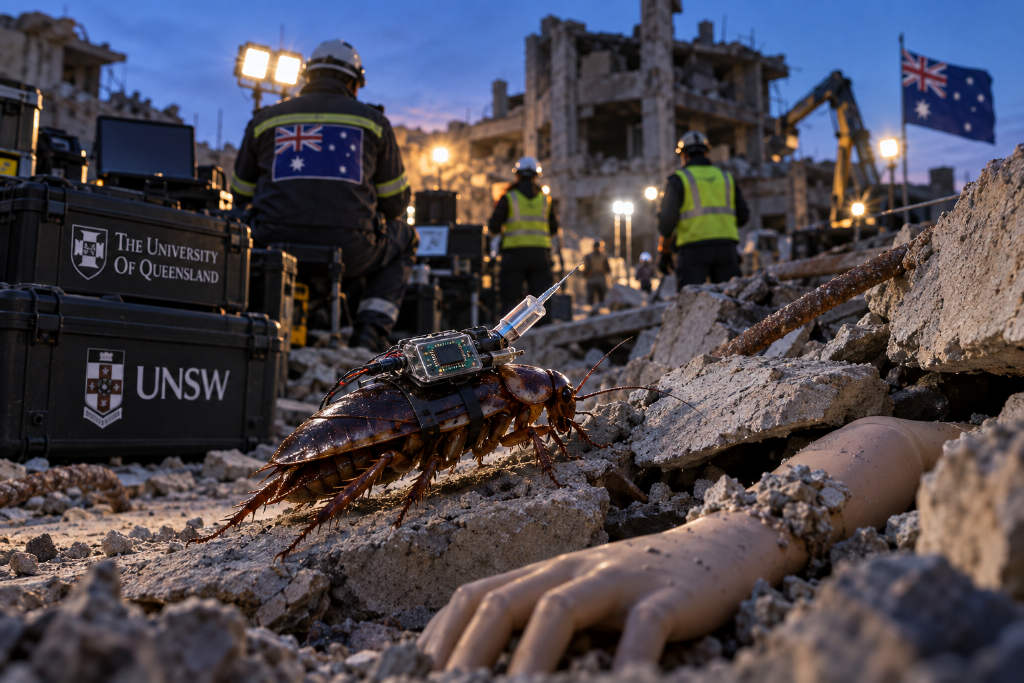
Researchers from the University of Queensland (UQ) and the University of New South Wales (UNSW) have developed a cyborg insect system called Paraborg, turning giant burrowing cockroaches into remotely controlled platforms for search, rescue, and injection tasks. In experiments, the insects were shown not only locating targets but also delivering injections to simulated casualties.
In the setup, a syringe penetrated a simulated victim and carbon dioxide pressure drove the plunger to complete the injection. The operator was not a human medic but a giant burrowing cockroach fitted with electrodes and a chip. The name Paraborg combines Paramedic and Cyborg. The results were published in Advanced Science.
95% success rate for short-range injections
According to the team’s tests, the success rate reached 95% when only short-range injection actions within 15 centimeters were counted. When the entire process was included, leaving the start point, passing checkpoints, and completing the injection, the rate dropped to 72%.
The researchers said small robots and drones have already been used in disaster search operations for years, especially in collapsed buildings and other spaces that are difficult for humans to enter. Most of those missions stop at detection. In an official news release, project lead and biorobotic engineer Thang Vo-Doan said, 「We wanted to go one step further. Once they find someone, can they actually help?」 That question became the starting point for the Paraborg project.
How the electrodes steer the cockroach
The team selected the giant burrowing cockroach found in northern Queensland as the carrier. This armored species can reach 87 millimeters in length and weigh as much as 40 grams, making it one of the largest cockroaches known.
To build the system, the researchers first anesthetized the cockroach and then implanted electrodes and a microchip. After the device is removed, the insects can still live like ordinary cockroaches, which means they can be reused rather than treated as disposable carriers.
Control depends on electrical stimulation. Stimulating the antennae guides turning, and each antenna can be controlled separately. Stimulating the pair of sensory organs at the rear, the cerci, adjusts walking speed. Tests showed that frequencies between 10 and 40 hertz worked best. At more than 50 hertz, the cockroaches gradually stopped responding to the stimulus, suggesting a tolerance limit for the remote-control method.
Two versions: camera scout and injector
The team built two versions of Paraborg. One carried a camera on its head to capture live visuals. The other was equipped with an automatic injection mechanism. The researchers said cockroaches can naturally carry up to 1.5 times their own body weight. After the injector was added, the total height increased by about 15 millimeters and the weight by about 17 grams, without disrupting normal movement in testing.
The injection system relies on a simple chemical reaction. The device triggers a chain reaction that breaks the seal between two compartments, one holding citric acid and the other baking soda. When the materials mix, they release carbon dioxide. The pressure then pushes a spring and plunger to carry out the injection. The team compared the principle to the baking soda volcano experiment commonly seen in school science classes.
In one test, researchers remotely guided a cockroach from a starting point through three checkpoints and then had it inject a simulated target. The team also demonstrated a handoff model: one cockroach equipped with a camera located the casualty, and another carrying the injector followed up to perform the injection.
Still 5 to 10 years away from real disaster use
All of the current tests were conducted in laboratory settings. They did not reproduce rubble piles, uneven terrain, or constantly changing conditions often found at real disaster sites. That leaves open whether the 72% full-mission success rate can be repeated in debris-filled environments.
Vo-Doan said that if the group can secure enough resources to accelerate research and field testing, rescue teams made up of cyborg insects could reach real disaster zones within 5 to 10 years. That also means large-scale deployment remains a long way off.
The UQ team had previously built cyborg beetles capable of climbing vertical walls. This time, the researchers switched to larger cockroaches for a straightforward reason: insects with greater payload capacity are better suited to carrying professional rescue and medical equipment.