
Keeping money on the platform is what gives an exchange a shot at the business that comes after.

Written by Liu Honglin
Binance’s latest stablecoin savings campaign has been hard to miss.
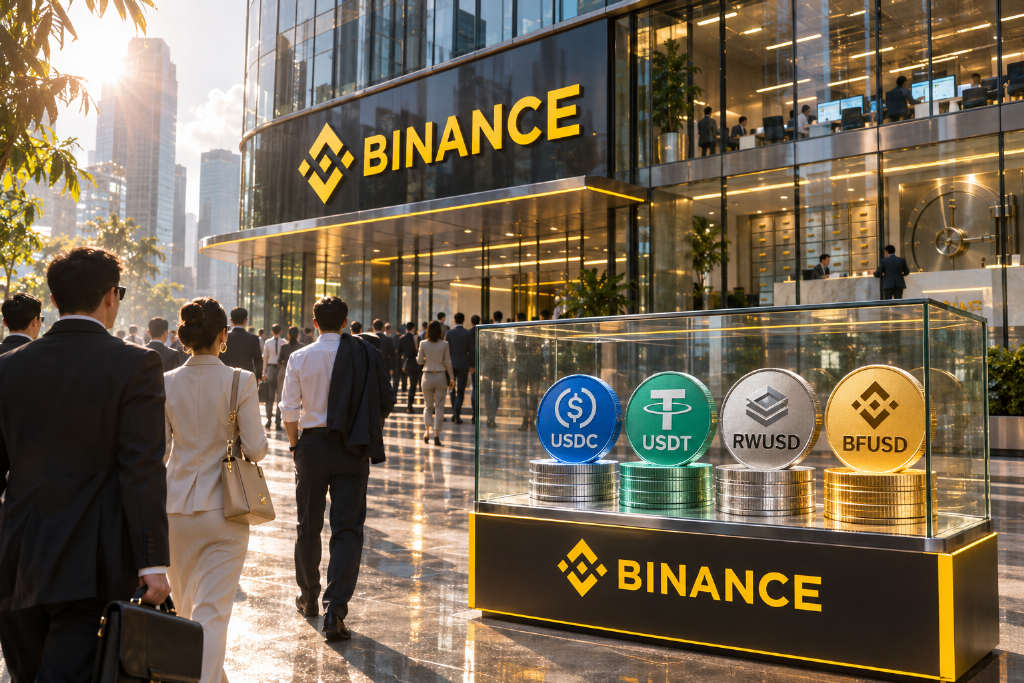
Flexible USDC deposits are offering as much as roughly 11.5% annualized. Eligible high-tier VIP users who place 300,000 USDC into the product could earn about 1,796 USDC under the campaign’s stated calculation method. At the same time, Binance has also raised rates on flexible USDT, RWUSD, and BFUSD, and users can join several of the offers at once.
USDC and USDT are among the most widely used dollar-pegged stablecoins in the market. Many users hold them while waiting for a chance to buy crypto, or for transfers and settlement. A double-digit annualized return without having to guess where Bitcoin goes next is an easy pitch to understand.
But those numbers also invite a basic question: if an exchange is paying that much interest, what business does it expect to earn it back from later?
Viewed alongside similar products at other crypto exchanges, the answer is fairly clear. Platforms are competing for the pool of user funds that is not being traded right now.
How much does an 11.5% headline rate really cost?
The first reaction many users have to a high yield is simple: how can the platform afford it?
A large part of the answer sits in the way the offer is segmented by user type and deposit cap.
In Binance’s USDC promotion, the boosted quota for ordinary users starts at 10,000 tokens. Once a user’s savings balance reaches a certain threshold, the quota rises to 30,000. Only at higher VIP levels does the boosted cap expand step by step to 200,000 and then 300,000 tokens. The USDT campaign running at the same time shows a combined annualized rate of about 11%, but the boosted portion applies only to the first 1,000 USDT.
For 1,000 USDT, the campaign display implies earnings of about 5.7 USDT during the event period. The annualized figure on the poster is eye-catching, but the exchange’s actual cost for a small user is limited.
At the 300,000 USDC tier, the roughly 11.5% total annualized rate consists of about 3% in real-time yield at the time and another 8.5% in temporary bonus yield. Using the same campaign method, about 1,327 USDC of the roughly 1,796 USDC total return comes from the extra promotional boost.
That extra payout is there for one reason: Binance wants that 300,000 USDC to stay put during the campaign.
OKX, Binance’s long-running rival, is using a similar playbook. Its Simple Earn page shows 10% bonus APY for USDT and USDC, but the personal cap for each is 500 tokens.
Duration, quota, membership tier, and the total reward pool all keep this kind of spending inside a controllable marketing budget. A platform can decide how many users to subsidize and how much balance each one can place under the boosted rate. Small quotas encourage more users to try the product. Larger quotas are aimed at bigger clients.
Why exchanges want idle balances to stay where they are
If funds remain on an exchange, the user’s next trade is more likely to happen there too.
A user who sells Bitcoin and receives 100,000 USDT can either withdraw the money or leave it on the platform while waiting for the next opportunity. If that balance earns nothing, there is a stronger reason to move it elsewhere. Offer a bit of yield, and the user can postpone the decision on what to buy next while still keeping the funds in place.
When market conditions change, the money is already in the account and ready to trade. That gives the platform another chance to collect trading fees. If the user goes on to use lending or margin services, more revenue can follow. Whether the subsidy is worth paying depends on whether later fee income and lending income can cover the cost of attracting and retaining that capital.
That also explains why exchanges are willing to offer larger boosted quotas to clients with bigger balances and heavier trading activity. Keep the principal on-platform now, and there is a better chance to keep doing business with that client later. If future revenue exceeds the subsidy and servicing cost, the spend makes sense.
Binance’s latest rate increase also arrived just days after withdrawals resumed following a security incident, when users were actively rearranging their funds.
Binance began restoring withdrawals in phases on Nov. 1. According to data later disclosed by the platform, it processed withdrawals worth $4.649 billion in the early stage of the reopening, while receiving deposits worth $1.01 billion, for net outflows of about $3.64 billion. Binance said withdrawal demand was initially much higher and then gradually eased, while incoming deposits remained sizable. The exchange also said it would absorb losses tied to the stolen assets. Once withdrawals resumed, users were again free to decide whether their money should stay.
At the same time, rival venues were taking in funds. Citing a 24-hour snapshot through the early hours of Nov. 2 Beijing time, The Block reported that another 10 large exchanges tracked by DeFiLlama posted combined net inflows of about $368 million. Those inflows cannot all be treated as money that left Binance, but users clearly had the chance to choose another platform and reallocate assets. If Binance wanted to keep them, it needed to give them a reason.
During the same period, Binance also offered eligible users 30 days of VIP tier protection, allowing them to keep their status even if they temporarily fell short of the usual asset or trading requirements. In the article’s view, both measures were designed to steady existing clients and keep them using Binance after services resumed.
Who is really paying the yield?
Promotional boosts are temporary. The regular yield that exchanges pay users still needs a recurring source of income behind it.

Some platforms fund it through lending and related businesses. Others pay rewards out of their own revenue.
Take OKX’s flexible Simple Earn product. Its official description says user assets are lent to flexible loan and margin trading users. If traders want to borrow stablecoins and are willing to pay interest, the people supplying those funds have a source of return, while the platform takes a service fee.
When borrowing demand is strong, supplier yields can rise. When demand weakens, yields can fall. What users see is a flexible savings product. Behind it are borrowers, collateral, and trading risk. Returns on this kind of stablecoin product are directly tied to financing demand in the crypto market.
A different model can be seen at Coinbase. The company describes USDC rewards as a loyalty program funded by Coinbase itself and says it will not use or lend a customer’s USDC without instruction. To understand where that reward comes from, the article points to Circle, the issuer of USDC.
After issuing USDC, Circle holds reserve assets that generate income. To encourage exchanges, wallets, and other partners to promote and use USDC, Circle shares economics with distribution channels. Exchanges, as core channels, earn revenue from the use and distribution of the stablecoin and then decide how much of that to pass on to users as rewards.
Circle disclosed in October that of roughly $1.4 billion in revenue in the first half of 2026, about $819 million went to distribution partners and transaction costs.
A study published by the Bank for International Settlements in June this year also split exchange-paid stablecoin yields into two broad models: one that depends on income from market activity and another that depends on income from reserve assets. In practice, the two can overlap.
That brings the discussion back to Binance’s campaign. USDC gets a boosted quota of as much as 300,000 tokens, while USDT gets only 1,000. Users who want more rewards are naturally pushed toward swapping USDT into USDC. The exchange keeps the funds, and the issuer gains more holders and more usage of its stablecoin, which can increase the odds that it is used again in later transactions.
From the user’s side, it may look like a single click to convert or subscribe. Behind that click, the platform and the issuer each have their own commercial logic.
Similar yields, very different rights
Binance’s campaign places several products with yields around 10% side by side, and their names are close enough that users may focus first on which one pays more. But the products do not create the same legal relationship. What a user holds after subscribing, and how redemption works later, depends on the specific structure.
For flexible USDC and USDT, users place existing stablecoins into a yield product and the platform promises to return the same type and amount of token under the terms, plus the stated yield. Binance’s Simple Earn terms say subscribed assets are not separately segregated. They may be commingled with assets of other customers and the platform, and they may be used to lend to other users. That goes beyond simple custody. Whether users get assets back on time depends on the platform performing as agreed.
RWUSD is a yield product offered by Binance. According to the official description, its returns may be supported by strategies involving tokenized U.S. Treasuries and by ecosystem income, and successful redemption converts it into USDC on a 1:1 basis. Binance also states clearly that RWUSD is not a stablecoin and that holders do not obtain claims on the relevant real-world assets, underlying securities, or other financial instruments.
Users subscribe through Binance, and they redeem through Binance. Even if Treasury-related assets are used to support the yield, that does not mean the user has bought Treasuries. If there is a problem with repayment later, the claim still runs against Binance under the product terms, not directly against the U.S. Treasury or an underlying fund.
BFUSD is another yield-bearing asset offered by Binance, and it is not a standard stablecoin either. On redemption, it is converted back into supported dollar stablecoins under platform rules. Its yield mainly comes from spot-futures hedging and crypto staking. Binance says it holds spot positions while taking opposite-direction positions in the futures market to reduce the effect of price swings, then earns from periodic funding payments between long and short positions.
That hedge can reduce part of the price risk, but funding rates and returns still change, and the positions need ongoing management. Binance’s BFUSD risk disclosure says rewards may be zero, redemption may be delayed in extreme cases, and users may be unable to redeem if the platform becomes insolvent or fails operationally. Money that was meant for payments can become unavailable on time if services are paused or redemptions are restricted.
OKX has also warned in its flexible products that if the pool for a given token has been fully lent out, redemption may be temporarily limited. Once the money has been lent to someone else, a wave of simultaneous redemption requests means the platform has to bring funds back first. A product may be called flexible, but how quickly cash can actually be retrieved still depends on the terms and on how much liquidity the platform can mobilize at that moment.
That matters even more for people who use stablecoins for real settlement. If money set aside for supplier payments or payroll gets stuck waiting for redemption or for withdrawals to reopen, the extra yield may not cover the cost of a missed payment. Before deciding how much to place into these products, the more important question is when the money must be available, not the last decimal point in the annualized rate.
Compliance risks around promoting these products
The article also points to the compliance boundary. Mainland China does not permit this kind of virtual-currency financial business. Binance’s campaign itself carries regional restrictions, and users in places including Hong Kong and Singapore cannot participate. Even so, once news of high yields spreads through Chinese-speaking communities, some people will ask friends familiar with crypto how to get involved. Anyone who then starts recommending products and charging commissions needs to think about the legal responsibility that may follow.
A notice issued in February 2026, titled Notice on Further Preventing and Handling Risks Related to Virtual Currency and Similar Activities, continued to make clear that domestic virtual-currency exchange and related financial product trading are prohibited, and that overseas entities and individuals may not illegally provide such services to domestic parties. The fact that an offshore platform can offer a product in some jurisdictions does not mean a mainland-based team can copy the model or solicit customers for it inside the mainland.
The article gives an example. A community organizer sees the campaign, believes there is spread income to be made, asks members to transfer USDT to him, then places the funds into the exchange in one batch while promising a return. Once the money enters his account, subscriptions and redemptions are under his control, and everyone else can only wait for him to return principal and yield. If the platform does not pay rewards as expected, or if the account is restricted, the contributors will still look to him, and he will have to explain how he plans to honor what he promised.
If he then goes on to solicit strangers in a public group, repeatedly advertises fixed returns, pools the funds, and repays principal and interest himself, the matter could be investigated in the direction of illegal fundraising. At that point, saying only that the money was placed into exchange savings products would not settle the issue. Using one’s own funds to join a campaign and taking public money without authorization while promising returns are two different things.
The real contest goes beyond headline APY
The article closes with a comparison to the subsidy wars of the mobile internet era, when ride-hailing and food delivery platforms used incentives to build user habits. Stablecoin yield boosts follow a similar logic: attract balances first, then try to earn recurring revenue later.
Stablecoins can move from one platform to another, so high rates alone may not be enough to keep users for long. As payment and settlement use cases expand, exchanges will also have to compete with wallets and payment companies. Large platforms have the capital to subsidize. Smaller service providers may still find room through local channels and merchant relationships. In the end, the winner in this subsidy battle will be the one that can turn today’s account balances into tomorrow’s recurring global flow-of-funds business.




