
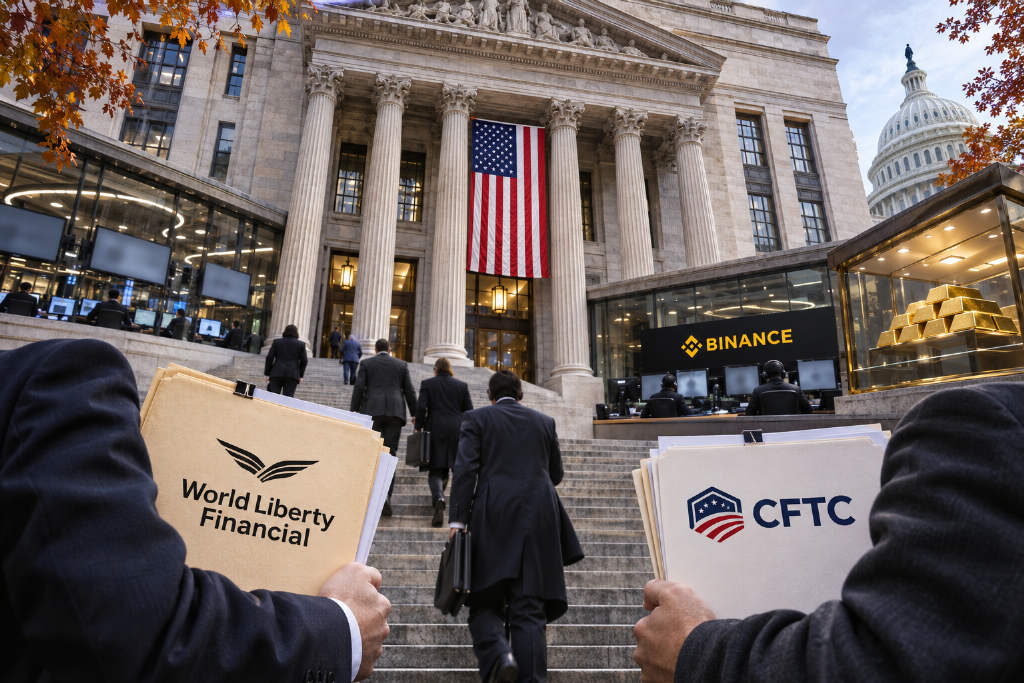
Nov. 4 brought a heavy mix of exchange security updates, U.S. derivatives regulation and fresh court action involving World Liberty Financial.
Most-traded CEX tokens and top gainers
Among the top 10 tokens by CEX trading volume, BTC rose 0.74% over 24 hours, ETH gained 1.13%, SOL added 0.53%, ZEC climbed 5.84%, XRP rose 1.91%, NEAR fell 1.26%, BNB slipped 0.30%, HYPE gained 0.52%, UNI rose 1.02%, and PEPE added 1.51%.
On OKX’s 24-hour gainers list, ZRO rose 7.82%, PUMP gained 7.48%, LIT added 7.34%, IRYS rose 7.04%, ZEC gained 5.36%, NIGHT rose 4.00%, STRK added 2.70%, XRP gained 1.77%, SUI rose 1.67%, and ENA added 1.02%.
On msx.com’s 24-hour crypto-related stock gainers list, AEHG rose 57.66%, CIFU gained 34.51%, AEHR added 27.84%, SMCX rose 24.64%, BEX gained 24.09%, IREX added 22.67%, CCXI rose 21.21%, APLX gained 20.66%, RIOT added 18.24%, and CRDU rose 18.11%.
Binance releases preliminary report on hack
Binance published a preliminary report on its security incident, saying the attack involved about $6.34 billion in digital assets. As of Nov. 3, the exchange said it had set aside compensation funds exceeding 100% of affected assets and had replenished 98% of impacted tokens. The remaining low-liquidity assets are still being sourced.
Binance said about $2.85 billion has been frozen or intercepted so far, though the figure still needs further reconciliation and remains subject to market price changes.
According to the report, the attacker exploited unauthorized access to an internal wallet-signing service to initiate transfers outside the normal withdrawal process, then used Ethereum’s EIP-7702 authorization mechanism to obtain partial execution control over hot wallets. During the attack, assets moved out of Binance hot wallets included 233.46 million XRP, about 970,500 SOL, 44.2 million OP and 18,270 BTC. The final unauthorized transfer, involving 2,961.9 ETH, was confirmed on-chain at 23:56 UTC on Oct. 29.
Binance said the incident involved several stages, including a supply-chain attack, social engineering, malware, abuse of internal AI tools and misuse of transaction authorization mechanisms. The company said attackers had previously used fake job interviews to trick employees into downloading malicious code, then leveraged infected devices and internal AI tools to gain deeper access to wallet infrastructure.
The exchange said it has rebuilt the affected wallet systems and internal AI tools, replaced related devices, revoked credentials and access tokens tied to affected employees, and strengthened wallet risk controls and AI anomaly detection. Binance also said it will hire an independent cybersecurity firm to review the incident and plans to establish a security research fund focused on AI and blockchain security. The investigation is still ongoing, and some technical details will remain undisclosed for now.
CFTC clears single-stock perpetual futures
The U.S. Commodity Futures Trading Commission has approved perpetual futures linked to U.S. single stocks, allowing the products to be listed and traded on regulated U.S. exchanges for the first time.
The move opens a regulated route for American investors to trade single-stock perpetual contracts and expands the overlap between traditional equities and crypto-style derivatives markets.
Justin Sun says he moved to sanction WLFI
Justin Sun said his lawyers have asked a U.S. federal court to sanction World Liberty Financial, or WLFI, and its lawyers, arguing that WLFI disclosed its UAE citizenship only months after the litigation began.
Sun said WLFI initially identified itself as the sole owner and listed its citizenship as Florida. In August, the court ruled that part of the claims would remain in open court. Less than a week later, WLFI amended its ownership chain to 22 members, including parties tied to the UAE and other jurisdictions, and then argued that the federal court lacked jurisdiction.
Sun said he has invested a cumulative $45 million in WLFI tokens. He said he sued WLFI in April for fraud and froze his tokens, and that after the sanctions motion is decided, he will refile the case in California state court.
Stablecoin market cap falls to the lowest level in more than a year
CryptoQuant analyst Darkfost said total stablecoin market capitalization has dropped to its lowest level in more than a year. Since April, the figure has fallen from about $280 billion to $263 billion, a decline of about $17 billion over six months, or roughly 6%.
Darkfost said Binance now accounts for about 70% of stablecoin supply on centralized exchanges. Its 90-day moving average stablecoin market cap has fallen from $51 billion to $34 billion. He added that about $3 billion in stablecoins flowed out after the platform’s earlier hack incident.
He said the decline in stablecoin market value reflects weak demand and a lack of fresh capital and liquidity entering the market.
Bitcoin trades above its 200-day moving average
Bitcoin traded below its 200-day moving average on U.S. midterm election day in 2014, 2018 and 2022, by about 35%, 9% and 22%, respectively. This year looks different.
BTC is currently around $76,990, about 5.2% above its roughly $73,169 200-day moving average, pointing to a relatively stronger long-term trend. The 2026 bear market in bitcoin has been shallower and front-loaded, with the main pullback concentrated in January and February this year.
Martin Lee, head of research at DWF Labs, said historical data shows bitcoin often trades sideways or slightly weak in the first few months after midterm elections, but has risen over the following 12 months each time.
Wall Street splits over AI investment outlook
At the 2026 Global Financial Leaders’ Investment Summit in Hong Kong, executives from PIMCO, Bain Capital, Blackstone and Franklin Templeton voiced varying degrees of concern about the AI investment boom.
PIMCO CEO Emmanuel Roman said the market will eventually enter a downturn, with possible triggers including higher U.S. interest rates, war in the Middle East and a eurozone crisis. Bain Capital chairman John Connaughton said some AI assets are already priced at very high valuations, and the key question is whether investors can earn returns that justify those prices. Franklin Templeton CEO Jenny Johnson warned that hyperscale cloud providers are shifting from relatively low-capital-demand businesses into capital-intensive operators, and that the AI investment cycle may already have stretched too far.
Large bank executives on Wall Street were more upbeat. Morgan Stanley CEO Ted Pick said AI capital spending could reach $10 trillion to $15 trillion, making it one of the most important economic shifts since the birth of the internet, though it could also crowd out corporate funding needs outside AI. Goldman Sachs CEO David Solomon said that while the technology supercycle will not develop in a straight line, capital markets remain active and should provide strong financing for AI and computing demand. The report cited Bloomberg.
Binance swings back to net inflows
On Nov. 3, DeFiLlama data showed Binance posted net inflows of about $1.6 billion over the previous 24 hours, reversing an earlier period of net outflows.
Binance’s 24-hour net outflow had previously reached an intraday high of about $7 billion. The latest reversal marks a cumulative swing of more than $8.6 billion. Total assets on the platform stood at about $127.699 billion during the same period.
Project and product updates
Bullish picks Solana, Aptos and Ethereum for tokenized stocks
Bullish said it has selected Solana, Aptos and Ethereum as the initial network partners for its tokenized stock service. Issuers will be able to choose which network to use for issuance, while official shareholder records will remain with transfer agents.
Solana will be the first supported network, with Aptos and Ethereum to follow at dates not yet disclosed. On Oct. 27, Bullish and Equiniti demonstrated the transfer of 61 million tokenized Bullish reserved shares on Solana at the New York Stock Exchange. Those shares are tied to Bullish’s acquisition of Equiniti. The transaction is expected to close in January 2027, subject to regulatory approval.
Coinbase launches Coinbase for Agents
Coinbase CEO Brian Armstrong said on X that the company has launched Coinbase for Agents. The product lets users connect agents to their accounts so those agents can trade and make payments on their behalf, with limits and controls set by the user.
OpenUSD governance group sets fee structure
Open Standard, the governance organization behind the OpenUSD stablecoin, or OUSD, has set a management fee and equity incentive structure. Internal documents show OUSD will charge a management fee of 0.1 basis points, or 0.001%, on payment volume, capped at $0.01 per payment.
Payments of $1,000 or more will pay the capped $0.01 fee. Payments below $1,000 will be charged 0.1 basis points of transaction value. The management fee will be paid to Open Standard.
Unlike USDT and USDC, where issuers retain interest from reserve assets, OUSD plans to distribute reserve income to partners after deducting the management fee.
Open Standard also plans to offer equity incentives based on the amount of OUSD held and circulated by partners. Partners will receive a share of the annual equity incentive pool each month based on holdings and transaction flow. The threshold is at least $50 million in holdings or equivalent scale, and no single partner may hold more than 5%.
Aave Pro opens collateral swap for Aave V4 markets
Aave said on X that collateral swap is now live on Aave Pro for Aave V4 markets on Ethereum, Base and Avalanche. The feature lets users swap collateral into other assets without closing positions, and is powered by @CoWSwap.
Funding deals
Bloquo raises $3.7 million seed round
Bloquo said it has raised $3.7 million in seed funding, led by Crescera Capital and Triaxis Capital, with participation from Lattice Fund.
The company is a Brazilian fintech building stablecoin-based financial infrastructure for banks and enterprises. Its platform combines cross-border payments, foreign exchange trading and liquidity provision, supports stablecoins including USDC and USDT, and can be accessed through APIs or a control panel. Bloquo is registered with the U.S. Financial Crimes Enforcement Network, or FinCEN, as a money services business and has applied to Brazil’s central bank for virtual asset broker registration.
CRSHMARKET raises $3.5 million seed round
CRSHMARKET said it has raised $3.5 million in seed funding led by 6th Man Ventures, or 6MV, with Reciprocal Ventures, Lattice Fund and Starting Line participating.
The project is a live prediction market built on Monad. Viewers can predict what happens next in gaming streams and real-life livestreams, with markets settling within 60 seconds and turning live content into a fast, social prediction market format.
Regulatory developments
Hong Kong SFC eyes tokenized gold ETF pilot
Wu Jiali, executive director of the Investment Products Division at Hong Kong’s Securities and Futures Commission, said at Hong Kong FinTech Week that the regulator will launch an Innovation Pathway and hopes to combine tokenized funds with digital currency to improve liquidity and treasury management efficiency.
Wu said the first batch of tokenized money market funds has already begun secondary trading on licensed platforms, and tokenized gold ETFs could be the next pilot. Hong Kong currently has 17 approved tokenized retail products covering money market funds, gold products and ETFs, with total assets under management of $1.3 billion.
Over the medium to long term, the SFC also plans to promote tokenized assets as collateral, expand the on-chain use of stocks and bonds, and explore smart contracts in investment decision-making and automated trading processes.
South Korea discusses raising cold-wallet custody ratio
Industry sources said South Korea’s Financial Services Commission held an emergency security inspection meeting on Nov. 2 with major crypto exchanges and custodians to discuss raising the cold-wallet custody ratio required of exchanges.
Authorities are considering lifting the current legal minimum of more than 80% under the Virtual Asset User Protection Act to around 99%, a level already maintained by some large exchanges. Upbit keeps more than 99% of user assets in cold wallets, Bithumb is around 94%, Coinone is at 85%, and GOPAX and some others are just above 80%.
French lawmakers reject two crypto exit-tax proposals
France’s National Assembly postponed the vote on the revenue section of the 2027 national budget until Tuesday as debate continues, with 758 amendments still under review. It was the second delay, and lawmakers must complete the first reading by midnight on Nov. 17.
On Friday, the Assembly rejected two crypto exit-tax proposals that would have taxed unrealized gains on crypto assets when taxpayers move their tax residence out of France. Another proposal targeted household crypto holdings worth more than 800,000 euros and would have applied to taxpayers who had been French tax residents for at least six of the previous 10 years.
Still under review are proposals requiring disclosure of self-custodied crypto assets worth at least 100,000 euros at year-end, and exempting gains tax when total crypto payments for goods and services do not exceed 1,000 euros in a tax year. A proposal passed on Oct. 16 would tax gains from converting crypto assets into fiat-pegged stablecoins, but it has not become law. The report cited Cointelegraph.
Market voices
CZ says the industry is discussing a security alliance
Binance founder CZ said in an interview that he has not yet spoken with U.S. President Donald Trump or officials in Washington about Binance’s roughly $6.3 billion hack, but said he hopes to receive assistance from the U.S. government.
CZ also said the crypto industry has started discussing a security alliance to share security practices, conduct cross-audits and coordinate rapid freezing of stolen funds. He said North Korean hacking activity threatens not only crypto platforms but also the traditional financial system. As tokenized stocks, real-world assets and stablecoins grow, the ties between crypto markets and the global financial system are getting closer, making large-scale hacks a matter that extends beyond corporate security into national security.
Arthur Hayes says dollar liquidity is recovering
Arthur Hayes said on X that dollar liquidity is being replenished. Before the Federal Reserve and/or banks begin expanding their balance sheets, he expects BTC to weaken.
Ansem says the market may be pricing in too much pessimism
Crypto trader Ansem said he had been bearish on U.S. equities because he expected a pullback in tech stocks, and that trend is now starting to show. He said panic tends to get reflected in prices quickly during market corrections, and concentrated selling can push prices to key support levels faster than expected.
Ansem added that with uncertainty around AI, geopolitics and the broader market still in place, markets may already be pricing in a more negative outcome than reality warrants. He said he is watching price action near key support levels and believes sentiment could shift quickly as selling pressure fades.



