
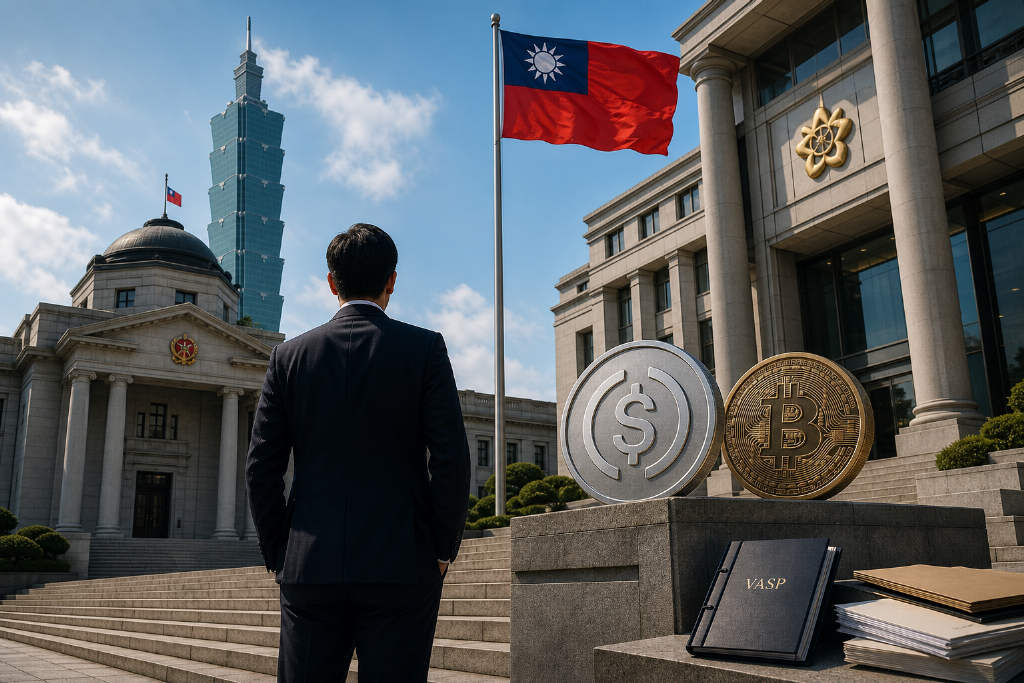
Taiwan’s Virtual Asset Service Act passed its third reading on June 30, 2026 and was promulgated on July 22, bringing virtual asset service providers, or VASPs, into a dedicated legal framework. Former premier Chen Ching, who also previously served as chairperson of the Financial Supervisory Commission and now chairs the New Generation Financial Foundation, said the law’s passage is only the starting point. The harder questions come next: how Taiwan plans to develop virtual assets and stablecoins, who makes the final call, and how the public should judge whether the law has worked.
Chen says the key measure is not license count but attention from the top
Speaking on episode 100 of XREX Group’s podcast Web3 Big Westward Expansion, Chen said the most important indicator after the law takes effect is not the number of licenses issued. His phrase was simple: “top-level attention.”
He said Taiwan’s earlier approach to virtual asset oversight was driven mainly by risk management concerns such as anti-money laundering. In his view, finance is already a heavily regulated business. If regulators focus only on what must not happen, but fail to set rules, standards and direction for ordinary business activity, that can still hurt the industry over time.
Under the current framework, VASPs are divided by business type into seven categories: exchange providers, trading platform operators, transfer providers, custody providers, underwriters, lenders and other virtual asset service providers. The law also introduces a licensing regime and requires internal control and audit systems, information security, listing and delisting review procedures, and protections for client assets.
Chen then turned to execution. A bigger law means more work, and he asked whether the number of people carrying out that work will rise as well. New oversight requires staffing, budget and coordination across agencies. Those resources, he said, are not matters the FSC can settle on its own.
He pointed to Taiwan’s consumer protection system as an example. Consumer protection crosses ministries, and if each agency handles only its own slice, the result can be a system where everyone is involved but no one is truly coordinating. That is why the Executive Yuan has a Consumer Protection Committee chaired by the vice premier, along with a Consumer Protection Office that coordinates across ministries and local governments. Virtual assets now face a similar cross-agency problem. Trading, payments, taxation, anti-money laundering, financial stability and consumer protection extend well past the boundaries of any single financial regulator.
For Chen, “top-level attention” does not mean a politician publicly voicing support for Web3. It means practical follow-through: whether subordinate rules can be completed on time, whether there are enough reviewers, and whether someone can make the final decision when ministries clash over authority.
Stablecoin approvals could create two decision-making centers
The law names the FSC as the competent authority in Article 2. But Article 34 also says that anyone issuing a stablecoin in Taiwan must apply to the FSC, and that before the FSC grants approval it must consult the central bank and obtain its consent.
Chen said this goes beyond a routine interagency consultation. If the central bank does not agree, the FSC cannot complete the approval. In practice, that creates two centers with real decision-making power. He summed it up with a proverb: “When there are three monks, there is no water to drink. In fact, two monks are enough to create the same problem.”
That does not mean the central bank should be left out. Chen said broad stablecoin use in payments, foreign exchange and cross-border transfers could affect bank deposits, the foreign exchange market and financial stability. Stablecoins’ functions in redemption, custody, transfer and even lending also overlap with banks’ existing businesses in remittance, foreign currency trading and credit. The real issue, he said, is not whether the central bank should regulate. It is who coordinates in the end when both the FSC and the central bank hold substantive authority, and whether companies can expect a clear and predictable review process.
Before arguing over the regulator, Taiwan needs to decide what stablecoins are for
Chen said there is a more basic question that comes before agency design: what exactly does Taiwan want stablecoins to do?
The Virtual Asset Service Act defines a stablecoin as a virtual asset represented as linked in value to one or more fiat currencies in order to maintain price stability. The center of that definition is the link to fiat currency. The United States has taken a different route. Chen noted that President Donald Trump signed the GENIUS Act in July 2025, using “payment stablecoin” as a core legal category. Under that approach, stablecoins are digital assets designed for payments or settlement, and qualified issuers must back circulating tokens with eligible reserve assets at a ratio of at least 1:1.
Chen said only after Taiwan decides whether stablecoins are meant for payments, cross-border remittances, trade settlement or some other financial use can it answer the next questions: which risks should be regulated, which agency should do it, and what roles banks, fintech firms and technology companies should play.
Chen frames stablecoins as an issue of strategy and monetary sovereignty
Chen pushed the discussion to the level of national strategy. He cited venture firm NFX general partner Morgan Beller, who argued in an essay titled Stablecoins Are Defense Tech that stablecoins should be viewed as defense technology. The point, Chen said, is not that stablecoins are military technology. It is that the digitalization of money touches a country’s financial power, international influence and monetary sovereignty.
“The government should look at everything from a strategic height,” Chen said.
He also referred to a May 2026 Bank for International Settlements study that found around 98% of stablecoins by market value are denominated in U.S. dollars. In his reading, that means stablecoins may not displace the dollar in the short term. They may instead extend the dollar into digital economic activity where it was not previously used. For other economies, the risk is digital dollarization. If people begin saving, paying and trading in dollar stablecoins, currency substitution could move faster than it did in earlier episodes of physical dollarization, reducing the space available for the domestic currency.
On that basis, the U.S. push to build a stablecoin regime can be read not only as crypto policy, but as part of a broader strategy for the digital form of the dollar.
Wayne Huang says local trading matters if local currency is to stay on-chain
XREX co-founder and Group CEO Wayne Huang added an industry view. Which currency is used as the unit of account in digital finance, he said, is itself part of monetary sovereignty.
Huang looked back at the early years of Bitcoin in Asia, when China was once a major global trading market and a large amount of activity was denominated in renminbi. After China’s regulatory stance changed, the global crypto market gradually shifted toward the U.S. dollar. By contrast, after Japan and South Korea built domestic regulatory systems for virtual assets, the yen and won still held important positions in their local crypto markets.
His conclusion was that regulation is not only a constraint. If trading can remain legally within a country, the domestic currency has a chance to move into the new financial market as well.
He said the issue may become more important as real-world assets, or RWAs, are tokenized. He used TSMC shares as an example. If those shares can one day trade on-chain around the clock, but are not priced in New Taiwan dollars and are not traded and settled through New Taiwan dollars or a New Taiwan dollar stablecoin, then Taiwan’s most important financial asset may be on-chain while the currency infrastructure underneath belongs to another country. That is why the stablecoin debate is moving beyond crypto industry policy and into currency competition.
Taiwan’s tech supply chain could offer a use case for a New Taiwan dollar stablecoin
Chen said Taiwan is not without leverage even as dollar stablecoins expand quickly. He sees at least three groups that could take part: banks, fintech companies and the technology sector. In his view, tech firms may be the most overlooked of the three.
Taiwan’s semiconductor and electronics industries are deeply embedded in global supply chains, and that means there are already large volumes of cross-border payments, supplier payments, treasury management and supply-chain finance needs. Chen said these real commercial activities could become practical use cases for stablecoins and tokenized deposits.
He also said he was concerned that he has not seen clear participation by Taiwanese institutions or companies in major projects such as OpenUSD. As dollar stablecoins, banks, payment companies and global technology firms begin to build the next generation of digital financial infrastructure, he said Taiwan needs to decide what place it wants to occupy in that network.
Chen links stablecoin policy to unmet demand, not abstract innovation
On innovation, Chen looked back more than 20 years to his tenure as chair of the Taiwan Stock Exchange, when he pushed for exchange-traded funds. At the time, Taiwan’s securities market was full of active products but lacked passive investment tools. The issue was not that the market needed to be taught to want ETFs. A group of investors already existed who did not want to pick stocks and simply wanted broad market exposure. The market just had not offered them a suitable product.
Taiwan later launched its first ETF, which eventually developed into the product investors know today as 0050. For Chen, real financial innovation does not invent demand out of thin air. It starts by identifying needs that already exist but have not yet been met, then building products to solve them.
He said the same logic applies to stablecoins. If Taiwanese companies truly need cross-border payments, settlement, supply-chain finance or on-chain asset trading, the policy question is not whether Taiwan should “develop crypto.” The real question is whether current financial tools can meet those needs effectively.
“FIN handles safety, TECH handles creativity”
Chen does not think the future stablecoin market is a binary choice between banks and technology companies. He broke fintech into two parts: “one handles safety, the other handles creativity.”
Financial institutions, he said, are strong in compliance, risk management, custody and core financial infrastructure. Technology companies are strong in engineering, product design and quickly testing new use cases. If the government first defines regulatory authority, stablecoin uses and market rules clearly, the two sides do not need to exclude one another. They can work together inside the same compliant framework.
But his argument ended where it began. Without enough staffing, budget and coordination across ministries, a law on paper will not be enough to make innovation real. If the rules are clear and the review timetable is predictable, firms have a better chance of turning compliance costs into market trust and international competitiveness.