


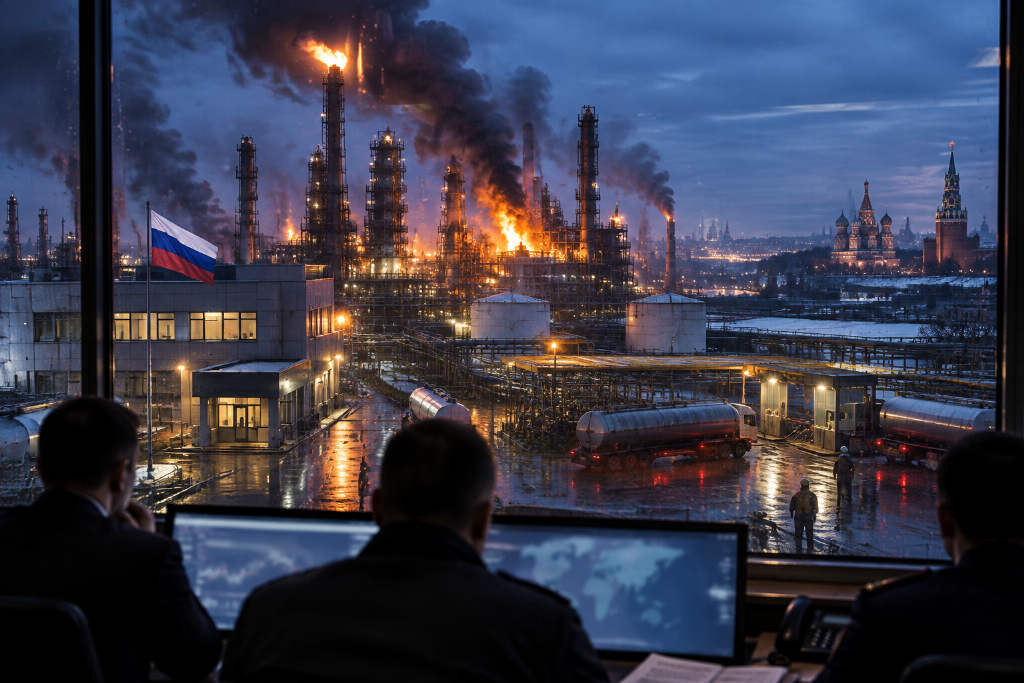
A senior Ukrainian official told the Financial Times on Oct. 9, 「We will burn Russian refineries」, signaling that Kyiv was not prepared to follow the diesel arrangement Donald Trump said he had just struck with Vladimir Putin. Three days later, the market had not moved in Trump’s favor.
Pricing data showed Brent crude rising 2% on Oct. 12, with an intraday high of $106.8 a barrel. Diesel futures also reversed the prior week’s modest decline. The U.S. average diesel price reached $6.26 a gallon, nearly 80% above the level at the start of the year.
Trump laid out a diesel supply plan, and OFAC issued a license the same day
On Oct. 9, after a call with Putin, Trump wrote on Truth Social that Russia had agreed to supply diesel in stages: more than 300,000 tons immediately, 500,000 tons in November, 1 million tons after that, and a possible additional 3 million tons depending on the condition of Russian refineries.
Those figures came from Trump’s post, and there is still no public bilateral written agreement available for verification. The Kremlin confirmed the transaction in a Telegram statement. Russian Deputy Prime Minister Alexander Novak told Russian state media that work would begin immediately to lift export restrictions.
Also on Oct. 9, the U.S. Treasury Department’s Office of Foreign Assets Control issued General License No. 135. It authorizes transactions related to the sale, delivery, unloading, and import of diesel produced in Russia, including imports into the United States, through April 7, 2027.
Questions remain over Russian refining capacity and export volumes
The biggest question is where the fuel would come from. Michelle Brouhard, head of policy and geopolitical risk at energy intelligence firm Kpler, told the Financial Times: 「What I am most curious about is where this diesel is going to come from?」 She added: 「Russia does not have an export problem; it has a refining problem.」
Kpler data cited in the report shows that before 2025, Russia exported an average of 2.6 million tons of diesel a month by sea. From 2026, that number fell sharply, and now seaborne exports have effectively stopped apart from a few exceptions. Analysts cited in the report said Russian refineries are currently operating at roughly 60% capacity.
The International Energy Agency said in a September report that Russian gasoline output was down 20% from 2025 levels, while diesel production had dropped by nearly 30%.
The United States has not historically been a major buyer of Russian diesel. The Financial Times said the last U.S. purchase was in July 2022. In months when imports occurred, the average was about 77,000 tons, with a peak of 210,000 tons in January 2022. Trump said the first batch of more than 300,000 tons would serve 「the U.S. and global market」, but it remains unclear how much, if any, would go to the United States. NBC News calculated that 300,000 tons is about 2.25 million barrels, less than one day of U.S. diesel consumption.
Miami talks exposed a split between Washington and Kyiv
That same day in Miami, Ukraine’s negotiating team met Trump envoys Steve Witkoff and Jared Kushner for nearly eight hours.
The Financial Times, citing three people familiar with the matter, reported that the Ukrainian side was caught off guard by the diesel deal announcement. The report said Witkoff and Kushner mentioned during the meeting that intelligence sharing could be cut off if Kyiv did not stop. A U.S. official, however, told Axios that the envoys had not issued a direct ultimatum, while confirming that they had conveyed Washington’s expectation that Kyiv would respond.
Hours after the Ukrainian official made the refinery threat, Russia said the Yug Rusi oil terminal in Rostov-on-Don had been attacked.
Trump declared an energy ceasefire, but Ukraine and Russia did not match that claim
On Oct. 10, Trump told reporters outside the White House, 「I suggest they get a new leader who can make a deal.」
On Oct. 11, Volodymyr Zelensky said in an ABC News interview, 「Do not attack us, do not kill our children, and we will stop attacking your diesel. I think this is a fair deal.」
After that interview aired, Trump said that, effective immediately, the war between Russia and Ukraine now had an energy ceasefire and that both sides had agreed.
But on Monday at the Warsaw Security Forum, Zelensky said Ukraine learned of the ceasefire from media reports. He said that after Trump’s announcement, Russian forces still attacked a power plant in Kharkiv, a natural gas production facility, and a civilian gas station. 「Obviously, Putin does not read Truth Social,」 Zelensky said. He added that if Russia does not agree to an energy ceasefire this winter, 「we will respond.」
Asked whether Moscow had agreed, Kremlin spokesman Dmitry Peskov said only that 「contacts are ongoing.」
Trump nevertheless told reporters at the White House on Monday, 「They agreed, and you know why? Because I said, ‘You agree.’」 The report also noted that Trump had announced a similar energy ceasefire in mid-September, but that arrangement likewise did not materialize.