
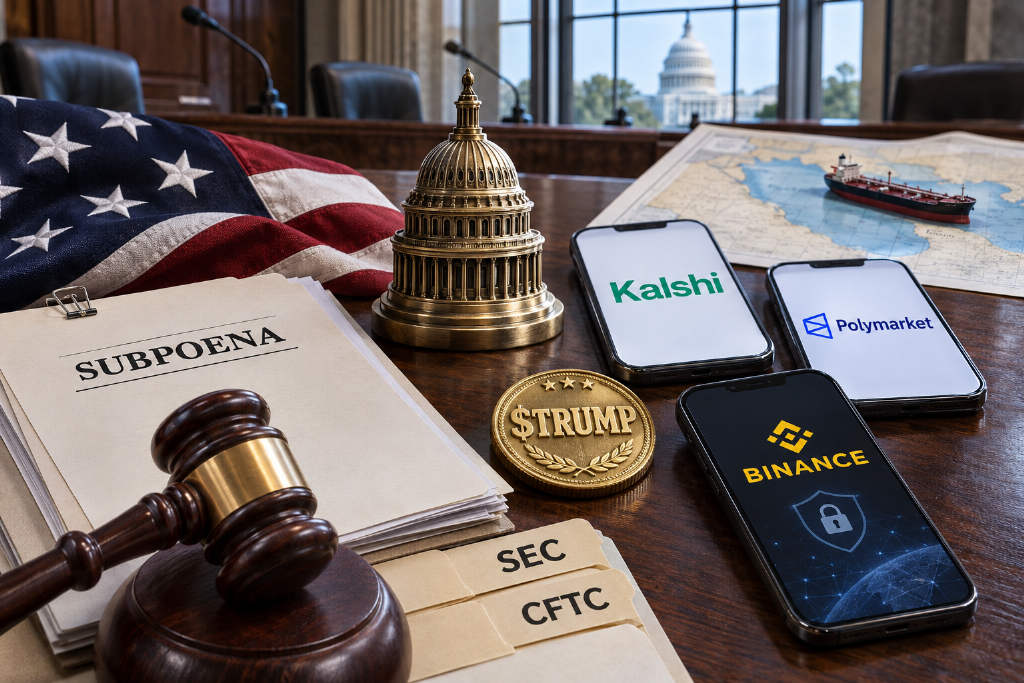
Crypto is entering the 2026 US midterm election under a fresh layer of uncertainty. A report by Bankless, translated and published by TechFlow, says the industry may soon face a sharper wave of hearings, records requests, and subpoenas if Democrats retake Congress, even as the Securities and Exchange Commission and the Commodity Futures Trading Commission continue to push regulated market access using powers they already have. The report also points to a separate risk that may matter more for prices in the near term: rising tensions around Iran and military friction near the Strait of Hormuz.

The timing is difficult for the industry. Less than a week after Binance was hit by what the report describes as an approximately $6.3 billion theft, crypto is now dealing with the possibility of a major political shift in Washington. Data from prediction market Kalshi, cited in the piece, showed as of Tuesday morning that Democrats had about a 94% chance of winning control of the House and a 75% chance of taking the Senate.
Congressional control could bring a new round of crypto investigations
The report says that if Democrats win the House, they would take over committee investigative powers, including the authority to hold public hearings, subpoena witnesses, and demand internal documents. In that scenario, lawmakers known for a hard line on crypto, including Elizabeth Warren and Maxine Waters, could lead key committees. The center of gravity in Congress would then shift away from broad crypto legislation such as the CLARITY Act and toward direct oversight.
According to the article, Warren and Waters had already started laying groundwork in April 2025 by asking the SEC to preserve records tied to an investigation into Trump-backed World Liberty Financial and potential conflicts of interest. Other lawmakers have also called for scrutiny of the Trump-linked $TRUMP meme coin. House Oversight Committee Democrat Robert Garcia, the report says, has already made the Trump family’s crypto ventures and overseas business dealings a core area of interest.
Binance’s recent security incident could become another entry point. The report says Waters, in a public statement issued on October 30, tied the theft to Trump’s earlier presidential pardon for Binance founder Changpeng Zhao, or CZ, and to business links between Binance and World Liberty. The article also makes clear that no causal connection between those political and commercial ties and the hack itself has been established.
Still, the scale of the loss could strengthen calls for tougher oversight of exchange cybersecurity, anti-financial-crime controls, and platform accountability. The author argues that tighter external scrutiny of centralized exchange security would not necessarily be negative if it stays focused on specific misconduct. The concern raised in the piece is whether that scrutiny could spread to compliant crypto firms with no direct connection to the incident.
Kalshi and Polymarket are also in focus
The report says prediction markets with ties to the Trump family could also face heavier pressure. After 1789 Capital invested last year, Donald Trump Jr. became a strategic adviser to Kalshi and joined Polymarket’s advisory board.
The article cites a New York Times report saying Trump Jr. had lobbied Republican state attorneys general not to pursue enforcement against prediction markets. Warren then pressed those attorneys general to release full records of the meetings. On Monday this week, four Democratic senators also sent an inquiry to X over whether Polymarket received preferential treatment in advertising on the platform.
Democrats have also introduced the STOP Corrupt Bets Act, which the report says would ban prediction contracts tied to elections, sports, government decisions, and war. That would cut directly into Kalshi’s business mix. The article says sports and parlay contracts accounted for about 84% of its total trading volume this year, while election contracts made up roughly 0.5%.
At the same time, the fight over who has authority to regulate these platforms is intensifying between the federal government and state regulators. The report quotes Dustin Gouker of the newsletter The Event Horizon as saying that compared with the hearings Democrats could bring if they control Congress, earlier congressional questioning might look "as mild as an ice cream social."
Kalshi appears to be preparing for that possibility. The article says the company has just hired a lobbying firm with close ties to Hakeem Jeffries, who is described as highly likely to become the next Speaker of the House. Because the CFTC has been defending prediction markets against lawsuits brought by state regulators, congressional scrutiny of the platforms could also spill over to the agency itself.
SEC and CFTC are still moving on regulated market access
The report argues that stronger congressional oversight does not mean regulatory progress through executive agencies will stop. Even though the CLARITY Act failed to advance in September, the SEC and CFTC are still using existing statutory authority to build compliance pathways for the industry.
Two days after the CLARITY Act stalled, the SEC issued a temporary innovation exemption allowing qualified trading venues to offer tokenized US stock trading directly onchain, according to the article. In October, the CFTC also opened public comment on rules covering leveraged crypto trading and federally registered crypto markets.
The report adds that CFTC Chair Michael Selig has now formally announced that Equity Perpetual Futures can be listed on qualified regulated US exchanges effective immediately. Trading venues still need to complete SEC and CFTC registrations, product filings, and clearing and custody arrangements. Even so, the article says the regulatory access route for the product is now open.
Payward has already filed to offer these stock perpetual contracts through Bitnomial, the report says. Lighter and Trade[XYZ], which is backed by Intercontinental Exchange, the parent company of the New York Stock Exchange, are also moving through their own compliance filing processes.
The piece does not present those agency-level gains as immune from politics. Warren has already publicly questioned the CFTC’s enforcement record and staff cuts. If Democrats retake Congress, agency approval decisions could face tighter accountability review. But the report also notes that congressional control does not erase an agency’s statutory powers. The more likely outcome, in its view, is parallel movement: regulatory approvals continue while targeted investigations and hearings accelerate.
Iran tensions may be the bigger macro variable
For markets, the report says the harder variable to model may be Iran rather than Washington. It points to multiple reports last week saying Trump was considering renewed large-scale military strikes on Iran after the midterm election. That, the article says, raised fears of a surge in oil prices, stickier inflation, and another hit to global risk assets.
There was a brief pause on Monday. The report says Trump indicated he was not in a hurry to restart large-scale military action, and hopes for diplomacy pushed oil prices sharply lower. Late Monday night, however, the Associated Press reported that US forces had carried out a limited strike on an Iranian target near the Strait of Hormuz.
A US government official described the strike as a "defensive action," according to the article, and said diplomatic talks were still active. The central question now is whether such military friction remains isolated or expands into a broader regional conflict.
The report closes by arguing that investors have had weeks to prepare for the possibility of Democrats regaining congressional power. Developments involving Iran are far less predictable, and their impact on macro financial markets could exceed the effect of political maneuvering inside Washington.




