BERT

vivo AI Lab
2026-09-09 11:29:10

CAPO-SLT targets RL instability in sign language translation and posts top Chinese benchmark scores

vivo AI Lab has introduced CAPO-SLT, short for Confidence-Aware Policy Optimization for Sign Language Translation, a method aimed at a specific failure mode in automatic sign language translation: a model can align visual inputs and text reasonably well, yet still drift during token-by-token generation when a locally plausible word is not supported by visual evidence. Once such a word enters the decoding context, the semantic error can compound across the rest of the sentence. The paper keeps the visual encoder and reward design unchanged and instead modifies the policy optimization rule used during reinforcement learning. For positive-advantage tokens, the upper clipping bound is adjusted according to the old policy’s confidence: tokens with higher prior confidence get a more conservative cap, while lower-confidence tokens retain more room for positive updates. The method also limits excessive penalties on negative-advantage tokens to reduce the impact of sentence-level reward noise. On the CSL-Daily test set, CAPO-SLT achieved the best scores in all three reported Chinese sign language translation metrics while using pose-only input. The paper reports gains of 2.93, 1.26 and 0.64 points over Geo-Sign, and 4.96, 3.07 and 3.67 points over pose-only Uni-Sign. The study also reports 41.4 BLEU-1, 15.2 BLEU-4 and 34.9 ROUGE-L on How2Sign, plus 63.77% Per-Instance and 61.91% Per-Class accuracy on WLASL2000.

180
CAPO-SLT targets RL instability in sign language translation and posts top Chinese benchmark scores
Nvidia
2026-09-03 06:25:00

Nvidia’s Reported $12.9 Billion Hugging Face Deal Puts a Price on the Open-Source AI Gateway

Nvidia is nearing a deal to acquire open-source AI platform Hugging Face for about $12.9 billion, according to a Sept. 2 Bloomberg report cited by PANews. The total value could reach roughly $14 billion if a retention package of around $1 billion for employees is included. No final agreement has been signed, and timing and terms could still change. The report stands in contrast to an earlier The Information story from late August that said the two sides had already agreed to a transaction. What makes the potential acquisition stand out is the valuation gap. The Information reported on Aug. 24 that Hugging Face’s annualized revenue had just topped $150 million, up from roughly $100 million about two months earlier. Based on those figures, the implied offer values the company at around 86 times annualized revenue and about 2.9 times its $4.5 billion valuation from its 2023 Series D round. PANews argues that the premium is not explained by near-term cash flow, but by Hugging Face’s role as the default distribution point for open-source models, datasets, tools, and increasingly compute access. If completed, the deal would also raise a larger question: whether a platform long described as neutral can remain so under the ownership of a chipmaker whose stack already shapes much of the AI market.

290
Nvidia’s Reported $12.9 Billion Hugging Face Deal Puts a Price on the Open-Source AI Gateway
Artificial In
2026-08-31 10:55:20

From the Dartmouth proposal to Jensen Huang’s AGI remark: a 70-year history of AI booms, winters and shifting definitions

MarsBit revisits the 70-year arc of artificial intelligence through a current flashpoint: Jensen Huang’s remark on Nvidia’s August 26, 2026 earnings call that, "for a lot of tasks, we can say that we have achieved AGI." The article does not treat that line as settled fact. Instead, it uses the debate around it to trace AI from the 1955 Dartmouth proposal, where John McCarthy, Marvin Minsky, Nathaniel Rochester and Claude Shannon outlined a summer project built on the idea that learning and intelligence could, in principle, be described precisely enough for a machine to simulate them. The piece walks through the field’s early optimism, the perceptron era, symbolic AI, the Lighthill report, expert systems, the two AI winters, and the period when researchers avoided the term "AI" altogether in favor of machine learning, pattern recognition and related labels. It then follows the buildup to the deep learning turn, including ImageNet, AlexNet, DeepMind’s reinforcement learning work, AlphaGo, and the Transformer paper "Attention Is All You Need," before moving into BERT, GPT, scaling laws, Chinchilla, diffusion models and ChatGPT. The central argument is that AI history keeps repeating a few patterns: promises outrun capabilities, definitions keep moving, and methods built to scale with compute often overtake systems packed with hand-crafted human knowledge. On that basis, the question of whether AGI has been achieved remains unresolved not only because capability is contested, but because the term itself has never had a fixed, falsifiable definition.

300
From the Dartmouth proposal to Jensen Huang’s AGI remark: a 70-year history of AI booms, winters and shifting definitions
Skild AI
2026-08-26 08:30:11

Skild AI Unveils S1, a Robot Foundation Model That Learns New Tasks From a Single Demo

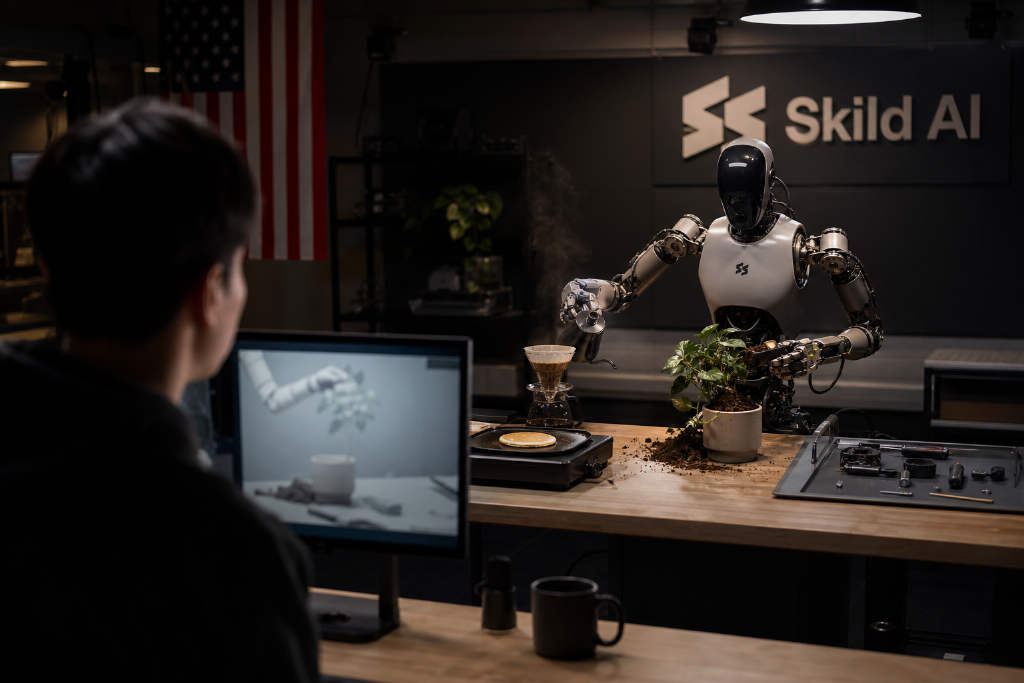
Skild AI has introduced S1, a new robot foundation model built around in-context learning rather than task-specific post-training. The company says the model can watch a single human demonstration video and then carry out an unfamiliar multi-step task without fine-tuning, post-training, or any change to model weights. In the company’s demos, S1 handled long-horizon tasks such as making pancakes, brewing coffee, repotting a plant, and assembling equipment, with task windows extending past 10 minutes. According to the figures cited in the source article, S1 reached a 66% success rate on out-of-distribution tasks, compared with 9% for a language-prompted vision-language-action baseline. The article also says a conventional post-training approach would need roughly 380 demonstrations to match the result S1 achieved after seeing just one example, while 2,000 demonstrations could push the traditional setup to 86%. The report frames S1 as part of a broader shift in embodied AI, comparing robotics today to the BERT era in language models and arguing that in-context learning could move robots closer to a GPT-style paradigm. It also highlights Skild AI’s background, including its founding by Carnegie Mellon University professors Deepak Pathak and Abhinav Gupta, and its funding history, from a $300 million Series A at a $1.5 billion valuation in 2024 to a $1.4 billion Series C in January at a valuation above $14 billion.

370
Skild AI Unveils S1, a Robot Foundation Model That Learns New Tasks From a Single Demo
Jeff Dean
2026-08-10 00:25:13

Jeff Dean’s Discovery Loop pitch deck surfaces, with Khosla and Radical named as co-leads

Jeff Dean’s new startup, Discovery Loop, is drawing attention after details from its pitch deck circulated online. Rather than spending much time on product-market slides, the presentation focuses on the founding team’s track record across Google Search, Ads, Gmail, Translate, Gemini, Cloud TPU, GFS, MapReduce, Bigtable, Spanner, TensorFlow, Pathways, and a long list of AI research and application milestones. It also highlights the scale of teams previously managed by the founders, along with their academic citation records in machine learning and distributed systems. The company says its mission is to automate machine learning, science, and engineering in order to speed up discovery and progress. Its core idea is an “automated experimentation loop,” where AI helps generate hypotheses, run large numbers of experiments, analyze results, and adjust the next round of work. According to the article, Discovery Loop will start with machine learning research and engineering, then may expand the same framework into computer hardware, drug discovery, and other scientific and engineering fields. Confirmed backers named in the report include Khosla Ventures, Radical Ventures, Lightspeed Venture Partners, Kleiner Perkins, and Doerr Capital, with Khosla and Radical listed as co-leads. Alphabet also participated and signed a long-term cloud computing agreement with the company. Axios, citing people familiar with the matter, said the round reached several hundred million dollars, though that figure has not been officially confirmed by Discovery Loop or its investors.

1020
Jeff Dean’s Discovery Loop pitch deck surfaces, with Khosla and Radical named as co-leads
AI
2026-07-22 07:54:07

ICML 2026 paper says random noise can serve as a transfer source in low-label learning

A study presented at ICML 2026 argues that transfer learning does not always need a semantically meaningful source domain. The paper, titled "Semi-Supervised Noise Adaptation: Transferring Knowledge from Noise Domain," introduces Semi-Supervised Noise Adaptation (SSNA) and a Noise Adaptation Framework (NAF) that builds class-separable structure from randomly sampled Gaussian noise, then aligns that structure with a target domain using a small number of labeled examples. Under a 4-labels-per-class setting and a ResNet-18 backbone, NAF outperformed the standard empirical risk minimization baseline on CIFAR-10, CIFAR-100, DTD-47, and Caltech-101 by 12.35, 7.61, 4.38, and 2.74 percentage points, respectively. The study also reported gains on fine-grained datasets, ImageNet-1K, and the AG News-4 text classification task with BERT. The code has been open-sourced. Ablation results in the paper suggest the useful part is not randomness itself, but whether the noise domain forms a separable class structure in representation space. When that structure collapses, performance falls sharply. When class centers are pulled farther apart, results improve. The work frames synthetic noise as a low-cost substitute when real source data cannot be shared because of privacy, confidentiality, or copyright limits.

340
ICML 2026 paper says random noise can serve as a transfer source in low-label learning
United States
2026-07-15 17:14:35

U.S. to issue $1 Trump commemorative coin for 250th anniversary

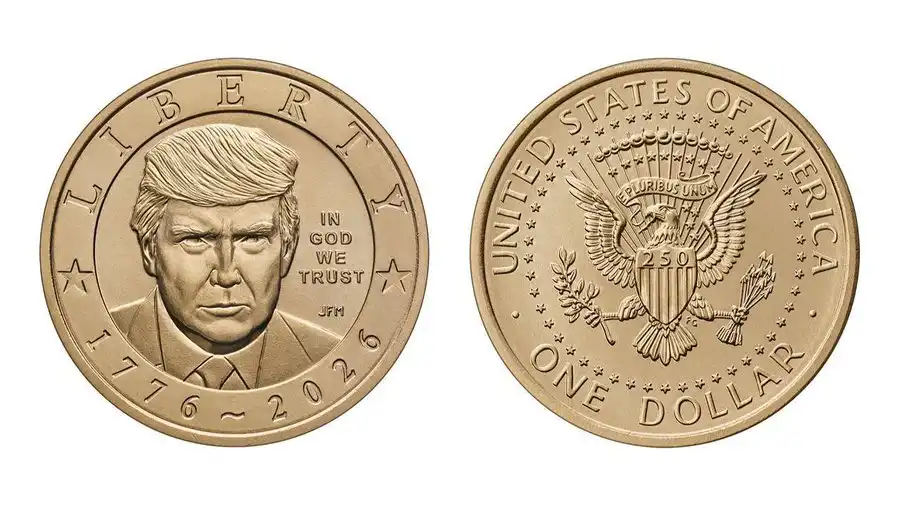
U.S. Treasury Secretary Scott Bessent said on July 16 that the United States Mint will produce a $1 commemorative coin to mark the 250th anniversary of the country’s founding. The coin will have a gold-colored appearance but will not contain actual gold or other precious metals. Its obverse will feature President Donald Trump in a suit and tie, along with the inscriptions “LIBERTY,” “IN GOD WE TRUST,” and the dates 1776-2026. The reverse will show the U.S. Great Seal eagle and the markings “$1” and “250.” The coin is expected to be released this fall. According to the report, the move breaks with the long-standing tradition that living presidents do not usually appear on U.S. currency. Bessent described the issue as “an enduring symbol of patriotism” and “a commemoration of the legacy of liberty.”

1150
U.S. to issue $1 Trump commemorative coin for 250th anniversary