CPU

SK Hynix
2026-07-29 03:06:00

SK Hynix posts record Q2 margins as HBM4 shipments and long-term deals lift demand visibility

SK Hynix reported record second-quarter 2026 revenue, operating profit and margins as higher DRAM and NAND pricing combined with expanding AI server memory demand. The company said HBM4 shipments began in Q2, while HBM4E samples built on its 1c nanometer process were delivered to major customers earlier than previously planned. Enterprise SSDs, server DRAM and SOCAMM2 also continued to scale. The numbers, however, still came in below consensus on both revenue and operating profit. Net profit surged, but the increase was heavily influenced by KRW 63.27 trillion in investment-related gains, which the source said market analysis linked mainly to the sale of Kioxia-related investment interests. That left operating profit, gross margin and operating cash flow as more relevant indicators for assessing core earnings quality. SK Hynix also said it had completed negotiations on long-term supply agreements with about 10 customers, including key accounts, adding pricing structures designed for memory price volatility. Some contracts include prepayment or deposit mechanisms. Even so, the market reaction remained volatile. Shares had fallen 14.65% the day before earnings, then rose more than 4% after the release before turning lower after the earnings call. By press time, the stock was down more than 11%, reflecting investor concern over results missing expectations, whether memory prices are near a peak, and the effect of expanding capital expenditure.

1300
SK Hynix posts record Q2 margins as HBM4 shipments and long-term deals lift demand visibility
US semiconduc
2026-07-29 00:49:10

US chip reshoring brings $770 billion in projects, but a 67,000-worker gap still looms by 2030

The US semiconductor buildout has become easy to measure in dollars and factory announcements. Since 2020, more than $770 billion in semiconductor supply-chain investment has been announced across 30 states and 160 projects, according to the Semiconductor Industry Association. The harder question is labor. In its 2026 State of the U.S. Semiconductor Industry report, SIA said the sector directly employs about 342,000 workers and supports nearly 2 million indirect and induced jobs, yet the industry could still face a shortage of roughly 67,000 technicians, engineers and computer-related professionals by 2030. That figure is not a count of currently vacant jobs. It comes from a 2023 projection model by SIA and Oxford Economics, which estimated that the industry would add about 115,000 jobs by 2030 and that around 67,000 of them could go unfilled under then-current graduation and labor-supply trends. The shortfall is spread across technicians, engineers and computer science roles, with training pipelines that look very different from one another. The article argues that the US response offers a policy lesson beyond subsidy size: workforce supply is being treated as part of semiconductor infrastructure. It also examines what that approach may mean for China, where new fabrication, packaging, materials and equipment projects are expanding faster than local talent systems in some regions can fully support.

1050
US chip reshoring brings $770 billion in projects, but a 67,000-worker gap still looms by 2030
CXMT
2026-07-28 02:03:46

July 28 crypto and tech roundup: CXMT’s blockbuster debut, domestic DUV production, and a packed day for AI and regulation

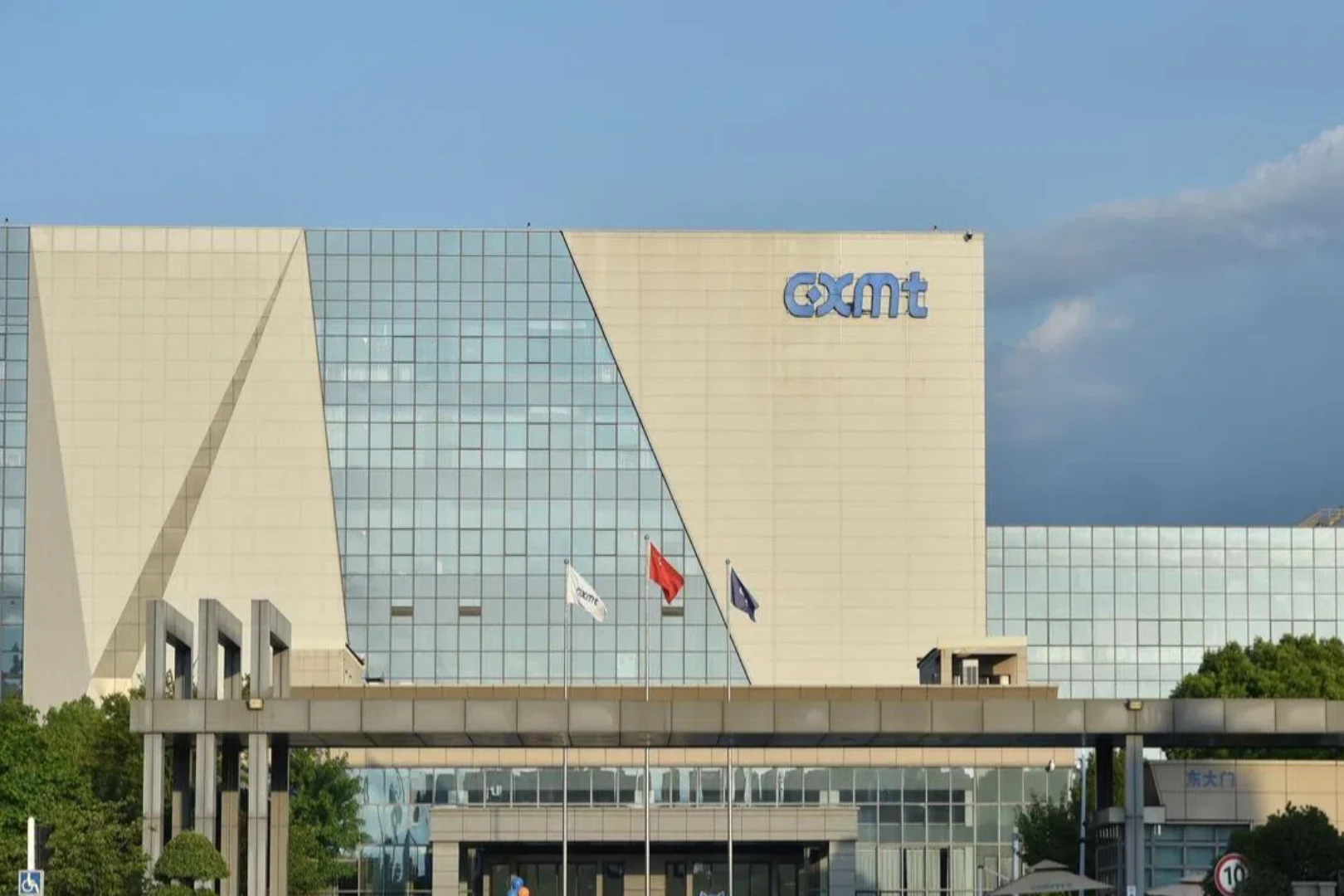
July 28 brought a dense mix of crypto market moves, semiconductor headlines, AI developments, and regulatory updates. In equities tied to China’s chip sector, CXMT posted a 465.82% gain on its first trading day, with turnover topping RMB 140 billion and market capitalization reaching RMB 3.28 trillion. Separate reporting cited by The Information said a Shanghai state-backed company has started mass production of self-developed DUV lithography manufacturing equipment, with output planned at around five units in 2026 and about 20 in 2027; SMIC, Hua Hong Semiconductor, and CXMT were named as intended customers. In crypto, most of the highest-volume CEX tokens were down over the past 24 hours, while AEON led the OKX gainers list with an 84.28% rise. Hyperliquid data around the CXMT IPO drew attention after Allium said pre-listing volume reached $17.8 million and that 96% of smart-money accounts had established profitable shorts before the open. Elsewhere, Strategy disclosed its first buyback of Stretch STRC shares under its digital credit securities repurchase plan, and Triple-A’s reported exploit losses expanded to $11.8 million. On policy, BlackRock backed the CLARITY Act, but the U.S. Senate temporarily set the bill aside, while lawmakers in Japan called for easing the country’s 2x crypto leverage cap.

840
July 28 crypto and tech roundup: CXMT’s blockbuster debut, domestic DUV production, and a packed day for AI and regulation
CXMT
2026-07-27 10:00:00

CXMT’s STAR Market debut lifts valuation above $3.2 trillion yuan, handing Hefei a paper gain of more than 1.2 trillion yuan

Changxin Technology, also known as CXMT, made its debut on Shanghai’s STAR Market on July 27, 2026, closing at 49 yuan, up 465.82% from its offer price and pushing its market capitalization above 3.2 trillion yuan. That made it the largest company on China’s A-share market by market value, according to the source text, surpassing Industrial and Commercial Bank of China. Behind the listing stands Hefei, which spent a decade backing the memory-chip maker through losses that accumulated to 36.65 billion yuan. Based on an approximately 36.79% holding across Hefei’s state-owned capital system, the city’s paper stake is now worth more than 1.2 trillion yuan. The article traces founder Zhu Yiming’s path from GigaDevice to CXMT, the company’s legal acquisition of DRAM technology assets from Qimonda, the 2019 launch of its 8Gb DDR4 chip, and the severe 2023 downturn that drove annual losses to 16.34 billion yuan. It also details how Hefei kept adding capital, including nearly 2 billion yuan used to buy existing shares at the end of 2024, and argues that the investment reshaped the city’s industrial base, expanding its integrated-circuit cluster to more than 450 companies by the end of 2025.

880
CXMT’s STAR Market debut lifts valuation above $3.2 trillion yuan, handing Hefei a paper gain of more than 1.2 trillion yuan
AMD
2026-07-27 05:33:10

AMD to set up AI research center in South Korea under chip ecosystem pact

AMD will establish an AI research center in South Korea as part of a new cooperation framework on AI chip ecosystems, according to South Korea’s Ministry of Science and ICT. The ministry said on July 27 that it signed a memorandum of understanding with AMD in San Francisco on July 23. Under the plan, AMD will launch an AI Center of Excellence in South Korea to support technical cooperation among local companies, universities, and research institutions. The center is expected to back AI chip software development, computing technology validation, and joint research. AMD also plans to work more closely with domestic South Korean AI chip companies. The memorandum also covers the construction of heterogeneous AI computing infrastructure. That setup would connect AMD’s CPUs and GPUs with AI chips from South Korean companies that are described as having strengths in inference, including NPUs. The two sides also aim to build an open AI computing ecosystem with participation from South Korean companies across memory, networking, servers, and software. The report was cited by Yonhap News Agency.

680
AMD to set up AI research center in South Korea under chip ecosystem pact
Bitget
2026-07-27 02:30:56

Bitget UEX daily: Oil drops as US-Iran strikes pause, while Big Tech earnings take center stage this week

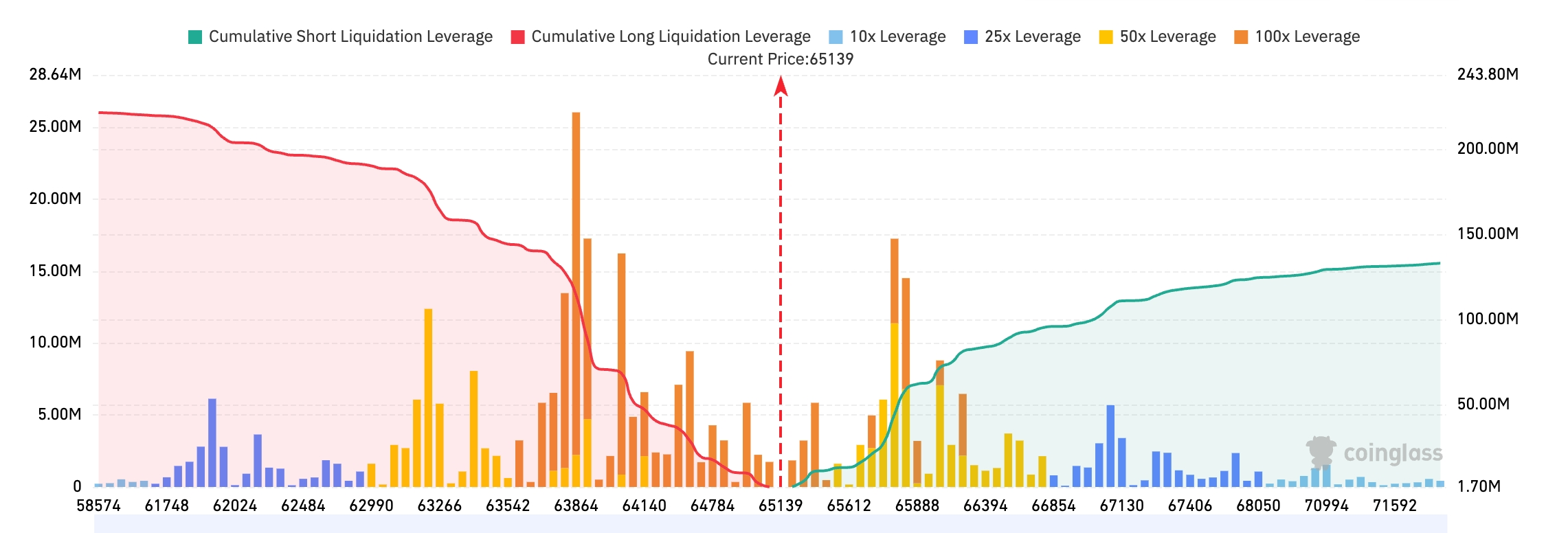
Bitget UEX’s latest market note said easing tensions between the United States and Iran helped push crude prices sharply lower, cooling some of the inflation and rate-hike concerns that had built up during the previous oil rally. The report said the shift improved risk appetite across markets, with crypto recovering alongside other risk assets. BTC traded around $65,195 and ETH around $1,974, while total crypto market capitalization rose to roughly $2.31 trillion. In liquidation data, 24-hour liquidations reached about $213 million, including $160 million in short liquidations. The note also reviewed a mixed close in US equities last Friday. The Dow and S&P 500 ended slightly higher, while the Nasdaq slipped, reflecting continued pressure on technology shares. Apple rose 3.53%, while Nvidia, Amazon, Meta and Tesla fell. Sector performance was uneven as semiconductor, memory and optical communications names sold off, while some software stocks outperformed. Looking ahead, the report highlighted this week’s major macro events, including the Federal Reserve’s rate decision, US core PCE and GDP data, along with earnings from Apple, Meta, Amazon, Microsoft, Qualcomm and SK Hynix.

900
Bitget UEX daily: Oil drops as US-Iran strikes pause, while Big Tech earnings take center stage this week
Intel
2026-07-26 23:59:01

Intel says Q2 server CPU ASP rose 48% year over year

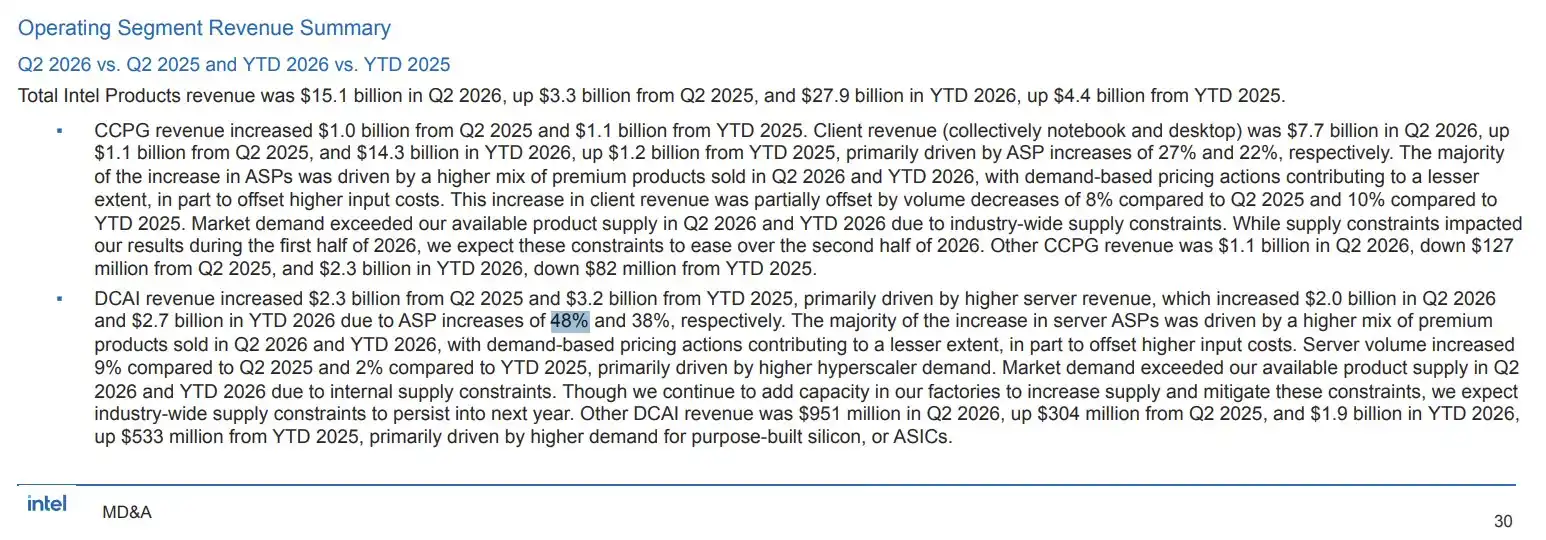
Intel said in its Q2 2026 Form 10-Q that the average selling price of its server CPUs climbed 48% from a year earlier. The filing linked the increase to a higher mix of high-end server products and strong demand, which helped lift revenue in its data center and AI segment by $230 million. Intel’s total revenue for the period also rose 25% year over year to $16.1 billion. The higher ASP points to stronger pricing power in the server market and a recovery in the company’s related business lines, based on the figures disclosed in the filing.

750
Intel says Q2 server CPU ASP rose 48% year over year
AMD
2026-07-25 03:50:26

AMD unveils MI400, Venice and Helios as Meta, OpenAI and Anthropic line up gigawatt-scale orders

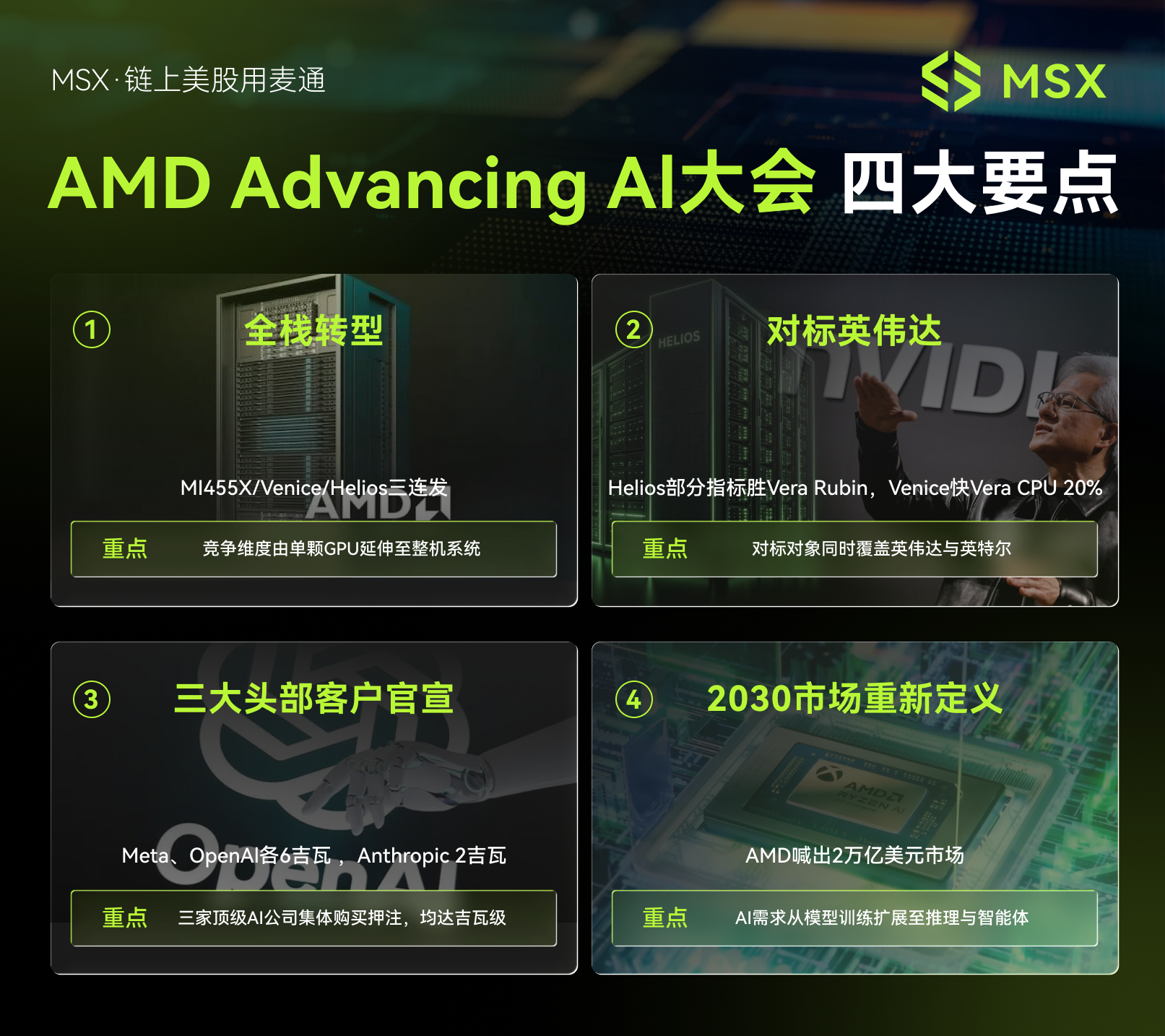
Advanced Micro Devices used its Advancing AI 2026 event in San Francisco on July 22-23 to roll out three major products at once: the Instinct MI400 accelerator family, the EPYC "Venice" server CPU, and the Helios rack-scale AI platform. The release, as described by MSX Research Institute, shows AMD shifting its pitch from being an alternative GPU supplier to Nvidia toward becoming a full-stack AI infrastructure provider spanning chips, systems, networking and software. CEO Lisa Su also laid out a broader market thesis, saying the total computing market could reach $2 trillion by 2030, including $1.4 trillion for AI accelerators and $200 billion for data-center CPUs. AMD claimed Helios, built around MI455X accelerators, can outperform Nvidia’s next-generation Vera Rubin platform on some key metrics, while Venice can deliver up to 3.4x the performance of Intel Xeon and about 20% more than Nvidia’s Vera CPU. On the customer side, Meta, OpenAI and Anthropic have all committed gigawatt-scale orders. MSX said Meta and OpenAI each secured warrants for as many as 160 million AMD shares, equivalent to about 10% of AMD equity each, while AMD may invest up to $5 billion in Anthropic. Still, MSX noted the performance claims are AMD’s own and said investors are now watching whether MI400, Venice and Helios can turn into sustained revenue.

870
AMD unveils MI400, Venice and Helios as Meta, OpenAI and Anthropic line up gigawatt-scale orders