CVD

Bitcoin
2026-09-16 01:24:02

Willy Woo says U.S. investors sold after CLARITY vote failed while offshore markets kept buying

Bitcoin analyst Willy Woo said selling from U.S. investors picked up after the CLARITY Act failed to clear a procedural vote in the Senate, pointing to exchange cumulative volume delta data as evidence. According to Woo, Coinbase’s CVD accelerated lower to about negative 6,659 BTC, while Binance’s CVD recovered from its lows to around negative 5,841 BTC. He said that pattern suggests offshore markets, which he described as more dominant, were still absorbing supply. At the same time, Bitcoin pulled back from a high of $80,560 and briefly fell to $74,968. Woo also cited CVD readings from other venues, with Bybit at roughly negative 582 BTC, OKX at negative 1,135 BTC, and Bitstamp at negative 764 BTC. He characterized the divergence between Coinbase and Binance flows as bullish.


300
Willy Woo says U.S. investors sold after CLARITY vote failed while offshore markets kept buying
SEMICON Taiwa
2026-09-14 07:15:41

Post-SEMICON Taiwan takeaways: FOPLP, glass substrates and silicon photonics open five new supply-chain angles

A post-event discussion from Statementdog following SEMICON Taiwan highlighted how the semiconductor supply chain is being reshaped as AI computing pushes performance and power demands higher. The program focused on order spillover from wafer foundries into advanced packaging, the rise of fan-out panel-level packaging (FOPLP), new thermal materials such as diamond and insulating silicon carbide, and the growing importance of high-precision optical alignment equipment for co-packaged optics (CPO). The discussion said advanced packaging is no longer confined to foundries. OSAT companies including ASE, SPIL and Powertech, along with European players, are expanding more aggressively into the segment, with capital spending in many cases rising by more than 100% as they try to replicate and refine advanced packaging processes. Statementdog also pointed to TSMC’s expected adoption of ASML’s High-NA EUV tools around 2030 as a sign of its strategy of delaying mature-spec adoption to pursue what it described as the best cost efficiency. Beyond packaging, the program flagged five areas to watch: order spillover tied to European capacity expansion, still-unsettled thermal material standards, diverging FOPLP process routes, high-priced optical alignment platforms for silicon photonics and CPO, and equipment demand linked to the shift from glass carriers toward glass substrates and interposers.

980
Post-SEMICON Taiwan takeaways: FOPLP, glass substrates and silicon photonics open five new supply-chain angles
ChainFeeds
2026-09-10 01:57:46

ChainFeeds roundup tracks L2 economics, Bitcoin inflows and token screens

ChainFeeds’ Sept. 10 research roundup pulled together several separate threads across crypto markets and infrastructure. One piece argued that the commercial success of Ethereum layer-2 networks such as Base and Robinhood Chain does not automatically feed back into Ethereum’s own fundamentals, even when those networks generate meaningful revenue. Another highlighted glassnode’s latest view on Bitcoin: spot momentum has cooled after the late-August rebound, but institutional demand has picked up again, with U.S. spot Bitcoin ETFs posting stronger net inflows. The newsletter also reviewed a screen for large-cap tokens whose revenue growth may not yet be reflected in price. Starting with the top 300 tokens by market capitalization, the framework narrowed the list to just two names, Jupiter and Orca, after comparing valuation, revenue growth, and relative price performance. Separately, the roundup included a look at Robinhood Chain’s emerging application layer, including launchpads, credit infrastructure and liquidity designs, and a report on Anthropic’s planned IPO push at a reported $2 trillion valuation. Together, the package presents a cross-section of current debates around blockchain business models, Bitcoin market structure, token fundamentals and AI-linked capital markets activity.

1120
ChainFeeds roundup tracks L2 economics, Bitcoin inflows and token screens
Bitcoin
2026-09-09 05:11:21

Glassnode says Bitcoin spot momentum cooled as leverage built during $80,000 range trading

Bitcoin has been trading near the $80,000 mark, but Glassnode data suggests the market structure underneath that sideways move has become more uneven. In its Sept. 8 report, the on-chain analytics firm said Bitcoin was around $79,100 at the time, up just 0.7% over the week and holding within a $77,300 to $81,300 range after the late-August rally gave way to consolidation. Spot activity weakened during that period. Glassnode said its Spot Momentum indicator fell 30% week over week to 54.6, while spot volume stayed near $5.3 billion with little change. Spot CVD improved from negative $84.9 million to negative $29.6 million, which pointed to fading aggressive selling but not a clear shift into strong active buying. At the same time, derivatives exposure kept rising. Bitcoin futures open interest increased 1% to $37.1 billion, and options open interest rose 2.1% to $40.1 billion. Yet Glassnode did not describe the setup as outright overheated long leverage, noting that long-side funding payments fell 32.8% to $1.3 million and perpetual CVD improved sharply. The options market looked more constructive, with 25-Delta Skew dropping from +0.79% to -2.05% and volatility spread falling to -20.9%. Meanwhile, U.S. spot Bitcoin ETFs posted net inflows of $681.2 million for the latest week, while ETF trading volume fell 19.2% to $12.1 billion.

980
Glassnode says Bitcoin spot momentum cooled as leverage built during $80,000 range trading
semiconductor
2026-09-02 12:13:13

China’s chip equipment push moves into tougher territory as metrology advances and bottlenecks persist

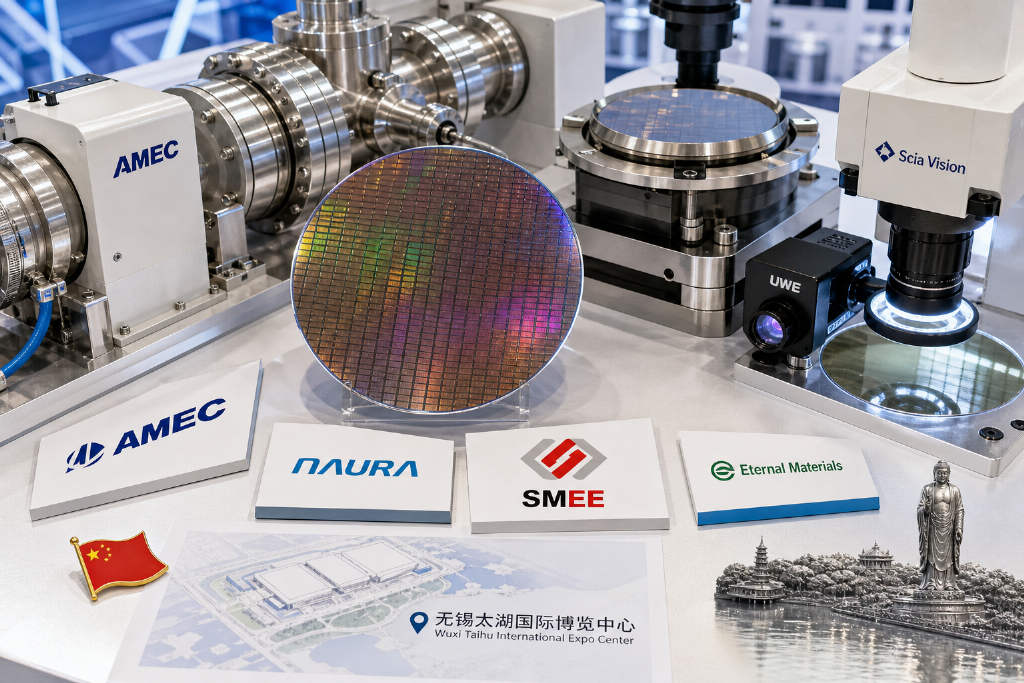
China’s semiconductor equipment industry is entering a more demanding phase, with the easiest import-substitution wins largely behind it and harder categories now drawing the most attention. At CSEAC 2026 in Wuxi, equipment makers and component suppliers used the show to present where domestic progress stands across process tools, metrology and inspection systems, advanced packaging, and core parts. In process equipment, companies such as Advanced Micro-Fabrication Equipment Inc. China (AMEC), NAURA, and Shanghai Micro Electronics Equipment showed continued expansion across etch, deposition, and lithography-related systems. But ion implanters remain a major weak spot. According to data cited by Aion Semiconductor, overall localization in ion implantation is still below 15%, with high-current tools below 10% and high-energy tools largely blank. Metrology and inspection appear to be moving faster. eGenerate, Yuwei Semiconductor, and SDRA were among the companies highlighted for equipment already in volume delivery or advanced validation. In advanced packaging, wafer-to-wafer bonding is more mature, while die-to-wafer bonding is still largely in validation. The report also points to continued progress in domestic core components, arguing that the sector is shifting from isolated breakthroughs toward broader ecosystem building, even as trust barriers, validation constraints, and long R&D cycles remain in place.

990
China’s chip equipment push moves into tougher territory as metrology advances and bottlenecks persist
Bitcoin
2026-08-31 16:28:24

Glassnode says Bitcoin rebound remains intact as institutional allocation and speculative leverage rise

Bitcoin is holding near $78,600 after briefly breaking above $80,000, and the rally that started from the $64,000 area in late August has largely stayed in place, according to Glassnode. The firm said broader digital asset markets still show solid institutional demand, even as spot and derivatives trading activity has cooled in some pockets. It also pointed to signs that market order flow may be shifting, with secondary-market volume and spot cumulative volume delta indicating weaker retail participation. At the same time, capital continues to move into regulated crypto investment products, while U.S. spot Bitcoin ETF holdings remain in profit and have continued to record weekly net inflows. Glassnode added that shorter-term, price-sensitive capital is entering the market alongside elevated options open interest and a rapid narrowing in volatility spreads, a combination that may suggest traders are underpricing near-term volatility risk. On-chain data shows a similar split: settlement activity remains elevated, but user participation is softening, with entity-adjusted transfer volume above normal levels while daily active addresses and total fee revenue edge lower. Overall, Glassnode said Bitcoin is moving from a phase of strong upside into one marked by structural divergence, with solid underlying support but rising risks of short-term volatility and pullbacks.

670
Glassnode says Bitcoin rebound remains intact as institutional allocation and speculative leverage rise
AMEC
2026-08-31 12:11:14

AMEC’s rise in etching tools puts China chip equipment makers under a brighter global spotlight

A long-form report carried by MarsBit and credited to WeChat account HSTL8888 traces how Advanced Micro-Fabrication Equipment Inc. China, or AMEC, moved from a startup backed by local government funding in Shanghai to a supplier validated by Taiwan Semiconductor Manufacturing Co. The piece opens with a Reuters report from early August saying Samsung Electronics and SK Hynix were evaluating AMEC chipmaking tools for use in their fabs in China, and that testing of the company’s etching tools may have started about two years ago. Samsung later denied it had ever considered the move, while SK Hynix declined to comment. The report then broadens into a history of China’s semiconductor equipment industry, covering AMEC, Piotech-related deposition efforts, Hwatsing for CMP, Skyverse for wafer inspection, ACM Research Shanghai for cleaning tools, and NAURA as a platform-style equipment company built through acquisitions. It argues that tightening U.S. export controls, support from domestic fabs such as Semiconductor Manufacturing International Corp. and funding through the National Integrated Circuit Industry Investment Fund together accelerated localization. Citing industry and official figures, the article says China’s overall localization rate in semiconductor equipment rose from under 5% to about 20% by 2025, while major foundries kept capacity utilization above 90% in the first seven months of this year.

930
AMEC’s rise in etching tools puts China chip equipment makers under a brighter global spotlight
Semiconductor
2026-08-24 11:55:11

Used semiconductor tools gain strategic weight as mature-node demand stays firm

Used semiconductor equipment is moving from a low-cost backup option to a core asset in mature-node chip manufacturing, as demand for automotive power devices, industrial control chips, analog chips, IoT MCUs and sensor chips remains strong. The article says many of these products continue to rely on 90nm to 28nm processes, while advanced-node development costs, tape-out fees and equipment spending keep rising and the performance gains from each generation narrow. According to the source, the global market for used semiconductor equipment exceeded 26 billion yuan in 2024 and could approach 66.5 billion yuan by 2031, implying a six-year compound annual growth rate of 14.4%. Supply conditions have also changed. Major chipmakers that once released retired tools into the secondary market are now keeping older equipment for internal process conversions, niche capacity expansion and maintenance, reducing the pool of tradable assets. The report also points to a structural mismatch inside the industry. Semiconductor manufacturing requires extreme precision and standardization, but the used-equipment trade still lacks unified grading standards, testing rules, warranty systems and credible third-party inspection institutions. At the same time, tighter global controls have expanded from advanced equipment and technology to retired tools, refurbished systems, spare parts, calibration services and firmware updates, making used tools a more important part of supply-chain security planning.

1070
Used semiconductor tools gain strategic weight as mature-node demand stays firm