Kling AI2026-09-01 08:32:25National AI Fund Injects 1.4B Yuan into Kuaishou's Kling AIKuaishou's Kling AI has secured an equity investment from a national-level industry fund. According to the official announcement, the National Artificial Intelligence Industry Investment Fund injected 1.4 billion yuan into Beijing Kling, and Zhengda Robot invested approximately $19.29 million, which is equivalent to about 131 million yuan. This transaction marks a follow-up closing of the nearly $3 billion financing plan that Kling disclosed back in July. The same announcement further states that the capital increase ceiling of approximately 20.447 billion yuan, or roughly $3 billion, has been fully used up. After the completion of this round, the National Artificial Intelligence Industry Investment Fund and Zhengda Robot each hold approximately 1.14% and 0.11% stakes, respectively. The fund participating in this round, namely the National Artificial Intelligence Industry Investment Fund, has a total asset scale of around 60.06 billion yuan, and it is controlled by Phase III of the National Integrated Circuit Industry Investment Fund.820
Tencent2026-08-28 07:06:42Tencent Tests Expert-Level AI Model Hy4 in Yuanbao AppTencent is testing an expert-level AI model named Hy4 in its Yuanbao app, Techub News reported. The move reflects intensifying competition in China's AI space, and Crypto Briefing says it could reshape global tech dynamics and leadership in innovation.970
Embodied AI2026-08-27 07:44:1018 university-backed embodied AI startups disclosed about 15 billion yuan in funding in the first eight months of 2026A new article tied to ITjuzi’s latest report on China’s embodied AI startup landscape spotlights a distinct group inside the sector: companies founded or incubated directly by universities, professors and research institutes. Using a narrower definition of what it calls the “academic camp,” the piece identifies 18 embodied AI companies and estimates that, in the first eight months of 2026, their disclosed fundraising reached roughly 15 billion yuan, with more than 13 billion yuan specifically disclosed. The article separates these companies into two groups. One includes startups led by professors who still hold university posts while building companies and drawing on school resources. The other covers businesses spun out directly by universities, research institutes or laboratory platforms. The list spans Tsinghua University, Peking University, Zhejiang University, Shanghai Jiao Tong University, Fudan University, Westlake University, the Beijing Academy of Artificial Intelligence, the Beijing Institute for General Artificial Intelligence and institutions tied to the Chinese Academy of Sciences. The article argues that Tsinghua-linked projects appear especially often in embodied AI, while university capital is also starting to invest directly rather than limiting ties to patents or technology transfer. At the same time, it notes that academic teams still face hard commercial challenges in manufacturing, supply chains and overseas distribution.750
Huawei alumni2026-08-24 11:36:18Huawei-linked founders pull in about $1.2 billion as embodied AI funding clusters in early-stage dealsHuawei alumni have become one of the strongest fundraising groups in China’s embodied intelligence sector this year, according to incomplete data cited from ITjuzi. From Jan. 1 to Aug. 14, 2026, 12 embodied AI companies founded or co-founded by entrepreneurs with Huawei backgrounds completed 24 financing rounds, with total funding estimated at roughly 8.635 billion yuan. The pace was heavily concentrated in early stages, with 9 angel rounds, 5 seed rounds and 5 Pre-A rounds, meaning more than 80% of the deals landed before companies had spent much time in market. Capital was also concentrated at the top. X Square Intelligence, founded less than two years ago by former Huawei autonomous driving CTO and chief scientist Chen Yilun and former Baidu intelligent driving executive Li Zhenyu, closed a $455 million Pre-A round in April, described in the report as the largest single financing round in China’s embodied intelligence industry. Kunlunxing Robotics also raised funding worth tens of billions of yuan, and the two companies together accounted for about 70% of the Huawei-linked total. Other names highlighted in the report include Ola Wanxiang, Knowin Intelligence, Gunao Panshi, Beta Infinite, Moxi Intelligence, Moushen Intelligence, Yuansheng Intelligence, Xinzhi Jushen, Zhicheng AI and Qiwu Technology.1340
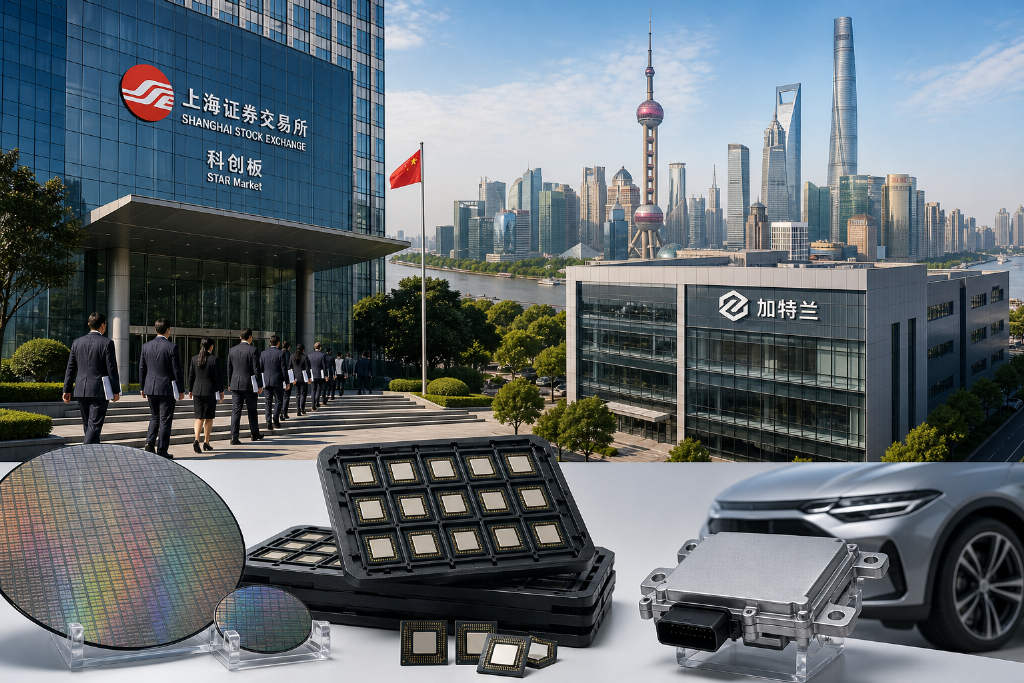
Calterah2026-08-22 02:28:10Shanghai automotive chip unicorn Calterah files for STAR Market listingCalterah Microelectronics, a Shanghai-based automotive radar chip unicorn, has filed for a STAR Market IPO and plans to raise 3.489 billion yuan. The company says its 2025 share of China’s in-vehicle millimeter-wave radar chip market reached 31.1%, with more than 30 million chips shipped and customers including BYD, Geely, Nio and Volvo. Over 12 years, it completed 11 funding rounds and crossed a 10 billion yuan valuation.1380
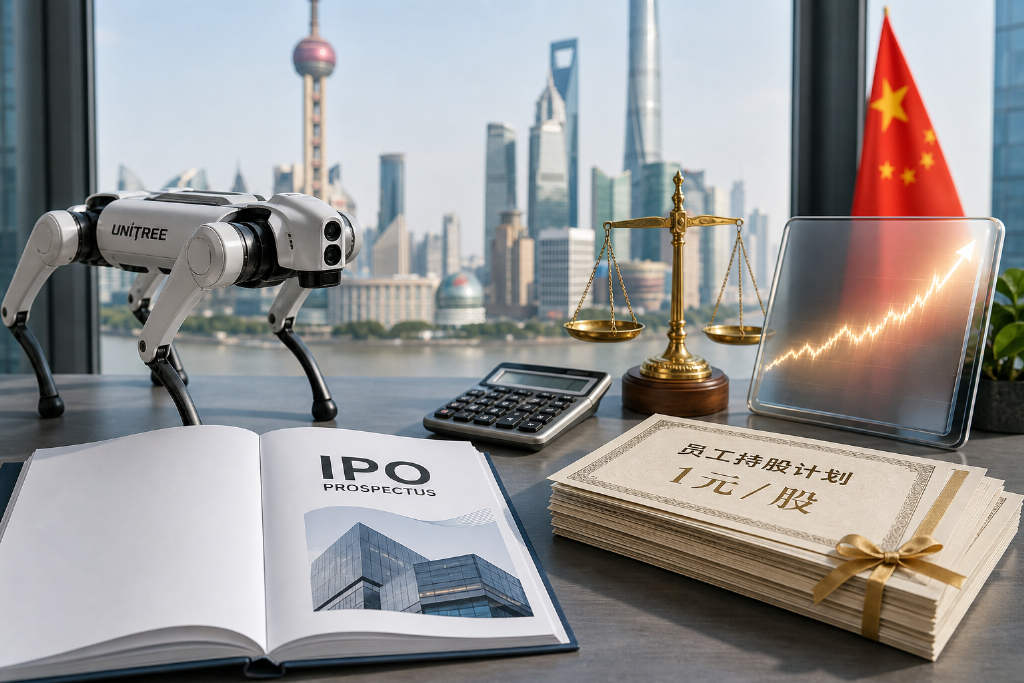
Unitree2026-08-19 08:37:29Unitree listing spotlights employee options granted at RMB 1, with some paper gains reaching RMB 1.58 billionUnitree Technology debuted on Shanghai’s STAR Market on Aug. 19, opening up 629% at RMB 1,100 and briefly reaching a market capitalization of RMB 444.9 billion, according to the source article. While much of the attention went to founder Wang Xingxing, outside investors and first-day retail gains, the prospectus also showed how the company’s employee incentive structure turned early stock options into enormous paper wealth for some staff members. A limited partnership called Shanghai Yuyi holds 10.94% of Unitree and serves as the company’s employee equity incentive platform. The article says the first batch of options, priced at RMB 1 per unit of registered capital and granted in 2017 when the company was struggling to pay wages, was ultimately housed in that structure. Based on the first trading day price cited in the report, Yang Zhiyu, Chen Li and Zhang Yangguang — three core employees born in the 1990s — saw their paper holdings rise to about RMB 1.58 billion, RMB 840 million and RMB 480 million, respectively. The report also said Unitree created two employee asset management plans for its IPO strategic placement, with 171 executives and core staff subscribing a combined RMB 272 million. At the same time, the gains remain largely unrealized because of lock-up periods, performance-based vesting terms and employee departures that already led to canceled incentive quotas before the prospectus signing date.570
Embodied AI2026-08-13 04:11:12China’s Embodied AI Boom Is Running Into a New Problem: Many Startups Still Don’t Know How to SpendChina’s embodied AI sector has moved from a funding shortage to a capital management problem. A lengthy report carried by MarsBit, citing Leo Zhang ToB Notes and written by Zhang Shenyu, describes how startups flush with cash are now exposing opposite but equally damaging habits: reckless spending and excessive frugality. One investor said a well-known embodied AI company paid RMB 100 million in cash and equity for just a few minutes of gala exposure without board or shareholder approval. The campaign failed to show the value of its product, the investor said, and the spending reduced the firm’s R&D ratio enough to hit a Hong Kong listing rule threshold, potentially forcing it to re-queue for an IPO attempt. At the other extreme, another company reportedly had more than RMB 100 million on its books but refused to send hardware staff to oversee production lines in person, choosing remote video acceptance for more than 100 robots. A potential investor later learned of that decision and dropped the financing. The report argues that with hundreds of billions of yuan flowing into embodied AI, founders and investors alike are struggling to measure what spending should look like in a sector defined by heavy costs in talent, compute, data and hardware, but few mature benchmarks for judging whether the money is producing real progress.1660
Shenzhen2026-08-10 05:18:11Shenzhen IPO wave delivers gains to state-backed investors across Chinese citiesShenzhen is emerging as a major source of IPO-driven returns for state-backed investors across China, according to the article republished by MarsBit from the WeChat account Zhengjieju. The piece says Shenzhen has added 26 domestic and overseas listed companies so far this year, the highest total among large and mid-sized Chinese cities, and argues that many of those listings have created sizable paper gains for government capital and industry funds from outside the city. The article highlights several cases. AI storage chip company Dapu Micro listed on ChiNext on April 16 at RMB 46.08 per share and now has a market value above RMB 200 billion. Shenzhen’s Longgang district guidance fund, which invested RMB 20 million in 2019, still held 5.6991 million shares at the time of listing, with a market value above RMB 2 billion. Nanjing Qilin Venture Capital, which invested RMB 80 million in 2020 for a 5.18% stake, is described as the company’s largest state-owned shareholder. It also points to HKC Corp., listed on the Shenzhen Stock Exchange main board on June 26, where state-backed investors from Mianyang, Liuyang in Changsha, Chongqing, Gui’an and Chuzhou recorded gains after earlier strategic investments. The article frames this as a model of regional coordination: Shenzhen incubates technology companies, outside cities invest through equity, and manufacturing capacity is then deployed in multiple locations.2110