NVIDIA2026-09-21 14:59:26NVIDIA open-sources OpenShell to give AI agents a sandboxed runtimeNVIDIA has released OpenShell, an open-source secure runtime designed to provide a sandboxed execution environment for AI agents. The company said the project is meant to enforce security policies at layers agents cannot directly reach, while managing agent access to data, networks, and system resources. Two companies have already built on top of it: Cisco’s DefenseClaw, which adds a governance layer, and JFrog, which has integrated OpenShell to scan and validate agent skills and enforce policies over which skills an agent may access. In a blog post, NVIDIA argued that AI security should be treated as an engineering problem rather than a single-point feature. It said security controls need to be applied across every layer of the agent stack, including traceable identity, restricted access permissions, and logging for tool calls and authorization decisions. The announcement was cited by Techub, referencing NVIDIA’s blog.380
Cisco2026-09-15 14:32:45Cisco and Nvidia expand Splunk agentic AI partnershipChainCatcher reported that Cisco (CSCO.O) and Nvidia (NVDA.O) have expanded their cooperation agreement around Splunk’s agentic artificial intelligence initiative. The brief source report named the two companies and said the partnership had been broadened, but it did not provide additional terms, financial details, product updates, or a timeline beyond the published newsflash. Based on the available information, the confirmed fact is limited to an expanded agreement involving Cisco, Nvidia, and Splunk’s agentic AI collaboration.740
Cisco2026-09-10 09:05:50Cisco teams up with Palantir and Nvidia on secure AI factoryCisco said it will work with Palantir and Nvidia to build a secure artificial intelligence factory, according to a brief report published by ChainCatcher. The stated goal of the effort is to simplify AI deployment. No additional details were provided in the source about the structure of the partnership, the rollout timeline, the products involved, or any financial terms. The announcement, as cited in the original item, focuses on the collaboration itself and its intended use in making AI deployment easier.720
AMD2026-08-31 11:21:12AMD, Cisco and Humain to deploy AI infrastructure from 2027Odaily, citing Jin10, reported that Advanced Micro Devices Inc. (AMD.O), Cisco Systems Inc. (CSCO.O) and Humain plan to deploy artificial intelligence infrastructure starting in 2027. The project is described as having a total capacity of up to 250 megawatts. No further details were provided in the input on where the infrastructure will be built, how the rollout will be structured, or the size of the investment. The brief identifies the companies involved, the planned start date and the maximum capacity figure, but does not add information on timelines beyond 2027, technical specifications or financing arrangements.970
Cisco2026-08-27 10:19:02Cisco Talos says Russian-speaking hackers are weaponizing Cursor for cyberattacksCisco Talos said in a new report that Russian-speaking hackers have been found weaponizing Cursor, an AI coding tool, to carry out cyberattacks. The finding points to a growing security risk tied to the misuse of generative AI tools beyond their intended development use cases. According to the report, the abuse of tools like Cursor highlights an urgent need for stronger safeguards during AI development, along with clearer ethical standards for how such systems are built and deployed. The update was cited by Techub News, which referenced Crypto Briefing. No additional technical details about the attacks were provided in the source digest, but the core takeaway from the Talos report is that offensive use of AI-assisted coding tools is no longer theoretical and is now being observed in practice.360
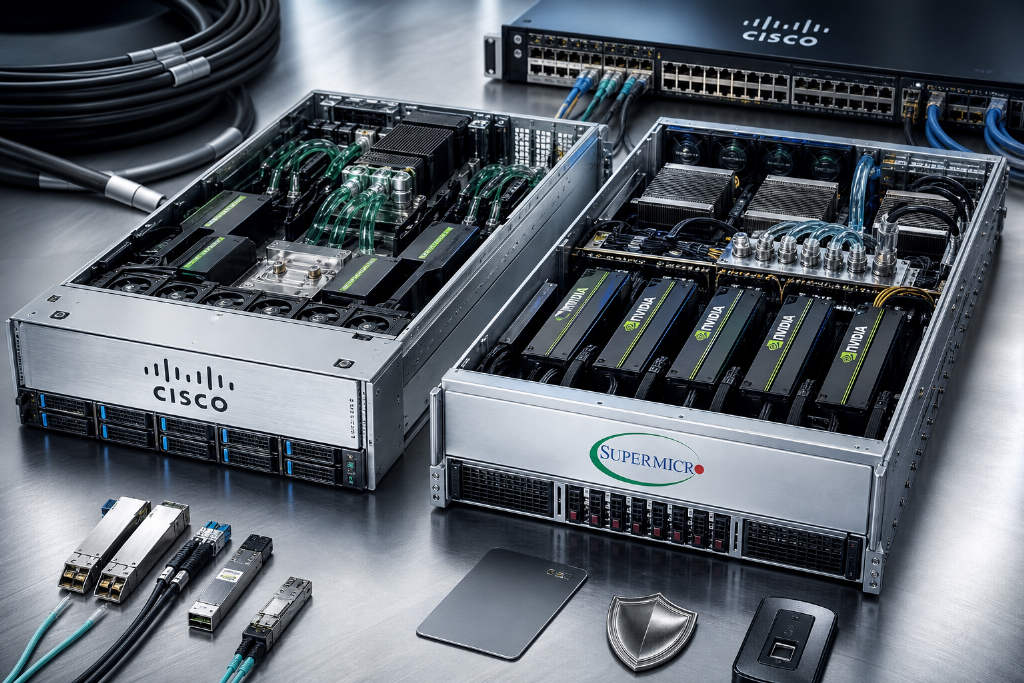
Cisco2026-08-25 14:12:24Cisco teams up with Supermicro on AI infrastructure offering for enterprisesCisco said on Aug. 25 that it has entered a partnership with Supermicro to bring NVIDIA-powered AI computing systems into its Secure AI Factory platform, creating a pre-validated, one-stop infrastructure deployment package for enterprise customers. The offering is scheduled to launch in October 2026. The companies said the setup combines Supermicro’s high-density servers, including both liquid-cooled and air-cooled configurations, with Cisco’s networking, security, and observability stack. The aim is to give enterprises an integrated path to AI infrastructure deployment without requiring them to assemble hardware from multiple vendors on their own. Cisco President Jeetu Patel said the company is working to position itself as a key infrastructure provider for the AI era. The announcement was carried by Techub, citing CryptoBriefing.870
Cisco2026-08-25 12:01:45Cisco and Nvidia Expand Secure AI Factory for the Rack-Scale EraChainCatcher reported that Cisco and Nvidia are working together to expand a secure AI factory as they prepare for the rack-scale era. No further details were disclosed in the source, including the scope of the expansion, product specifics, timelines, or any technical rollout plan. The item only states the partnership and its stated purpose, and does not provide additional context or metrics.860
Cisco2026-08-25 12:20:51Cisco Partners With Super Micro to Add AI Servers to Infrastructure PortfolioCisco is working with Super Micro Computer to add high-performance AI servers to its infrastructure lineup, according to Axios. The company said the collaboration will bring high-density liquid-cooled and air-cooled systems into its Secure AI Factory offering, which it is building with Nvidia support. Cisco is also expanding beyond networking equipment as it pushes further into AI infrastructure and aims to sell more hardware used to run AI workloads.940