BackFranklin

Franklin

Whale Activit
2026-08-13 02:17:00

Crypto and AI roundup for Aug. 12-13: whale transfers, regulation moves and fresh fundraising

A dense stream of updates hit crypto and AI markets between Aug. 12 and Aug. 13, spanning venture funding, protocol incidents, regulatory moves, exchange actions and large on-chain transfers. PANews’ roundup included Lovable’s $400 million Series C at a $13.3 billion valuation, Wintermute’s plan to spend about $1 billion over five years on high-frequency trading and AI data center infrastructure, and Tencent’s second-quarter results showing higher capital expenditure tied to AI spending. In digital assets, Harmony said it had traced fraudulently minted tokens across 409 wallets and was considering a rollback, while Solana briefly came close to a network-freeze threshold after a data center routing issue knocked nearly 29% of staked SOL offline. Anchorpoint also began the first phase of distributing its Hong Kong dollar stablecoin HKDAP, and Coinbase said it will suspend 10 perpetual contracts on Aug. 26. Whale activity remained active as well, including an Ethereum ICO participant moving 2,000 ETH to Coinbase, a wallet sending 2,300 BTC to Wintermute-linked deposit addresses since June 25, and a leveraged ETH trader closing out positions for a reported $4.3 million profit. The period also brought new product releases from Grok and DeepSeek, a major SEC no-action letter tied to Franklin Templeton’s BENJI fund, and fresh scrutiny of prediction markets from U.S. regulators and New York City lawmakers.

420
Crypto and AI roundup for Aug. 12-13: whale transfers, regulation moves and fresh fundraising
Morgan Stanle
2026-08-13 02:37:53

Morgan Stanley’s Spot SOL and ETH ETFs Put Crypto ETFs Into a Yield-Bearing Phase

NYSE Arca approved Morgan Stanley’s spot Solana and Ethereum ETFs on July 24, 2026, marking what the source article describes as a major shift in the structure of U.S. crypto exchange-traded products. The approval is notable on two fronts in the original report: it is presented as the first time a top Wall Street investment bank has issued a non-Bitcoin crypto ETF, and as the first time U.S. regulators have allowed native public-chain staking to be built directly into a tightly regulated spot ETF structure at scale. According to the source, both ETFs carry a 0.14% management fee, below several cited peers. Morgan Stanley’s S-1 filing states that the Ethereum trust plans to stake 50% to 80% of its ETH holdings, while the Solana trust may stake up to 100% of its SOL. The article says Figment and Coinbase Canada are among the node service providers, taking 5% of staking rewards as a service fee. The report argues that this structure changes how crypto ETFs are priced by adding a recurring income layer on top of price exposure. It also links the launch to broader market shifts, including fund flows moving beyond Bitcoin-only allocations and a possible change in regulatory treatment of staking from a prohibited feature to a disclosure-based product template.

260
Morgan Stanley’s Spot SOL and ETH ETFs Put Crypto ETFs Into a Yield-Bearing Phase
Ondo
2026-08-13 02:02:49

Ondo drops its chain plan and keeps Ethereum for settlement

Ondo Finance has decided it will not run both Ondo Chain and Ondo Network in parallel, with CEO Ian De Bode confirming the company has abandoned the blockchain-based execution model and will keep Ethereum as the settlement layer instead. The revised design moves execution into trusted execution environments, where approved code runs inside hardware-isolated enclaves and key material is split across operators, while asset transfers continue to settle on Ethereum. The argument behind the shift is straightforward: for order matching, Ondo sees blockchain as an expensive bundle of consensus, replication, transparency, and final-state settlement. In its view, consensus and replication add latency, while transparency exposes information that a trading venue does not want to publish in real time. The piece contrasts this approach with examples from traditional finance and crypto, including ASX’s failed CHESS replacement, DTCC’s tokenization push, Coinbase’s Base, Robinhood’s tokenized stock effort, dYdX’s app-chain move, Hyperliquid’s validator model, and Unichain’s struggle to capture Uniswap activity. The article also notes that trusted execution environments come with their own risks. Recent hardware attacks against Intel and AMD, including the TEE.fail research, showed that physical access can break assumptions around enclave security. Ondo’s next phase will separate code attestation, key custody, and server hosting across different entities, while posting final state on-chain and adding proof-of-stake and slashing later.

1390
Ondo drops its chain plan and keeps Ethereum for settlement
OCC
2026-08-13 00:05:26

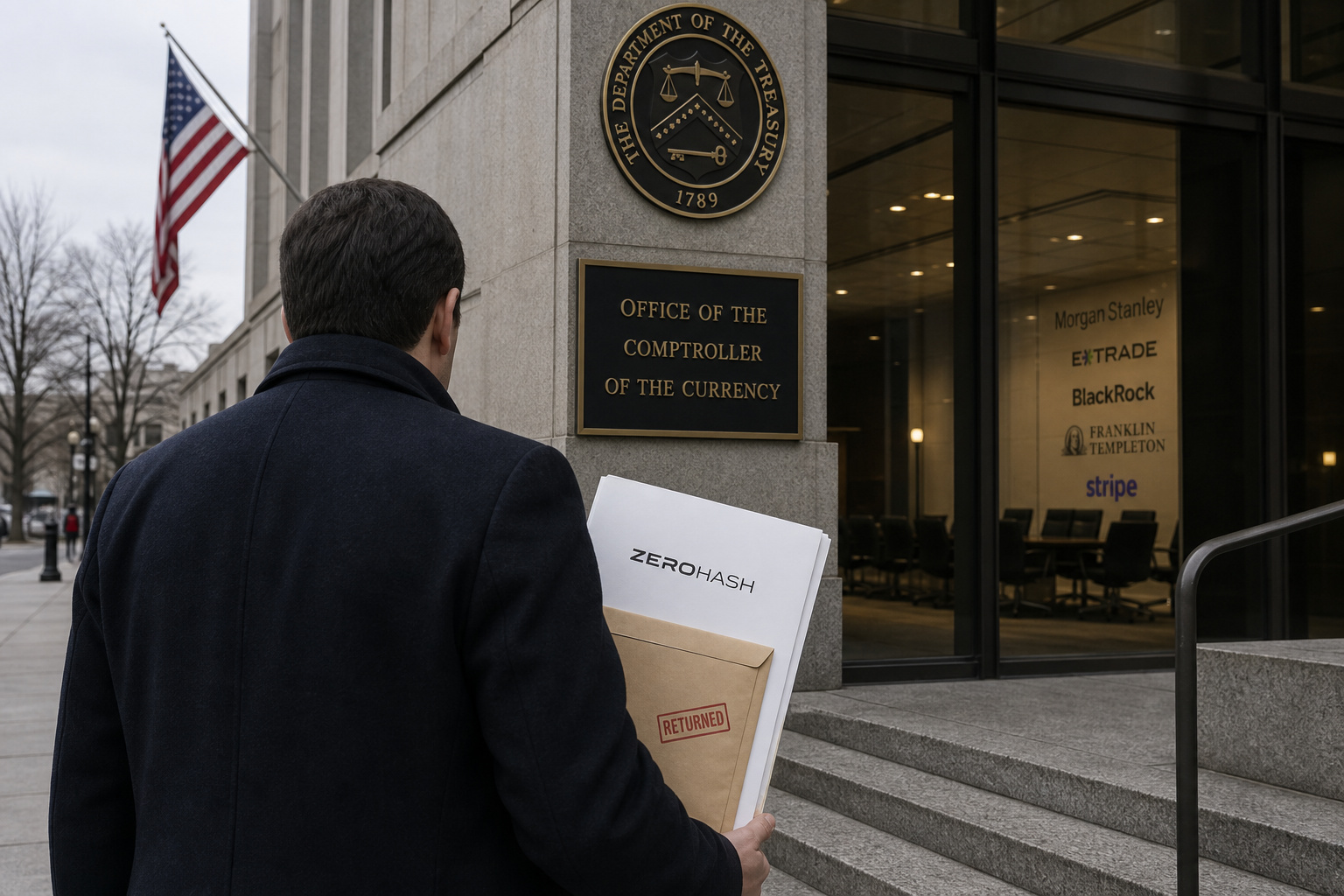
Zerohash's US Trust Bank Charter Application Returned by OCC, Refiling Planned This Month

Zerohash's application for a US trust bank charter has been returned by the Office of the Comptroller of the Currency (OCC), with records showing the move on July 17. The crypto infrastructure firm, which serves Morgan Stanley and E*Trade, called the return an administrative step rather than a substantive denial. It plans to refile this month with a phased approach centered on gaining approval for national trust activities. Already operating as a state-level trust bank, Zerohash counts BlackRock, Franklin Templeton and Stripe among its clients, and was valued at more than $1.5 billion in a prior fundraising round. The company is also facing a lawsuit from its former chief compliance officer, who claims he was dismissed after flagging more than 200 compliance gaps; an attempt by Zerohash to push the dispute into arbitration was initially rejected.

500
Zerohash's US Trust Bank Charter Application Returned by OCC, Refiling Planned This Month
SEC
2026-08-12 19:56:52

SEC Division Issues No-Action Letter to FTDA_US Over Franklin Templeton's FOBXX

The U.S. Securities and Exchange Commission's Division of Investment Management has issued a no-action letter to FTDA_US, according to a post on X from a reporter who covers cryptocurrency for Fox Business. The letter opens the door for FTDA_US's registered funds to manage their cash using Franklin Templeton's on-chain money market fund, FOBXX. The permission also extends to collateral related to securities lending. Under the exemption, Franklin Templeton is allowed to custody the fund shares and record ownership through the company's blockchain-integrated system. This means the firm does not have to comply with certain traditional rules that were drawn up for physical securities. Franklin Templeton said the arrangement can support intraday trading, hourly net asset value calculations, and faster processing of trades. The news was shared by the Fox Business reporter on X, citing the SEC's investment management division. The division's no-action letter is specific to FTDA_US and Franklin Templeton's FOBXX fund.

470
SEC Division Issues No-Action Letter to FTDA_US Over Franklin Templeton's FOBXX
RWA
2026-08-12 10:00:00

RWA nears $40 billion as holder count jumps to 1.7 million even as DeFi cools

Real-world assets remain one of the few crypto segments still expanding while native DeFi activity softens. Data cited by Foresight shows the publicly distributed RWA market, excluding stablecoins, reached $38.17 billion as of Aug. 10, 2026, leaving it $1.83 billion short of the $40 billion mark. The number of holders climbed to 1.7 million, with article figures showing sharp growth from June 30. That expansion is concentrated rather than broad. Tokenized U.S. Treasurys, tokenized equities and tokenized commodities account for the clearest gains, while a small set of products controls most of the market’s value. The report cited in the article tracked more than 7,000 tokenized products, yet only 62 assets represented 88% of market value. The piece argues that traditional financial firms, not crypto-native experimentation alone, are driving this phase. BlackRock’s BUIDL, Franklin Templeton’s tokenized funds and Ondo Finance are all highlighted, alongside rising RWA deposits and trading activity inside DeFi. At the same time, the article says unresolved issues around custody, legal ownership, redemption paths and regulation still stand between current growth and durable scale.

550
RWA nears $40 billion as holder count jumps to 1.7 million even as DeFi cools
Federal Reser
2026-08-12 06:28:04

Chicago Fed President Austan Goolsbee Explains the Fed’s Role, Rates, Inflation and Why Stocks Don’t Equal the Economy

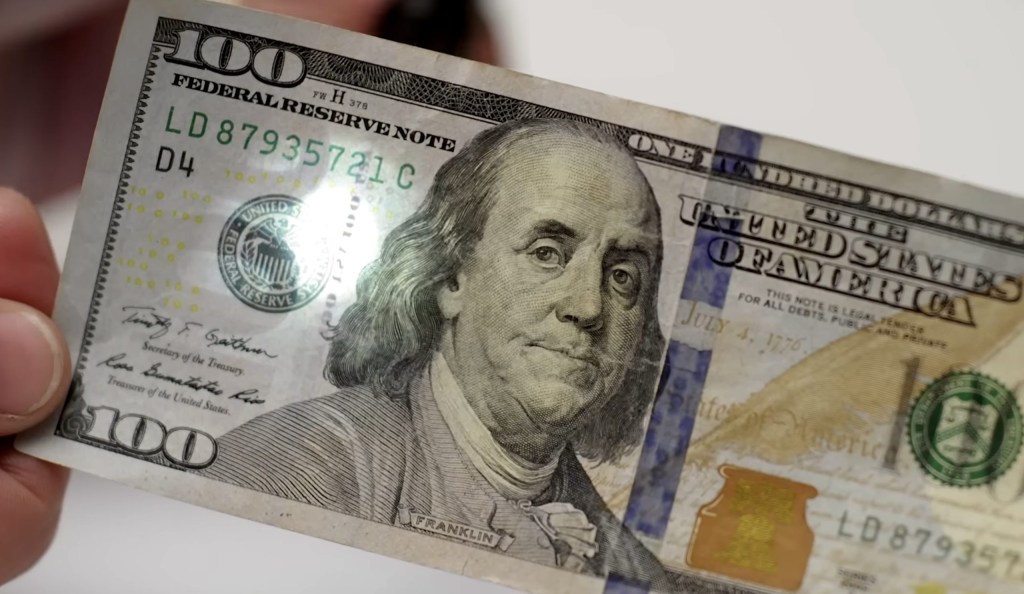
Chicago Federal Reserve Bank President Austan Goolsbee used a recent Wired appearance to answer a broad set of public questions about the U.S. economy and the Federal Reserve’s role in it. His remarks covered the Fed’s dual mandate, how interest-rate decisions are made, why the central bank targets inflation near 2%, and why he does not view a return to the gold standard as a good option. Goolsbee said the Fed is an independent institution within the U.S. government and that its core job is to balance maximum employment with price stability, not simply print money. He also walked through how policymakers gather regional business feedback before meetings, how the Beige Book is used, and why labor-market data, consumer spending and productivity matter more than stock prices alone when judging economic health. On housing, he said home prices have been pushed up by long-term structural trends and limited supply, while mortgage rates are not directly set by the Fed and depend on market conditions and borrower credit. Goolsbee also discussed why recent stock gains can reflect optimism about future profits, including excitement around artificial intelligence, and outlined several ways the public can identify counterfeit U.S. dollars.

510
Chicago Fed President Austan Goolsbee Explains the Fed’s Role, Rates, Inflation and Why Stocks Don’t Equal the Economy
Bitcoin
2026-08-12 04:33:48

US spot Bitcoin ETFs posted a $4.89 million net inflow, with BlackRock’s IBIT the only gainer

US spot Bitcoin exchange-traded funds recorded a net inflow of $4.8862 million on Aug. 11, according to SoSoValue data cited by Odaily. BlackRock’s IBIT led the day and was the only Bitcoin spot ETF to post net inflows, bringing in $50.1956 million. Its cumulative historical net inflow has now reached $61.172 billion. On the other side, Franklin’s Bitcoin ETF EZBC saw the largest single-day net outflow at $16.4616 million, while its historical cumulative net inflow stood at $310 million. As of press time, the total net asset value of US spot Bitcoin ETFs was $77.457 billion. The ETF net asset ratio, which measures ETF market value as a share of Bitcoin’s total market capitalization, stood at 6.06%. Historical cumulative net inflows across spot Bitcoin ETFs reached $52.038 billion.

610
US spot Bitcoin ETFs posted a $4.89 million net inflow, with BlackRock’s IBIT the only gainer