GEN

U.S. Treasury
2026-08-18 09:17:50

U.S. Treasury opens public comment on GENIUS Act rules for payment stablecoins

The U.S. Treasury Department on Aug. 17 released a draft of implementation rules for the GENIUS Act and opened a 60-day public comment period, marking another step in the rollout of the U.S. stablecoin regulatory framework. The proposal focuses on two core questions: when a payment stablecoin is considered to be issued in the United States, and when an issuer or service provider is deemed to be offering or selling stablecoins to U.S. users. The GENIUS Act was signed into law by President Donald Trump in July 2025 and is described as the first U.S. federal law to establish a full regulatory framework for payment stablecoins. Treasury Secretary Scott Bessent said the administration and Congress have already put clear rules in place through the law, and that Treasury will move quickly to implement the regime while aiming to provide regulatory certainty for businesses, support the U.S. digital asset sector, reinforce the dollar’s role as the world’s reserve currency, and strengthen the country’s standing as a global crypto hub. Under the draft rules, the law is expected to take effect on Jan. 18, 2027. From that date, any entity without federal or state approval would be barred from issuing payment stablecoins in the United States. The proposal also outlines added restrictions for digital asset service providers handling foreign-issued payment stablecoins unless the issuer commits to complying with U.S. law and reciprocity arrangements.

80
U.S. Treasury opens public comment on GENIUS Act rules for payment stablecoins
predict.fun
2026-08-16 08:06:03

predict.fun prices T1 win probability at 43% ahead of LCK Stage 3 match against GEN

Monitoring data shows predict.fun pricing T1’s chances of beating GEN at 43% in its market for the LCK Stage 3 matchup. The BO3 series is scheduled for 4 p.m. today and also serves as the closing match of 2026 T1 Home Ground at Seoul’s KSPO DOME. Recent form has been mixed between the two sides. T1 is on a two-match losing streak after a 1:2 loss to HLE on Aug. 8 and another 1:2 defeat to DK in its first home match of this event. GEN, by contrast, beat HLE 2:1 and then followed with a 2:0 sweep over HLE in the rematch. In the first meeting between T1 and GEN in Stage 3, however, T1 came away with a 2:0 victory. The latest probability on predict.fun reflects that setup going into today’s series.

50
predict.fun prices T1 win probability at 43% ahead of LCK Stage 3 match against GEN
a16z Crypto
2026-08-15 15:45:26

a16z Crypto says the CLARITY Act is urgent as US crypto rules remain incomplete

a16z crypto used a recent conversation between firm co-founder Marc Andreessen and a16z crypto founder Chris Dixon to argue that the US needs the CLARITY Act without delay. Their case is built on a simple point: crypto is already a large financial market, with stablecoins handling trillions of dollars in annual transaction volume and major banks and payment companies building blockchain-based products, yet the federal rulebook for much of the market is still unfinished. In their view, the bill would create a durable structure for digital asset markets by dividing responsibilities between the Securities and Exchange Commission and the Commodity Futures Trading Commission, setting disclosure and conduct rules, and bringing trading venues and other intermediaries into a framework closer to traditional financial markets. Andreessen and Dixon also said the bill would raise consumer protections through registration, audits, custody standards and anti-fraud rules, while reducing the advantage currently enjoyed by offshore firms that avoid compliance costs. The discussion also covered sanctions enforcement, the difference between privacy and concealment on public blockchains, limits on developer liability for open-source software, the treatment of tokenized securities, restrictions on stablecoin yield-style products, and the risk that regulatory uncertainty will continue pushing businesses outside the US if Congress does not act.

110
a16z Crypto says the CLARITY Act is urgent as US crypto rules remain incomplete
Policy Regula
2026-08-15 03:27:31

OCC gives conditional preliminary approval to Trump-linked trust bank charter as USD1 moves in-house

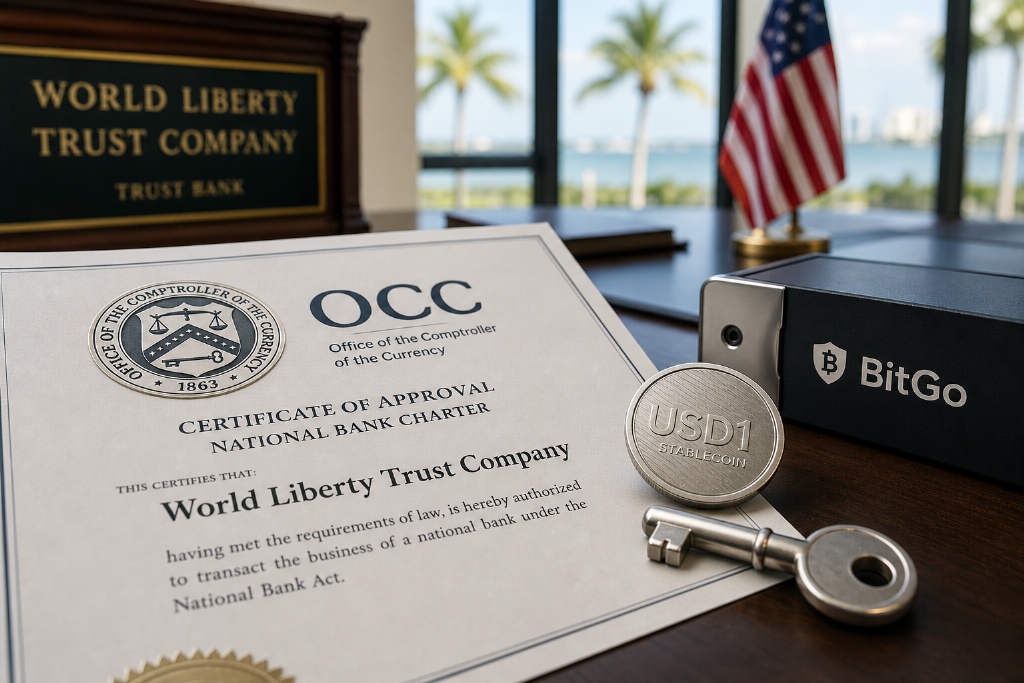
The Office of the Comptroller of the Currency issued Corporate Decision #1385 on Aug. 14, granting conditional preliminary approval for a national trust bank charter to World Liberty Trust Company, a Trump family-linked entity. The proposed bank, based in Bay Harbor Islands, Florida, is set to take over issuance, redemption, reserve management and custody functions for the USD1 stablecoin from BitGo Bank & Trust, which currently serves as the exclusive issuer and custodian. USD1 has about $4.03 billion in circulation and nearly $600 million in 24-hour trading volume, according to the report. The OCC approval comes with capital and liquidity conditions, including at least $20 million in tier 1 capital and liquid assets sufficient to cover 180 days of operating expenses. Attached to the decision were three passivity commitments dated July 13, including one signed by Eric F. Trump, that bar the signers from seeking board seats, influencing management, pricing or personnel decisions, or using material nonpublic information. The disclosure also drew a political response, with Senator Elizabeth Warren and other Democrats saying they would introduce legislation to bar senior government officials from owning or controlling banking institutions.

270
OCC gives conditional preliminary approval to Trump-linked trust bank charter as USD1 moves in-house
CLARITY Act
2026-08-14 14:09:26

What the Senate-Rewritten CLARITY Act Means for Bitcoin

Bitcoin Magazine argues that the CLARITY Act, after being extensively rewritten in the Senate, is not a dedicated Bitcoin bill and should not be treated as an automatic trigger for a new Bitcoin bull market. The article says the bill still contains several provisions that matter directly to Bitcoin: Section 605 would give self-custody explicit statutory protection; Section 604 would bar non-controlling developers and service providers from being treated as money transmitters simply for building or publishing non-custodial tools; and Section 401 would let banks, brokerages, financial holding companies, state banks, national banks and credit unions engage in a broad set of digital asset activities without seeking approvals beyond existing banking law. At the same time, the piece says the current bill still does not lock Bitcoin’s commodity status into federal statute, does not preserve the House language that would block a retail CBDC from the Federal Reserve, and would still require a major rulemaking effort before any framework becomes operational. The article is a guest post by Isaiah Austin and states that the views expressed are the author’s own, not necessarily those of BTC Inc or Bitcoin Magazine.

190
What the Senate-Rewritten CLARITY Act Means for Bitcoin
RWA
2026-08-14 10:25:00

RWA Weekly: Hong Kong’s regulated HKD stablecoin moves into rollout as the EU prepares MiCA access changes

Real-world asset activity and stablecoin policy both moved this week. As of Aug. 14, 2026, on-chain RWA market capitalization reached $38.29 billion, while the number of holders climbed to 1.7935 million, according to RWA.xyz data cited by PANews. In stablecoins, total market value slipped slightly to $297.91 billion, but transfer volume and monthly active addresses both fell, pointing to a quieter on-chain period even as holder counts kept growing. On the policy side, the People’s Bank of China said in its 15th Five-Year reform and development plan that it will steadily develop the digital yuan. In Europe, officials decided to revise the Markets in Crypto-Assets framework, or MiCA, with a focus on the market access rules that have left non-EU stablecoin issuers such as Tether outside the bloc. The U.K. advanced the second phase of its digital pound lab and also began work on a regulatory framework for tokenized gold. At the project level, Anchorpoint, the Hong Kong licensed stablecoin issuer backed by Standard Chartered, HKT and Animoca Brands, launched the first phase of issuance and institutional use for HKDAP. HashKey Exchange and OSL joined as recognized distributors. Elsewhere, NYSE, Itaú Unibanco, Coinbase, LG CNS, Miden, Dow Protocol and Rain each disclosed new tokenization, stablecoin or funding developments during the week.

200
RWA Weekly: Hong Kong’s regulated HKD stablecoin moves into rollout as the EU prepares MiCA access changes
Stablecoins
2026-08-14 09:02:39

70 years of offshore dollars: how stablecoins and self-custody changed who owes you one dollar

A TechFlowPost feature traces the history of offshore dollars from the birth of the eurodollar market to the rise of stablecoins and self-custody wallets, arguing that the core question has never gone away: who actually owes you $1? The article says the dollar has moved through several institutional containers over the past seven decades, from New York bank ledgers and London bank balance sheets to fintech databases and the reserve structures behind stablecoin issuers. At the same time, the relationship between users and their accounts has also shifted, moving from full institutional custody toward direct user control over onchain assets. The piece links three historic fault lines in the offshore dollar system to three forms of power: settlement, last-resort liquidity, and pricing. It points to the 1974 Herstatt failure, the 2008 global dollar shortage, and the eventual shutdown of the U.S. dollar LIBOR panel in June 2023. It then places Revolut, Wise, stablecoins, and Bitget Wallet along the same continuum. In that framing, stablecoins did not invent a new dollar. They separated redemption from transfer, keeping reserves in traditional finance while moving transfer onto public blockchains. Self-custody wallets, meanwhile, did not replace the issuer’s redemption promise, but changed who controls the movement of assets. The article argues that this is where the latest shift in dollar infrastructure becomes most visible.

90
70 years of offshore dollars: how stablecoins and self-custody changed who owes you one dollar
Eurodollar
2026-08-14 08:42:39

From Eurodollars to Stablecoins: A 70-Year Shift in Offshore Dollar Credit

Foresight has published a long-form essay by Bitget Wallet researcher Lacie Zhang tracing a 70-year line from the birth of the eurodollar market to today’s stablecoins and self-custody wallets. The piece argues that stablecoins are not a clean break from the past. Instead, they represent a new stage in the offshore expansion of the U.S. dollar, one that changes how dollar claims move rather than eliminating the traditional financial system behind redemption. Zhang revisits how Soviet and Eastern European entities moved dollars into banks in Paris and London to avoid the risk of account freezes in the United States, how post-Suez British policy helped turn those deposits into a lending market, and how U.S. regulation and later petrodollar flows helped that market grow from millions to trillions of dollars. The essay then uses the 1974 Herstatt collapse, the 2008 dollar funding squeeze, and the fall of LIBOR to show that offshore banks gained the ability to expand dollar credit but never captured final control over clearing, emergency liquidity, or pricing. The article closes by contrasting fintech apps, stablecoins, and self-custody wallets. In Zhang’s framing, stablecoins move dollar balances onto public blockchains while leaving redemption anchored to U.S. Treasuries, bank deposits, and legal claims. Self-custody wallets change something else: who controls the movement of assets.

60
From Eurodollars to Stablecoins: A 70-Year Shift in Offshore Dollar Credit