OpenAI gathers 40 mathematicians as AI-driven math research splits the field
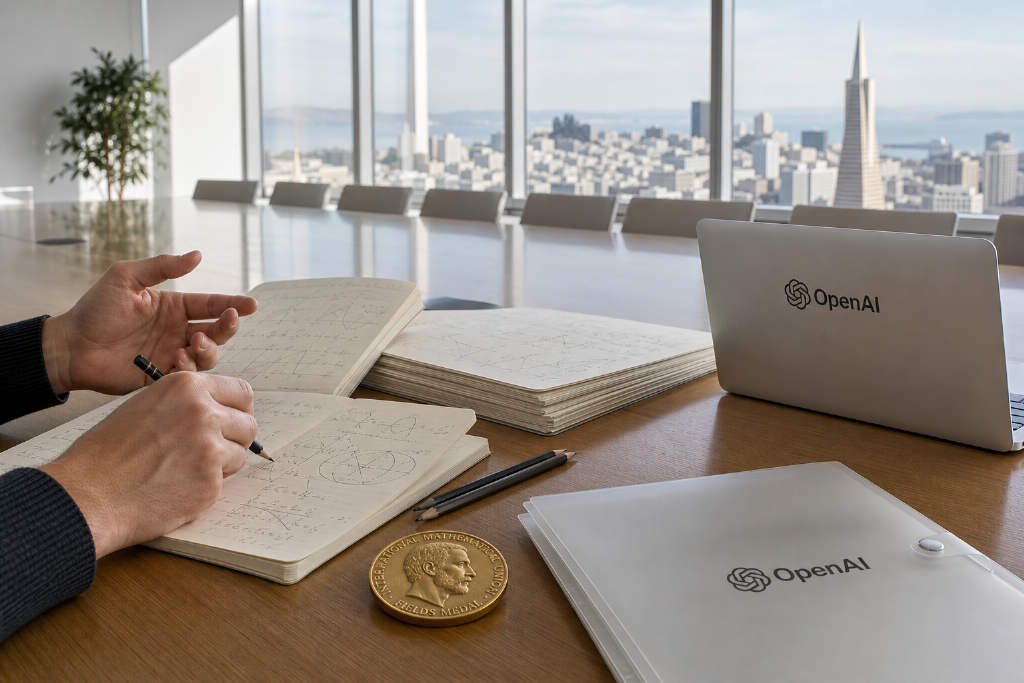
Fresh off receiving the Fields Medal, Jacob Tsimerman said at the award ceremony that he plans to join OpenAI to work on AI safety, placing one of mathematics’ highest-profile researchers at the center of a growing debate over what advanced models mean for the discipline. In early August, Tsimerman and OpenAI research scientist Sébastien Bubeck convened roughly 40 mathematicians at OpenAI’s San Francisco headquarters for a closed-door summit, where one talk carried the stark title “The End of Mathematics.” The meeting came after a string of AI-related results in mathematics and computer science. OpenAI said an unreleased model had overturned the unit distance conjecture in May, then disclosed 10 AI-generated findings across several subfields in August. Anthropic, for its part, saw employee Levent Alpöge use Claude to construct orthogonal vector pairs on a 668-dimensional hypercube, while another internal Claude experiment reportedly produced a new result related to the Riemann hypothesis. Those developments have sharpened a divide inside the math community. More than 3,000 mathematicians signed the Leiden Declaration in June, calling for responsible AI use, verification, and proper citation. Others favor rejecting AI tools and AI companies altogether. At issue is not only whether AI can produce proofs, but whether it can explain the hard parts well enough for the work to become part of mathematical literature.