Ghana

Merck KGaA
2026-09-08 07:00:00

Merck KGaA, The Hashgraph Group and PwC Germany pilot cocoa traceability system on Hedera

The Hashgraph Group, Merck KGaA and PwC Germany said Tuesday they are piloting a cocoa traceability system that links physical authentication scans to records written on Hedera, with the European Union’s deforestation regulation set to start applying to large and medium operators on Dec. 30, 2026. The announcement names no cocoa company and gives no details on tonnage, farm count, cost or a timeline beyond the pilot stage. It is also the third announcement tied to the passport platform since February without a named customer, and the second involving Darmstadt-based Merck KGaA, which operates as EMD in the United States and Canada and is unrelated to Merck & Co. The article argues that the pilot addresses product authentication and event logging, not the farm-level geolocation data the EU rule actually requires. Under Article 9, operators must retain for five years the geolocation of all plots where a commodity was produced, including polygon boundaries for plots above four hectares. The report also notes that cocoa is outside the scope of the EU’s Digital Product Passport regime under ESPR, despite the companies linking the pilot to that broader trend. Market data cited in the piece put HBAR at $0.077, down 2.5% over 24 hours, with Hedera showing a relatively small DeFi footprint next to its enterprise pilot activity.

100
Merck KGaA, The Hashgraph Group and PwC Germany pilot cocoa traceability system on Hedera
Stablecoins
2026-09-02 01:24:23

Stablecoin use is clustering around liquidity, settlement and treasury flows, not coffee purchases

A ChainCatcher article argues that the largest real-world stablecoin flows today are not centered on consumers buying coffee with USDC, but on trading venues, market makers, cross-border settlement, treasury operations, B2B trade, payouts and dollar access in emerging markets. Citing data shared by Triple-A founder Eric Barbier, the piece says Triple-A’s TPV doubled from July 2025 to July 2026, while TPV from trading platforms, exchanges and market makers rose 150% and now contributes roughly two-thirds of the company’s total. The article also points to Codex, which said its monthly volume has reached about $1.2 billion, while its newly launched 1:1 USDT-USDC conversion product, Codex Par, is already processing hundreds of millions of dollars per month on its own. The author’s central argument is that large stablecoin volume figures can be misleading if they are automatically read as merchant payments or remittances. A significant share of that activity may instead come from swaps, arbitrage, liquidity rebalancing, account funding and treasury movement. From African outbound liquidity corridors to B2B export settlement, gaming payouts, ad-spend funding and high-banking-friction sectors such as forex and CFDs, the article presents stablecoins as infrastructure that plugs into the most expensive, slowest or least connected part of an existing financial workflow. It also argues that once stablecoin-based payment and settlement flows become stable enough, credit products are likely to emerge on top of them.

50
Stablecoin use is clustering around liquidity, settlement and treasury flows, not coffee purchases
Human Rights
2026-08-25 16:00:00

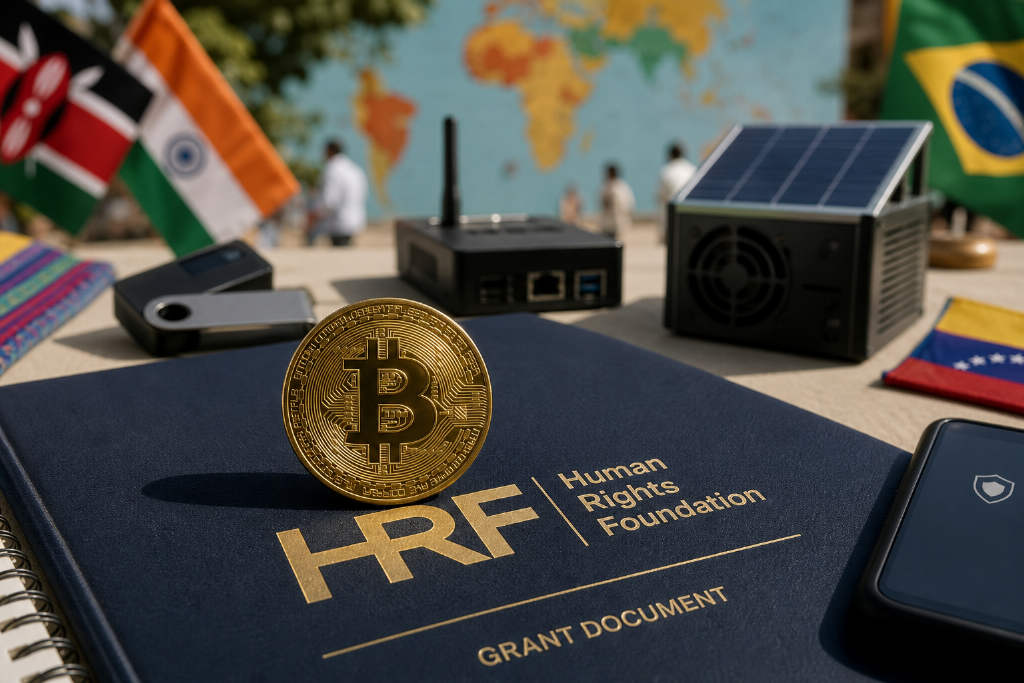
Human Rights Foundation Backs 16 Bitcoin and Freedom Tech Projects With More Than 600 Million Satoshis

The Human Rights Foundation said it is awarding more than 600 million satoshis, valued at $472,807 at current prices, to 16 projects across Africa, Asia, and Latin America through its Bitcoin Development Fund. The organization said the grants are aimed at strengthening Bitcoin infrastructure, widening real-world access to Bitcoin, and building secure communications and community tools for dissidents, journalists, nonprofit groups, and activists. This marks HRF’s second funding round of 2026, after it announced support for 26 projects in April. The selected projects span payments, wallet infrastructure, Nostr-based communications, open-source mining, education, and a nine-month civic infrastructure pilot in Venezuela. According to HRF, the goal is to reinforce Bitcoin’s use as a tool for financial freedom and to help vulnerable communities communicate, organize, and receive support more safely under repressive conditions.

400
Human Rights Foundation Backs 16 Bitcoin and Freedom Tech Projects With More Than 600 Million Satoshis
Yellow Card
2026-08-13 06:00:14

Yellow Card Raises $40 Million After Exiting Its Consumer App to Focus on Stablecoin Infrastructure

Stablecoin infrastructure provider Yellow Card said on Aug. 4 that it had raised $40 million in a strategic financing round backed by SC Ventures, Sony Innovation Fund, Polychain Capital, and Blockchain Capital, lifting its total equity funding to more than $120 million. The company’s path to this point took nearly a decade and included two major shifts: from a Bitcoin gift card product launched in 2016, to a retail crypto trading app in Nigeria in 2019, and then to a business focused on enterprise stablecoin infrastructure after demand moved sharply from Bitcoin to USDT. During the pandemic, Yellow Card’s transaction volume rose from $1 million per month to $1 million per day, and after listing USDT, 99% of volume shifted from Bitcoin to stablecoins in four months. The company later decided to shut its consumer mobile app, telling retail users on Oct. 29, 2025 to withdraw funds by Dec. 31 before the app closed on Jan. 1, 2026. Yellow Card now positions itself as a payments and settlement infrastructure provider for banks, fintech firms, and enterprises across emerging markets, with operations in more than 50 markets and licenses, authorizations, or registrations in 22 jurisdictions as of August 2026.

460
Yellow Card Raises $40 Million After Exiting Its Consumer App to Focus on Stablecoin Infrastructure
Coinbase
2026-08-05 14:57:40

Coinbase Publishes Full List of Supported Countries and Regions

Coinbase has published the full list of countries and regions where its services are available. In a post on X, the exchange said it is available only in the jurisdictions named. The list includes 106 countries and territories, with entries stretching from Albania and Angola to Uruguay, Uzbekistan, Venezuela and Zambia. Australia, Brazil, Canada, France, Germany, India, Mexico, Nigeria, Singapore, South Africa, Switzerland, the United Kingdom and the United States are among the major markets covered, as are Hong Kong (China) and Taiwan (China). The roster also features smaller jurisdictions such as the Bahamas, Bahrain, Barbados, Guernsey, Jersey, Liechtenstein, Monaco and San Marino. Other entries include Armenia, Azerbaijan, Bolivia, Botswana, Brunei, Bulgaria, Burkina Faso, Cameroon, Chile, Colombia, Costa Rica, Croatia, Cyprus, the Czech Republic, Denmark, the Dominican Republic, Ecuador, El Salvador, Estonia, Finland, Georgia, Ghana, Greece, Guatemala, Honduras, Hungary, Iceland, Ireland, Italy, Jamaica, Jordan, Kazakhstan, Kenya, Kuwait, Kyrgyzstan, Latvia, Lithuania, Luxembourg, the Maldives, Malta, Mauritius, Mongolia, Montenegro, Namibia, Nepal, the Netherlands, New Zealand, Nicaragua, Norway, Oman, Pakistan, Panama, Paraguay, Peru, the Philippines, Poland, Portugal, Romania, Rwanda, Serbia, Slovakia, Slovenia, Sri Lanka, Sweden, Togo, Trinidad and Tobago, Tunisia, Turkey, Uganda, Ukraine, the United Arab Emirates and more.

1720
Coinbase Publishes Full List of Supported Countries and Regions
stablecoin
2026-07-23 12:40:14

Stablecoin Cross-Border Payments Priced Below Interbank FX Every Month in Q2 2026

Borderless.xyz Q2 Benchmark shows stablecoin delivery pricing beat interbank rates in all three months, with median parity gap at -3.2 bps and hitting -5.9 bps in June. Cost to move $10,000 held at ~$27; provider choice emerged as the top cost lever, with single-provider setups costing $2,330 more per $1 million.

1120
Stablecoin Cross-Border Payments Priced Below Interbank FX Every Month in Q2 2026