INR

SEC
2026-08-11 14:24:59

SEC Plans Broad Overhaul of CAT, With Transition Potentially Running Through End-2027

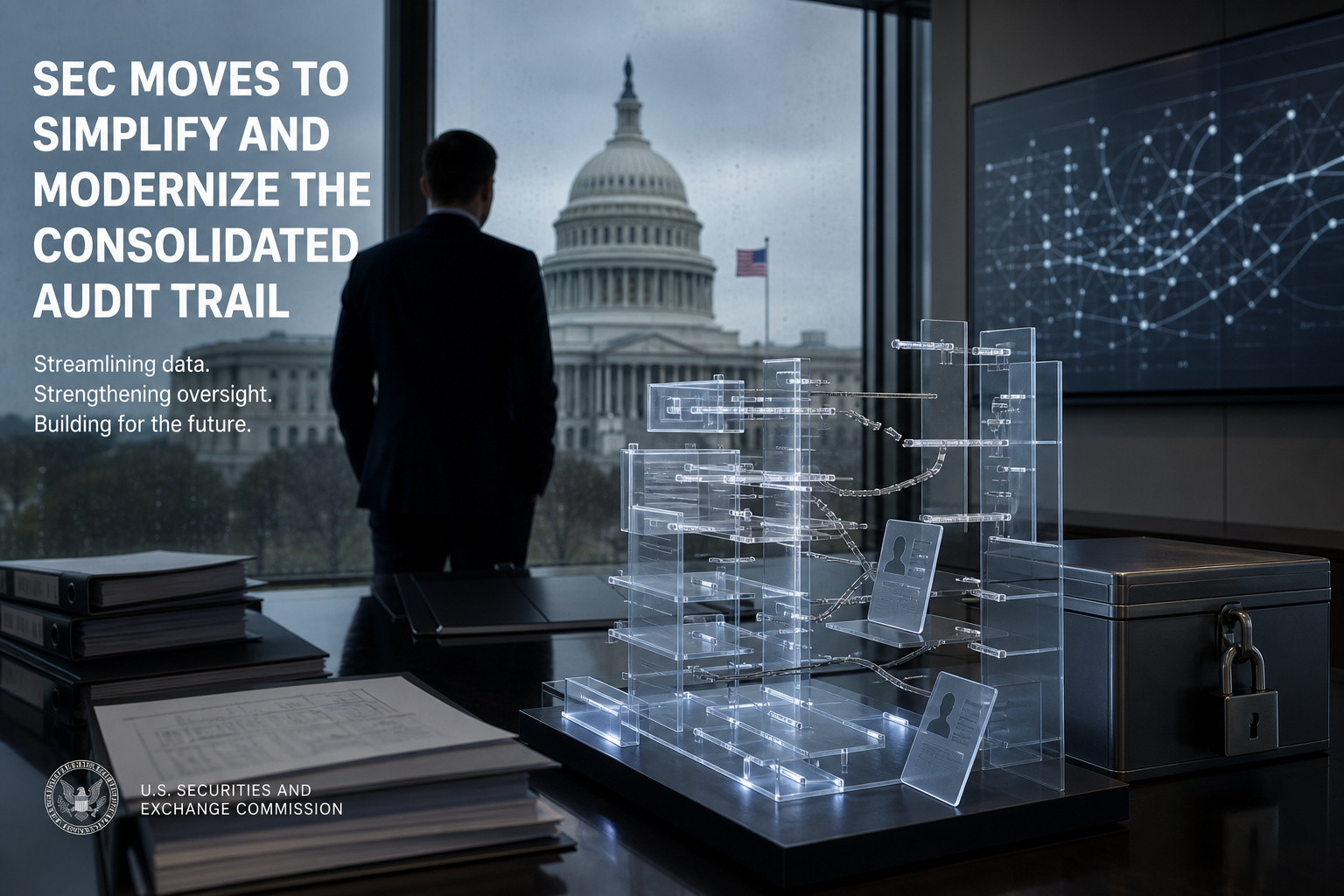
U.S. Securities and Exchange Commission Chair Paul S. Atkins said the agency is preparing a broad overhaul of the Consolidated Audit Trail, or CAT, targeting its governance structure, funding model, and operating framework. In a letter to CAT Operating Committee Chair Robert Walley, Atkins said the SEC has already reduced CAT’s annual operating costs during his tenure through exemptive relief and approval of amendments to the CAT NMS Plan, while also eliminating the requirement to report personally identifiable information to the system. Even so, the SEC said CAT still faces what it described as fundamental problems tied to cost, governance, and funding. The agency launched a concept release on April 16, 2026, to review CAT as well as other audit trail systems and data sources used in U.S. securities market oversight. According to the SEC, it has received hundreds of comment letters, with one central point of agreement: investors and market participants want the SEC to take on a larger role in CAT management and funding. Atkins said staff have been directed to develop deeper reform proposals, including alternative funding sources, a possible repeal of Rule 613, and internal preparation for the SEC to assume CAT governance responsibilities.

1040
SEC Plans Broad Overhaul of CAT, With Transition Potentially Running Through End-2027
U.S. stocks
2026-08-11 03:02:58

Real Stocks, tokenized shares or stock futures: MEXC outlines three ways to access U.S. equities

MEXC has launched a fee-free campaign for three U.S. equity-linked products during its August 2026 “U.S. Stocks Season”: RealStocks, Tokenized Stocks and Stock Futures. The exchange says the products all provide exposure to U.S. equities, but they differ sharply in legal ownership, shareholder rights, trading hours, leverage and use cases. RealStocks are spot U.S. stocks offered through a regulated broker setup and allow users to hold actual shares. Tokenized Stocks are blockchain-based instruments that track listed equities and trade around the clock, but they do not necessarily grant direct legal ownership of the underlying stock. Stock Futures are perpetual contracts tied to stock or stock index prices, designed for directional trading with leverage of up to 200x. MEXC said the comparison is meant to help users match product structure with investment goals, whether that means long-term ownership, flexible on-chain access or leveraged short-term trading. The platform also disclosed that more than 120,000 users opened RealStocks accounts in its first month, while stock and index futures volume rose about 261% month over month in June 2026.

1040
Real Stocks, tokenized shares or stock futures: MEXC outlines three ways to access U.S. equities
DAO treasury
2026-08-10 10:08:18

GSR says nearly 70% of DAO treasuries still sit in native tokens, leaving protocols exposed in downturns

GSR Global Head of Markets Spencer Hallarn argues that DAO treasuries remain structurally vulnerable because more than 70% of treasury assets are still held in native tokens. In his view, that concentration creates a three-part hit when markets turn: treasury values fall, protocol revenue slows, and on-chain activity weakens at the same time. He also says many teams wait too long to hedge, only seeking downside protection after prices have already dropped and implied volatility has pushed costs higher. Hallarn points to collar structures as one of the most common treasury hedging tools used by GSR, describing them as a way to set a floor while keeping exposure within a chosen range and avoiding an outright sale of tokens. He argues that treasury construction matters more than market timing, especially for teams trying to preserve operating runway. His broader recommendation is to separate operating reserves from long-term crypto holdings, hold cash or stable assets for expenses, and apply hedging where needed so a protocol can keep funding its roadmap through a prolonged downturn.

1020
GSR says nearly 70% of DAO treasuries still sit in native tokens, leaving protocols exposed in downturns
Onchain Broke
2026-08-07 05:12:08

Onchain brokerages are gaining attention, but industry operators say the business is hard to make work

Tokenized stocks, pre-IPO trading and other equity-linked crypto products are drawing more platforms into the market, from centralized exchanges to onchain perpetual futures venues and newer stock-trading protocols. But interviews cited by Odaily suggest the business model behind so-called onchain brokerages is far less straightforward than the market narrative implies. StableStock founder Zixi said the core hurdles start with business design: turning offchain equities into onchain products is not the same as moving stablecoins offchain to settle stock purchases, and each path carries a different operational burden. He described StableStock as a hybrid platform that combines offchain asset packaging and settlement, onchain tokenized asset trading, and rate-arbitrage wealth products rather than a pure “stablecoin brokerage.” The company has completed U.S. MSB registration and New Zealand FSP registration, while still pursuing higher-level securities-related licenses. The report says the sector now appears split between fee-driven trading venues and platforms trying to build broader value-added services such as FX, margin interest, liquidation fees, wealth products and asset-linked financial services. Even so, operators interviewed for the piece argued that brokerage economics remain thin, while crypto exchanges capture profit far more efficiently. The main pressures remain compliance, market volatility and liquidity depth, leaving many in the sector convinced that onchain brokerage is a real trend, but not an easy business.

1080
Onchain brokerages are gaining attention, but industry operators say the business is hard to make work
Policy and Re
2026-08-07 02:20:00

Dow Protocol denies OKX Ventures backing as U.S. Senate delays Clarity Act vote to September

A busy news cycle from Aug. 6 to Aug. 7 brought a mix of crypto regulation, market structure, corporate disclosures, and AI-linked developments. Dow Protocol said claims that OKX Ventures had invested in the project were false and said a list of investors would be released this week without OKX Ventures on it. The U.S. Senate, meanwhile, decided to delay a vote on the Clarity Act until September, extending uncertainty around a major federal crypto bill. Outside Washington, Thailand confirmed a five-year capital gains tax exemption on crypto trades executed through Thai SEC-licensed venues from Jan. 1, 2025 through Dec. 31, 2029. MetaMask introduced a self-custodial AI wallet that lets agents execute on-chain transactions within user-defined limits, and Wintermute registered a broker-dealer subsidiary with the U.S. Securities and Exchange Commission and FINRA. The update set also included Binance Alpha’s AGT and AIA blind box airdrop, Cipher Digital’s sale of 1,619 BTC at a realized loss, a Chainalysis report on more than $30 million in violent robbery losses targeting crypto holders in the first half of 2026, Bernstein’s renewed $140 target on Circle, and several funding, hardware, and security stories tied to the broader AI sector.

1850
Dow Protocol denies OKX Ventures backing as U.S. Senate delays Clarity Act vote to September
Wintermute
2026-08-07 00:20:00

Wintermute Registers as SEC/FINRA Broker-Dealer, Plans Push Into Stocks and Commodities

Wintermute, the cryptocurrency market maker, has registered a broker-dealer subsidiary with the US Securities and Exchange Commission (SEC) and the Financial Industry Regulatory Authority (FINRA), according to The Block. The registered entity marks a push beyond digital assets into traditional equities and commodities. The subsidiary can provide liquidity to US securities exchanges and over-the-counter counterparties, and it is allowed to trade stocks and options from its own account. Wintermute also said the company will be able to self-clear digital asset securities trades and serve as an authorized participant for exchange-traded products, including products related to digital assets. In the US framework, a broker-dealer is a company or individual registered with the SEC and FINRA that either executes trades for clients or deals in securities for its own account. As an authorized participant, the firm would help create and redeem large ETF shares by exchanging them for a basket of underlying securities or cash, a process that keeps a fund's market price aligned with its net asset value. The registration puts a crypto-native market maker into a regulated corner of US capital markets infrastructure.

1080
Wintermute Registers as SEC/FINRA Broker-Dealer, Plans Push Into Stocks and Commodities
Dinari
2026-08-05 17:56:52

Dinari opens 724 tokenized U.S. stocks and ETFs to eligible U.S. investors

Dinari said Tuesday that eligible U.S. investors can now buy 724 tokenized U.S. stocks and ETFs with USDC from self-custody wallets, including tokenized exposure to every company in the S&P 500. The company said the launch also covers eligible U.S. businesses and described itself as the first platform to make the full 724-name lineup available to both groups. Settlement runs in USDC through a partnership with Circle, while broker-dealers can license Dinari’s API-based infrastructure to distribute the products to their own customers. Dinari said the tokens, branded dShares, are backed by corresponding underlying securities held in qualified custody and are structured to preserve features tied to traditional stock ownership, including national best bid and offer execution, voting rights, cash dividends, corporate actions, and ownership of the backing security. The U.S. rollout also adds native USDC dividend support. Access remains limited to eligible investors and subject to onboarding and jurisdictional requirements under U.S. securities laws.

1070
Dinari opens 724 tokenized U.S. stocks and ETFs to eligible U.S. investors
Bitget
2026-08-05 08:14:04

Reality expands work with The Network Firm for daily PoR audits of rToken

Reality, Bitget’s licensed real-world asset issuance platform, said it has expanded its partnership with U.S. audit firm The Network Firm. Under the upgraded arrangement, The Network Firm will issue daily proof-of-reserves audit reports for Reality’s U.S. stock token product, rToken, using attestation standards set by the American Institute of Certified Public Accountants, or AICPA. The stated purpose is to verify that every issued rToken is matched by the corresponding stock or ETF held in a custodial account. The underlying equities and ETFs will continue to be held by Alpaca Securities LLC, a U.S. securities broker registered with FINRA and protected by SIPC, creating a three-party structure that separates issuance, verification, and custody. Reality said rToken currently supports 634 tokenized stocks and ETFs and is deeply integrated with the Bitget ecosystem, including use cases such as unified account margin and staking-backed lending. Earlier data showed Bitget’s stock token rToken exceeded $100 million in assets under management one month after launch.

1050
Reality expands work with The Network Firm for daily PoR audits of rToken