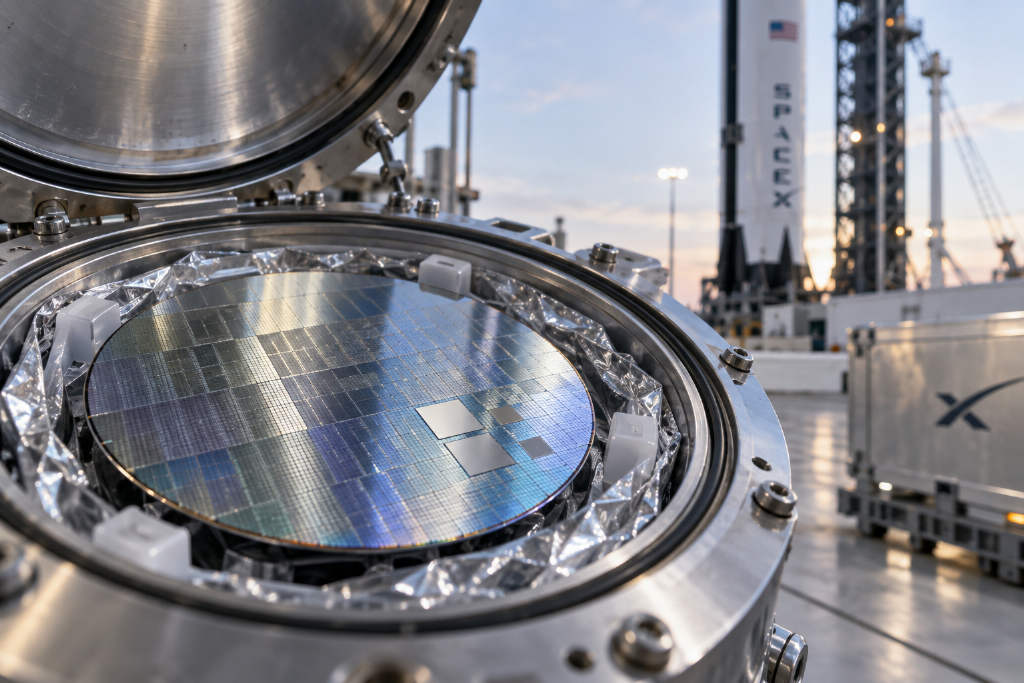
Besxar starts testing space-based semiconductor manufacturing with SpaceX flights
Besxar, a startup founded by former OpenAI employee Ashley Pilipiszyn, has begun validating a space-based semiconductor manufacturing prototype using SpaceX Falcon 9 missions. The company’s thesis is straightforward: instead of spending billions to recreate ultra-clean, near-vacuum conditions on Earth, use the vacuum of space itself as the manufacturing environment. Besxar argues that microgravity also removes thermal convection and buoyancy effects that can disrupt atomic arrangement during crystal growth, a factor it believes could improve compound semiconductor quality. The company signed an agreement with SpaceX in October 2025 to validate its orbital manufacturing concept over about 12 Falcon 9 flights. Its first mission, Mission Asimov, launched on July 5, 2026, carrying two V1 Fabship manufacturing pods on a suborbital Falcon 9 booster flight. The pods returned to Earth after several minutes and carried compound semiconductor wafer samples including GaAs and AlInAsSb from the University of Texas at Austin and the University of Virginia. Post-flight inspection, according to Compound Semiconductor, found the containers intact and the wafers free of cracks, warping, and visible damage. Besxar plans a staged roadmap over the next two years, moving from wafer heating tests to single-material deposition and then to multi-material growth. The company has raised nearly $14 million, including a $9 million seed round co-led by Dauntless Ventures and Overture VC, and says its long-term goal is to produce wafers for advanced power chips used in data centers, robotics, and electric vehicles.