Risk

HashKey
2026-08-27 10:33:02

HashKey reports 20.6% revenue growth in H1 2026 as institutional trading volume jumps 58.8%

HashKey Holding released its interim results for the first half of 2026 on Aug. 27, posting higher revenue, narrower adjusted losses and a bigger institutional trading mix despite a broad contraction in the global crypto market. Total revenue reached HK$343 million, up 20.6% from a year earlier, while gross profit rose 12.5% to HK$208 million and gross margin improved to 60.6% on a sequential basis. Adjusted loss narrowed from HK$398 million in the same period last year to HK$315 million, a 21% reduction. The exchange facilitation business remained the biggest contributor, generating HK$268 million in revenue, up 38.6%. Platform trading volume climbed 31.8% to HK$282.2 billion, with institutional clients accounting for HK$231.5 billion, up 58.8% year over year and representing 82% of the total. The report also highlighted growth in tokenization and on-chain services, where total on-chain RWA value reached HK$2.68 billion, up 167.8%, including what it described as Hong Kong’s first real-estate RWA and first regulated silver RWA token. Alongside the financial results, HashKey disclosed a string of expansion moves spanning Singapore, Vietnam, Dubai and Bermuda, as well as partnerships with JPMorgan, DBS Bank, Canton and Morpho.


160
HashKey reports 20.6% revenue growth in H1 2026 as institutional trading volume jumps 58.8%
DGrid
2026-08-27 09:21:33

DGrid launches validator nodes to extend PoQ into an economically weighted AI verification network

DGrid said it launched validator nodes on Aug. 25, 2026, framing the move as an upgrade to how trust is established in AI infrastructure rather than a routine product addition. The company’s system centers on PoQ, short for Proof of Quality, a verification mechanism it says is used to audit the quality of model services across its network. With validator nodes now live, that process is no longer described only at the protocol level. It is carried out continuously by network participants and linked to staking through operating weight. According to DGrid’s description, validator nodes send randomized blind-test requests to LLM providers, simulate production-like usage instead of relying on fixed benchmarks, score outputs across quality, latency, stability and format compliance, and then write the results on-chain. The stated goal is to detect cases in which a provider’s real service diverges from what it claims to offer, including model substitution, degraded service tiers or opaque routing. DGrid also ties the system to $DGAI staking. Users can delegate tokens to validator nodes, and stake affects each node’s operating weight inside the network. DGrid’s staking page shows that 48 hours after validator nodes went live, total staked volume had exceeded 26M $DGAI, with nearly 10,000 users participating. The broader architecture described by DGrid includes an AI Gateway, a Model Marketplace, PoQ-based verification, validator-node execution and staking-based economic security.

180
DGrid launches validator nodes to extend PoQ into an economically weighted AI verification network
Bitget
2026-08-27 07:09:15

Bitget launches $300 million Project Archimedes for quant firms and asset managers

Bitget has unveiled Project Archimedes, a $300 million institutional capital program aimed at quantitative trading firms, asset managers and market makers. The initiative is split into two tracks: a $100 million capital provider program for emerging and growth-stage market-neutral quant teams, and a $200 million interest-free lending program for established institutions with mature strategies and existing trading scale. According to Bitget, eligible participants in the second track can access zero-interest capital if they meet specified trading-volume or position requirements. The exchange said the program is designed to help institutions expand strategy capacity, improve capital efficiency and pursue opportunities in digital assets and tokenized markets. CEO Gracy Chen said strong strategies are often constrained not by talent, but by capital, adding that Bitget aims to support more than 50 high-quality projects with the fund over the next six months. The company also tied the initiative to its Unified Account structure, under which eligible rToken spot positions can be used as collateral for derivatives trades in the same account. Bitget said the program will initially focus on market-neutral strategies with clear operating records and measurable risk controls, with participants subject to strategy reviews, due diligence and drawdown assessments.

150
Bitget launches $300 million Project Archimedes for quant firms and asset managers
Policy Regula
2026-08-27 07:16:09

Simon White Warns Debt Cancellation Push Could Spread as Governments Struggle With Rising Debt Loads

Macro strategist Simon White, co-founder of Variant Perception, warned in a recent report that calls to cancel public debt in France could foreshadow a broader shift toward more radical debt policies in other heavily indebted countries. He argued that such ideas, while politically tempting, amount to monetary financing in another form and could end with higher inflation and a loss of value in financial assets. White cited French left-wing populist politician Jean-Luc Melenchon’s recent call to cancel 18% of France’s public debt, describing it as taking the bonds and “burning them.” He linked that rhetoric to earlier episodes seen during the eurozone debt crisis and in the United States. He also revisited the 2011 proposal for the US Treasury to mint a $1 trillion platinum coin, saying similar ideas may reappear as the US again nears its debt ceiling, with only $1.1 trillion remaining before it is hit. According to White, the US remains the most worrying case globally. He pointed to debt-to-GDP metrics, interest costs above $1 trillion, and a “twin deficit” larger than every major emerging and developed economy except Brazil. His report says that if orthodox options remain politically blocked, debt cancellation and other forms of monetary financing may look easier, even if they carry far greater inflation risks.

160
Simon White Warns Debt Cancellation Push Could Spread as Governments Struggle With Rising Debt Loads
Policy Regula
2026-08-27 05:54:53

CFTC warns of crypto ATM fraud risks as FBI logs about 13,000 complaints in 2025

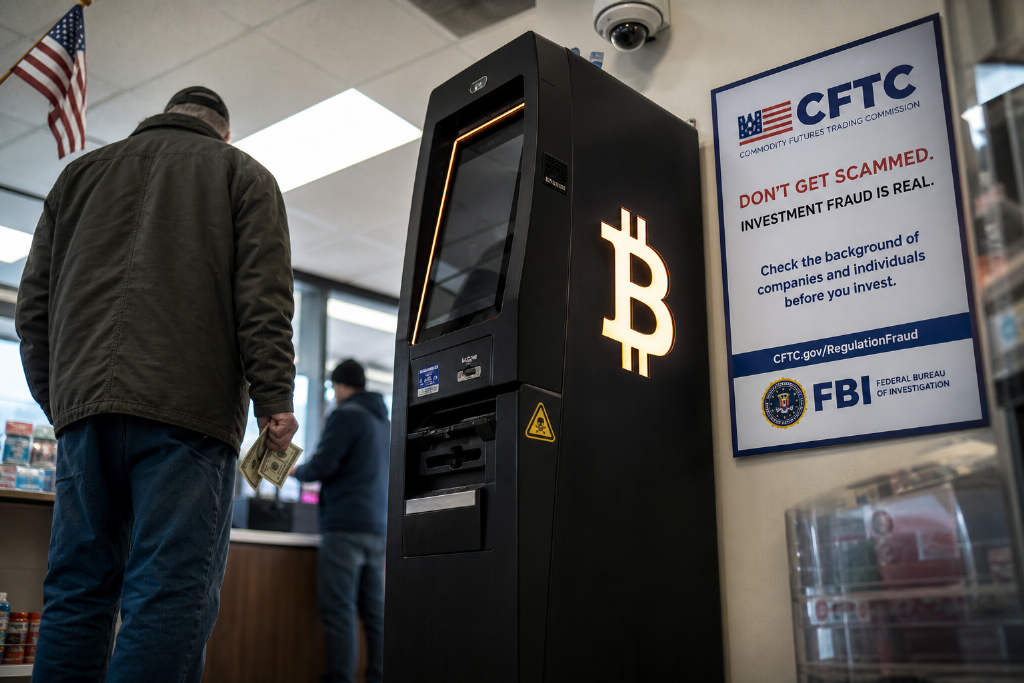
The U.S. Commodity Futures Trading Commission warned on Aug. 27 that cryptocurrency ATMs carry fraud risks, using a post on its official X account to caution users before they use the machines. The agency said cash inserted into a crypto ATM is converted into cryptocurrency right away, making the transaction immediate and irreversible once completed. It also noted that such machines can be used for anonymous transfers, which adds to the risk profile. The warning came as fraud cases tied to crypto ATMs have increased. According to data cited from the Federal Bureau of Investigation, complaints related to cryptocurrency ATMs reached about 13,000 in 2025. CFTC urged users to verify information before proceeding with any transaction. The item was reported by CoinPost and carried by Techub as a policy and regulation news brief.

70
CFTC warns of crypto ATM fraud risks as FBI logs about 13,000 complaints in 2025
Policy Regula
2026-08-26 16:22:47

Survey Finds 77% of Americans See Crypto in Retirement Plans as Risky

A survey from the National Institute on Retirement Security found broad skepticism among Americans about adding cryptocurrency to workplace retirement plans. The poll showed that 77% of respondents view crypto in such plans as risky, including 46% who said it is very risky. More than half, 53%, said they oppose employers offering cryptocurrency investment options. The survey also pointed to wider retirement concerns. Eighty percent of respondents said the United States is facing a retirement crisis, up from 67% in 2020. Another 61% said they are worried about achieving financial security in retirement, while 68% said preparing for retirement is becoming harder and 77% said debt is preventing them from saving enough. The findings come as U.S. policymakers push to expand access to alternative assets in retirement plans such as 401(k)s. The Labor Department withdrew prior cautionary guidance in May 2025. On Aug. 7, Donald Trump signed an executive order calling for broader access to alternative assets in defined contribution plans and directed the Labor Department and the Securities and Exchange Commission to study possible regulatory changes.

150
Survey Finds 77% of Americans See Crypto in Retirement Plans as Risky
XRP
2026-08-26 15:29:49

XRP Leads Crypto Pullback as Leverage Unwind Puts $1.40 Support in Focus

Crypto traders are moving into a more cautious stretch after Bitcoin briefly climbed above $80,000 for the first time in months before easing back toward the $78,000 area. Attention is now centered on two scheduled events cited by Decrypt: the upcoming core PCE inflation reading and Nvidia’s earnings, both seen as potential market-moving catalysts ahead of Jackson Hole. Within that broader pause, XRP has turned into the weakest performer among the 10 largest cryptocurrencies by market capitalization. CoinMarketCap data cited in the report shows XRP fell 6.23% over the past 24 hours to around $1.38. Even so, the token still holds a 35.55% gain over the past seven days, second only to Hyperliquid’s 38.65% increase among the top 10, and ahead of Bitcoin, Ethereum, and other major coins. Decrypt argues the retreat looks more like a leverage flush than institutional selling. The report notes that XRP-linked ETFs have posted nine consecutive days of net inflows, even as the token gives back part of a rally that carried it from about $1.00 on Aug. 18 to an intraday high near $1.69 four days later. Traders are now watching whether XRP can hold the $1.40 zone, a level that shifted from resistance to support during last week’s breakout.

140
XRP Leads Crypto Pullback as Leverage Unwind Puts $1.40 Support in Focus
Bitcoin
2026-08-26 09:18:01

$6.44 Billion in Bitcoin Options to Expire on Deribit Friday as 98.6% of Put Positions Lose Value

A total of 81,700 Bitcoin options contracts are set to expire on Deribit at 4 p.m. Taiwan time on Aug. 28, with a notional value of about $6.44 billion, equal to 18.9% of the exchange’s Bitcoin open interest. While Deribit Metrics data cited by CoinDesk put the put/call ratio at 0.83, the positioning appears far more lopsided beneath the surface. Based on Deribit real-time data referenced in the report, only 537 out of 37,427 put contracts had strikes above spot, leaving 98.6% of bearish positions without intrinsic value at expiry. On the call side, 30,810 of 43,789 contracts were already in the money, representing 70.4% of the total and $2.431 billion in notional value. Deribit Chief Risk Officer Shaun Fernando said the expiry is worth watching because volatility has jumped sharply in the same week, DVOL is up 30%, and the term structure has shifted from backwardation to contango. He added that gamma hedging could intensify near key strikes, creating either unusual pinning or faster price moves after a breakout.

120
$6.44 Billion in Bitcoin Options to Expire on Deribit Friday as 98.6% of Put Positions Lose Value