Risk

Strategy
2026-08-25 16:47:40

Report says Strategy’s $66B Bitcoin model depends more on capital markets than BTC price

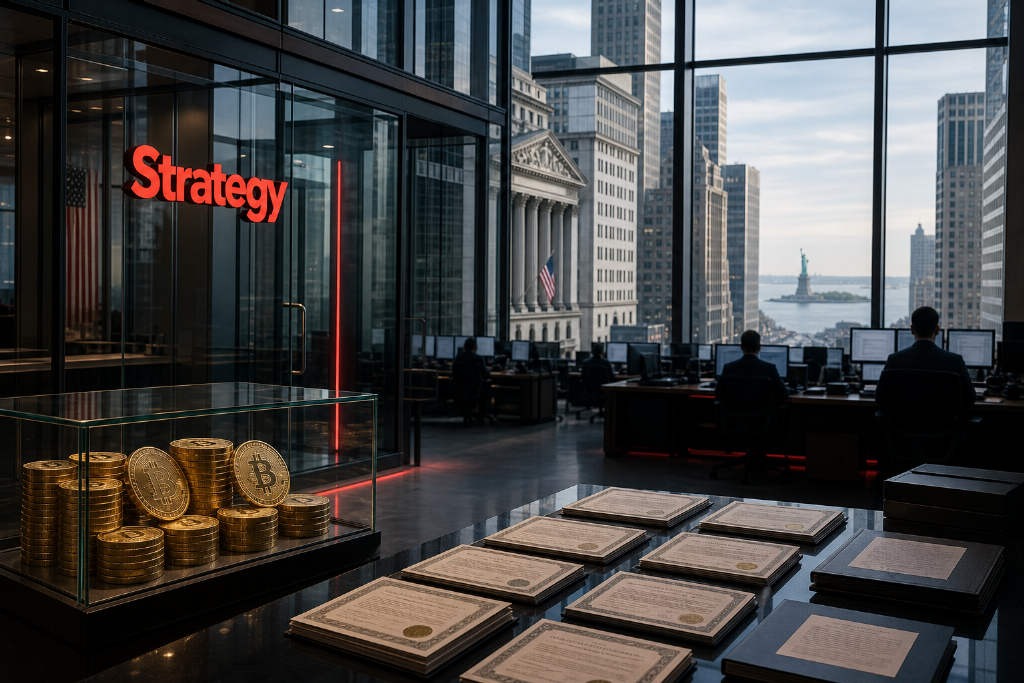
A recent Regime Intelligence analysis says Strategy’s biggest risk is not a Bitcoin crash, but losing access to capital markets. The company holds 840,447 BTC against about $22 billion in debt and preferred claims, and still needs to fund roughly $1.76 billion in annual obligations without relying on Bitcoin sales. The report says Bitcoin would have to fall about 96% before Strategy’s holdings and reserves no longer cover its convertible notes. But the balance-sheet pressure would then shift to preferred dividends and interest, which must be paid regardless of BTC’s price. Strategy has sold Bitcoin four times since May, including 1,690 BTC in its latest sale, to fund preferred dividends, share repurchases and its growing U.S. dollar reserve. CEO Phong Le said the company has sold about 25 times less Bitcoin than it has accumulated this year and expects to resume buying later this year.
170
Report says Strategy’s $66B Bitcoin model depends more on capital markets than BTC price
US stocks
2026-08-25 08:23:57

US Premarket Brief: Strategy Raised $2.01 Billion but Did Not Buy Any Bitcoin

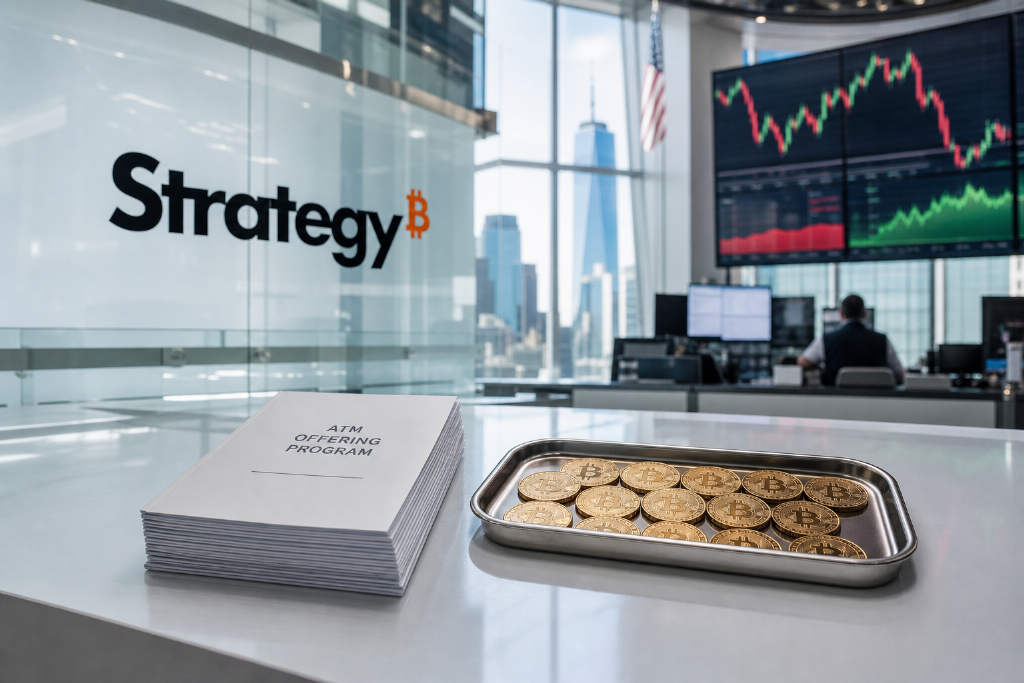
U.S. equities closed mixed on Aug. 24, with the Dow Jones Industrial Average up 0.26% while the S&P 500 and Nasdaq slipped 0.28% and 0.76%, a session the report described as a rotation out of growth and into defensive sectors ahead of a heavy earnings week. Technology shares fell on average while consumer defensive names and gold-linked assets held up better. The report put Strategy (MSTR), formerly MicroStrategy, at the center of the day. The stock rose 2.83% to $122.63, adding about $1.1 billion in market value to roughly $40.6 billion on volume of 41.02 million shares, around twice its daily average. But the sharper point was not the stock move. After issuing 18.26 million new shares last week and raising $2.01 billion, the company did not add any Bitcoin. Of that amount, $1.59 billion was placed into a newly created U.S. dollar cash account, lifting dollar reserves to $5.1 billion, while Bitcoin holdings stayed at 840,447 BTC with an average cost of $75,385 per coin. The article also contrasted Bitcoin’s 22% weekly gain with the uneven response in crypto-linked stocks, where only two of six names finished higher on the day. It then turned to position sizing through beta, highlighting Strategy’s 3.56 beta, and flagged after-hours results from Semtech (SMTC), where investors were expected to focus on data center revenue, CopperEdge customer adoption, and the shipment pace of 1.6T FiberEdge products.

240
US Premarket Brief: Strategy Raised $2.01 Billion but Did Not Buy Any Bitcoin
JPMorgan
2026-08-25 15:51:18

JPMorgan Warns on U.S. Stocks as AI Splits Grow, Sees a September De-Risking Window

JPMorgan said U.S. stocks are still in a bullish trend and near record highs, but internal rotation, rising technical resistance and seasonal weakness from August through October are adding risk. The bank said investors may want to trim equity exposure modestly rather than move into aggressive defensive positioning. Technical strategist Jason Hunter said the S&P 500 has not printed a clear top signal, though market internals are shifting. JPMorgan also pointed to AI as a key source of risk, citing the gap between AI hardware names and large cloud companies, recent weakness in Nvidia, Micron and Broadcom, and policy pushback tied to data center power demand. Even so, the bank raised its year-end S&P 500 target to 8,000. In the near term, Nvidia's earnings, remarks by Fed Chair Waller at Jackson Hole and PCE inflation data are expected to help shape September's market direction.

190
JPMorgan Warns on U.S. Stocks as AI Splits Grow, Sees a September De-Risking Window
US Treasury
2026-08-25 11:45:04

US Treasury forms Quantum-Readiness Task Force for finance sector transition

The US Treasury Department said it has created a Quantum-Readiness Task Force to support an orderly transition by the American financial sector toward quantum-secure technologies and post-quantum cryptography, or PQC. The group is set up as a public-private collaboration, bringing together government agencies, financial institutions, financial market infrastructures, technology providers, and other private-sector participants. According to the announcement, the task force will focus on three areas: coordination across the financial industry and PQC migration, readiness among third parties and vendors, and risks tied to digital assets and other emerging technologies. The Treasury said the initiative is based on Executive Order 14412 issued earlier by the Trump administration and also draws on the G7 Cyber Expert Group roadmap for the transition to post-quantum cryptography.

190
US Treasury forms Quantum-Readiness Task Force for finance sector transition
U.S. Treasury
2026-08-25 11:10:56

U.S. Treasury Launches Quantum Readiness Group With Digital Asset Risks on the Agenda

The U.S. Treasury Department has launched a Quantum Readiness Working Group, according to an announcement posted on the department’s official website. The group is structured as a public-private collaboration and is intended to help the U.S. financial sector move toward quantum-resistant technologies in an orderly way while preserving operational resilience. The Treasury said the effort will align with the Group of Seven (G7) Cyber Expert Group’s roadmap for post-quantum cryptography migration. Its work will be organized around three tracks: industry coordination and post-quantum cryptography migration, third-party and vendor readiness, and risks tied to digital assets and emerging technologies. Participants will include government bodies, financial institutions, financial market infrastructures, technology vendors, and other private-sector stakeholders. The stated priorities include identifying critical dependencies, improving cryptographic agility and interoperability, strengthening protections for critical financial infrastructure, and addressing implementation challenges related to third-party dependencies and digital assets.

150
U.S. Treasury Launches Quantum Readiness Group With Digital Asset Risks on the Agenda
HTX
2026-08-25 10:41:09

HTX Weekly Review: Policy and Liquidity Shift Lifted Meme and DeFi Tokens

HTX said crypto markets turned sharply higher during the week of Aug. 17-23 after a months-long slump, with Aug. 19 marking the key pivot. On that day, U.S. President Donald Trump convened crypto companies, regulators, and traditional finance representatives at the White House and publicly urged Congress to move forward with digital asset legislation. The U.S. Treasury also said it would at least double the cap on single long-end Treasury liquidity support repo operations, raising it from $2 billion to $4 billion. According to the report, the 30-year Treasury yield fell by about 9 basis points that day, risk assets strengthened, and Bitcoin rose more than 8% within 12 hours. For the full week, Bitcoin gained about 22% and broke above the $60,000-$70,000 range that had held for much of the year. Between Aug. 19 and Aug. 22, the total market capitalization of crypto assets excluding Bitcoin increased by roughly $215 billion, moving back above $1 trillion. HTX said assets across several sectors rose in tandem on its platform, with Meme and DeFi names showing the most concentrated gains. TRUMP, TUT, PEPE, and PUMP all posted strong advances, while PENDLE, AAVE, and MORPHO moved higher after Pendle expanded its PT Looping incentive program. ZEC also surged after Grayscale filed an amended registration statement tied to a planned spot ETF conversion, while XRP ranked among the stronger large-cap performers of the week.

310
HTX Weekly Review: Policy and Liquidity Shift Lifted Meme and DeFi Tokens
Policy and Re
2026-08-25 05:06:10

Fertilizer Prices Move First as El Niño Risks Build, Even Without a Broad Grain Rally

Expectations for a strong to super El Niño in late 2026 are rising, and weather disruptions are already showing up across India, Southeast Asia, Europe, and southern China. Yet the article argues that this does not automatically point to a broad collapse in staple crop output. Instead, the more immediate story is in fertilizers, where prices and profit expectations have begun to move ahead of grain markets under a different set of drivers. According to the original analysis by Wanzhou, published by Wallstreetcn and carried by MarsBit, urea is being supported by export expectations and higher overseas prices, phosphate fertilizers are tightening under sulfur shortages, resource constraints, and shipping disruptions, and potash is leaning on a more classic supply-side resource cycle. The piece stresses that current fertilizer strength cannot be reduced to a simple chain of El Niño leading to surging food prices and then higher fertilizer prices. The report also separates the outlook by product. Urea faces a second-half test as new capacity comes online and exports determine whether domestic oversupply can be absorbed. Phosphates are entering what the article calls a rare “supply-led” phase, while potash appears weak in the domestic spot market in the short term but firmer over the medium term because of concentrated global supply and maintenance-related disruptions. The key question now is whether weather-related crop risks in 2027 will turn a supply-driven rally into a broader supply-demand upswing.

110
Fertilizer Prices Move First as El Niño Risks Build, Even Without a Broad Grain Rally
Unitree
2026-08-25 02:43:20

Can Unitree Justify a $243.9 Billion Valuation After Its Post-IPO Pullback?

Unitree Technology’s first days on Shanghai’s STAR Market produced one of the most dramatic valuation swings in China’s robotics sector this year. The company listed on Aug. 19, 2026, at RMB 150.80 per share, implying a post-offering market capitalization of roughly RMB 61 billion. Intraday on its debut, the stock surged to RMB 1,100, briefly lifting its value to about RMB 444.9 billion, before closing at RMB 341.8 billion. By Aug. 24, after several sessions of declines, the stock had fallen to RMB 603.08, leaving Unitree with a market capitalization of about RMB 243.9 billion. In a lengthy valuation analysis carried by MarsBit and attributed to CEIBS accounting professor Zhang Feida, the question is not whether Unitree has real products or real revenue. The company posted about RMB 16.99 billion in revenue in 2025, more than 5,500 humanoid robot shipments, roughly RMB 591 million in adjusted net profit, and positive operating cash flow. The issue is whether those operating results can support a valuation that still prices in years of high returns after a sharp pullback. Using the Ohlson residual income model, Zhang examines four pillars behind that question: return on equity after IPO dilution, the durability of Unitree’s moat, the quality of its future growth, and risks tied to management, governance, ESG, and overseas regulation. The article argues that investors are not paying for Unitree’s current earnings alone, but for a much larger expectation that robots can move from demonstrations into repeatable labor across factories, warehouses, services, and eventually homes.

190
Can Unitree Justify a $243.9 Billion Valuation After Its Post-IPO Pullback?