Risk

Tom Lee
2026-08-23 12:09:03

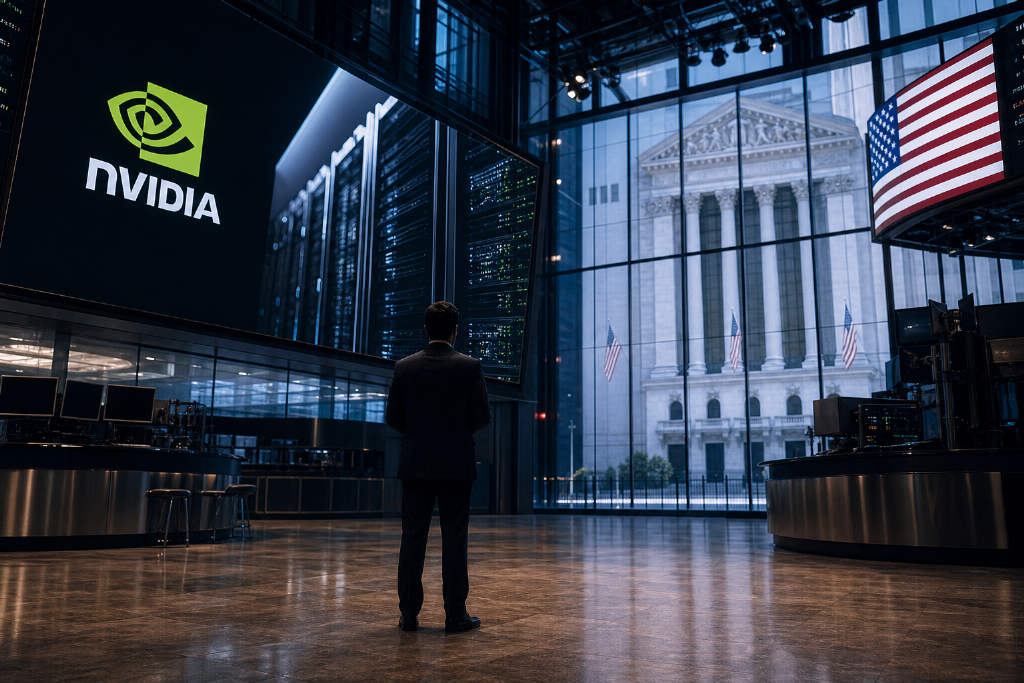
Tom Lee says next week could be a key turning point for U.S. stocks as Nvidia and Fed signals come into focus

Tom Lee said next week may shape into a major clearing event for U.S. equities, with investors set to reassess both enthusiasm for artificial intelligence trades and uncertainty around Federal Reserve policy. He said the main question for the market is whether confidence can recover after the recent cooling in AI-related trading. According to Lee, AI stocks have stalled for two main reasons: rising concerns about data center investment demand and profit returns, and added uncertainty from political factors affecting the AI industry. He also pointed to Nvidia CEO Jensen Huang as a potentially important figure for restoring confidence. If Nvidia can show that demand for AI infrastructure remains strong, with orders and market demand still growing, capital could rotate back into the AI segment. At the same time, Lee said uncertainty over the Fed’s policy outlook continues to build, and upcoming remarks from central bank officials will be closely watched for signals on the rate path. Market participants are also watching whether Nvidia-related developments and Fed comments next week will act as catalysts for technology shares and broader risk assets.

340
Tom Lee says next week could be a key turning point for U.S. stocks as Nvidia and Fed signals come into focus
Russia
2026-08-23 05:24:22

Drone strikes hit Wildberries warehouses as losses mount and pressure spreads to banks

Russia’s largest e-commerce platform, Wildberries, has been hit by a sustained wave of drone attacks over the past month, with the reported damage extending across a large share of its warehouse network. According to the source material, at least 21 strikes since mid-July have destroyed more than 1.5 million square meters of storage space, wiped out roughly a third of the company’s warehouse capacity, and left estimated cargo losses of $5.9 billion. The attacks were described as concentrated on logistics hubs. Facilities in Elektrostal, Kotovsk, Krasnodar, Shushary, Aleksin, Voronezh, and Koledino were listed among the damaged or destroyed sites. TechTimes also reported that Ukraine’s HUR cyber unit breached Wildberries’ payment system twice between Aug. 10 and Aug. 15 while roughly 600 drones were used in coordinated operations, temporarily disrupting seven of the company’s 10 main logistics centers. The fallout has moved past physical infrastructure. The report says around 80% of warehouse buildings and inventory were uninsured, and Wildberries’ terms that took effect on July 11 excluded compensation for drone strikes. Insurer Ingosstrakh raised related premiums by 3.3 times, while Russia’s central bank asked major lenders including Sberbank and VTB to prepare debt restructuring plans. The article adds that more than 400,000 sellers on the platform are still struggling to recover losses.

200
Drone strikes hit Wildberries warehouses as losses mount and pressure spreads to banks
Grayscale
2026-08-23 03:27:03

Grayscale says current Bitcoin price may offer a better entry point for long-term investors

Grayscale research head Zach Pandl said investors are generally not advised to try to time the market, but argued that Bitcoin’s current price may present a relatively attractive entry point for those with a long-term investment horizon. He framed the view around three factors: structural adoption trends, the market cycle and macro risk. According to Grayscale, Bitcoin’s long-term adoption case remains intact as government debt continues to grow, blockchain technology sees broader use in financial services, and generational shifts reshape portfolio construction. On market cycle signals, the firm noted that the current Bitcoin bear market has lasted about 10 months, while previous bear markets typically ran for 11 to 12 months, suggesting the market may be in the later stage of the downturn. Pandl also said the macro backdrop remains the main uncertainty. If the Federal Reserve raises rates again in the near term, Bitcoin could fall further. If it does not, the market may already have reached a bottom. Grayscale’s overall assessment was that structural adoption, cycle positioning and the broader macro outlook are relatively favorable at present, while the path ahead remains uncertain.

360
Grayscale says current Bitcoin price may offer a better entry point for long-term investors
Grayscale Res
2026-08-22 11:14:00

Grayscale says AI-era financial surveillance could lift Zcash as privacy demand returns

Grayscale Research argues that financial privacy is moving back into focus as stablecoins and broader blockchain use spread and artificial intelligence creates new ways to monitor financial activity. In a report written by Michael Zhao and translated by Foresight News, the firm says Zcash stands out because it combines a Bitcoin-like monetary design with optional shielded transactions powered by zero-knowledge proofs. The report frames privacy as a core monetary function rather than a niche add-on. It reviews earlier periods when digitized records, the Bank Secrecy Act, internet banking, and the Patriot Act pushed privacy higher on the public agenda, then says the market may be approaching a third wave of attention. In Grayscale’s view, Zcash is one of the few networks designed at the base-layer level to protect sender, receiver, and amount data while still allowing transaction validity to be verified. The network also supports selective disclosure through viewing keys. Grayscale says ZEC accounts for roughly 0.4% of total crypto market capitalization and about 0.6% of the “currency” segment it tracks, despite what it describes as meaningful on-chain usage. As of July 20, shielded transactions made up about 90% of all Zcash transactions, while roughly 4.2 million ZEC, or 25% of circulating supply, sat in the shielded pool. The firm also highlights regulatory, cryptographic, quantum, and execution risks, including the limits of compliance acceptance for shielded transfers and the complexity of future upgrades such as Tachyon and Crosslink.

460
Grayscale says AI-era financial surveillance could lift Zcash as privacy demand returns
Fidelity Digi
2026-08-22 14:30:00

Fidelity Digital Assets warns AI agent growth may not translate into public blockchain gains

Fidelity Digital Assets is cautioning investors against treating AI agents and public blockchain growth as the same trade. In the analysis cited by PANews, the firm argues that the market often jumps too quickly from the idea that AI agents need payments and identity to the conclusion that they must rely on public blockchains, and then one step further to the belief that higher on-chain activity will lift native token values. Fidelity says that chain of reasoning rests on multiple assumptions, any one of which could fail. The piece lays out six risks. Enterprises may prefer closed systems over permissionless networks if they offer better speed, cost control, identity management and compliance boundaries. Even if AI agents drive more on-chain payments, value may flow first to stablecoin issuers, payment providers, wallets or infrastructure operators rather than to native token holders. The report also argues that AI-driven coding tools could increase software output without creating matching user demand, while cheaper development may come with lower barriers for attackers searching for smart contract flaws. The broader message is not that AI and blockchains will not intersect. Fidelity instead argues that investors need to test each link in the thesis separately: whether AI agents actually settle on-chain, whether they do so on public networks, and whether that economic activity accrues to token holders in a durable way.

400
Fidelity Digital Assets warns AI agent growth may not translate into public blockchain gains
Policy Regula
2026-08-22 03:33:57

Markets This Week: U.S. debt strain, AI spending, and geopolitical risk set the tone

Global markets were driven this week by three overlapping themes: mounting pressure in the U.S. Treasury market, a fresh wave of capital commitments tied to AI infrastructure, and rising geopolitical tension centered on Iran and the Strait of Hormuz. After the U.S. Treasury expanded long-dated bond buybacks, Treasury yields briefly eased, but concerns over deficits and debt growth remained in place. U.S. federal debt topped $40 trillion for the first time, while the 30-year Treasury yield climbed to its highest level since 2007, adding pressure across long-duration bond markets worldwide. The Federal Reserve’s July meeting minutes showed a firmer hawkish tilt inside the central bank, with support for rate hikes extending beyond three voting members. Some officials also flagged tariffs, energy prices, and AI infrastructure investment as potential inflation drivers. In commodities, gold rose above $4,600 per ounce for a third straight weekly gain, while oil moved higher on Strait of Hormuz risk and expectations of tighter U.S. sanctions on Iran. In tech and equities, Nvidia, Broadcom, Anthropic, Unitree, SK Hynix, and Samsung all featured in a week defined by heavy capital deployment and shifting macro risk.

470
Markets This Week: U.S. debt strain, AI spending, and geopolitical risk set the tone
Ray Dalio
2026-08-22 00:59:58

Dalio Says Investors Should Hold Bitcoin and Gold to Hedge U.S. Debt Risk

Bridgewater founder Ray Dalio said on Aug. 22 that investors should cut bond exposure and use non-government assets such as gold and Bitcoin to hedge rising U.S. debt pressure. He suggested a portfolio allocation of roughly 10% to 15% in gold and holding “some” Bitcoin to help offset debt-crisis risk and improve long-term returns. Dalio said U.S. government revenue is expected to be about $5.5 trillion this year, while spending will reach $7.5 trillion, leaving a deficit of about $2 trillion. He also warned that a U.S. debt crisis could arrive in roughly three years, give or take two years. Dalio said rising debt-servicing pressure could force the government to accept higher rates or rely on central-bank balance sheet expansion to buy debt, which would weaken currencies and lift inflation. He added that non-sovereign monetary assets such as gold and Bitcoin are expected to perform well, a comment that further reinforces Bitcoin’s “digital gold” narrative as investors look for hedges against currency debasement and long-term fiscal risk.

380
Dalio Says Investors Should Hold Bitcoin and Gold to Hedge U.S. Debt Risk
Ray Dalio
2026-08-22 00:32:57

Ray Dalio Says U.S. Debt Risk Is Rising, Recommends Less Bonds, More Gold and a Small Bitcoin Allocation

Bridgewater founder Ray Dalio said recent moves by Japan, the U.S. Treasury and long-dated U.S. bonds line up closely with the “classic debt restructuring template” described in his book, How Countries Go Broke: The Big Cycle. He cited roughly $32 trillion in U.S. federal debt and about $1 trillion in annual interest expense, warning that debt could rise to $55 trillion to $60 trillion over the next 10 years. Dalio said the deficit should be cut to 3% of GDP through lower spending, higher taxes and lower rates, and he advised investors to reduce bond exposure while adding gold and a small amount of bitcoin. He also said holding gold equal to 10% to 15% of total assets can reduce portfolio risk and improve returns.

420
Ray Dalio Says U.S. Debt Risk Is Rising, Recommends Less Bonds, More Gold and a Small Bitcoin Allocation