VLA

XPeng
2026-08-25 09:12:51

He Xiaopeng says XPeng’s IRON humanoid robot will enter mass production by year-end

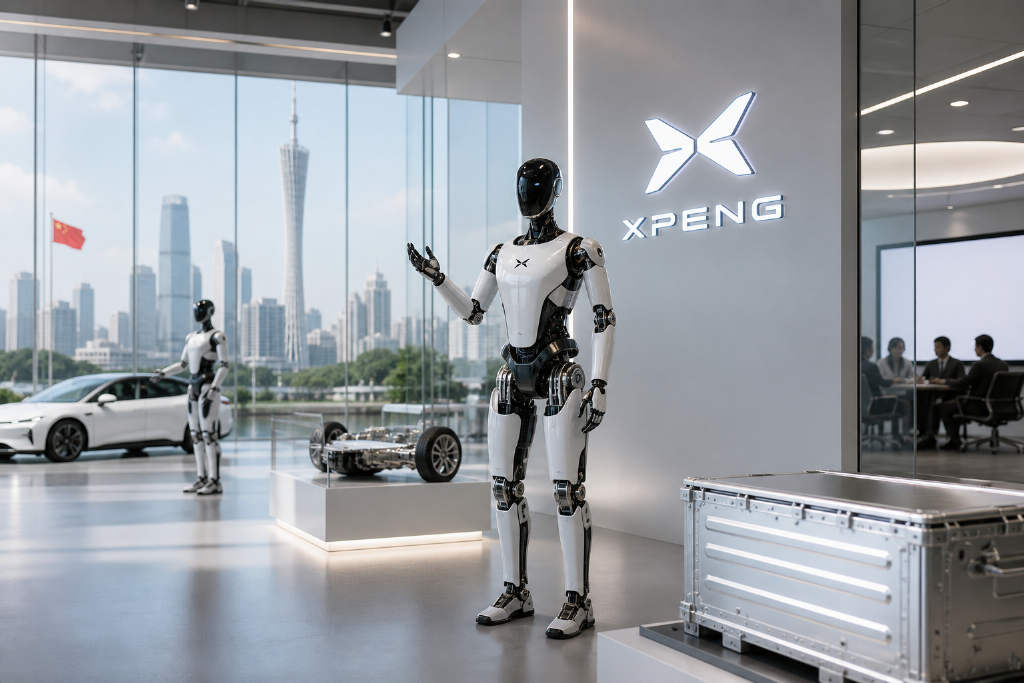
XPeng Chairman He Xiaopeng said at the company’s 2026 half-year earnings briefing that its humanoid robot IRON is scheduled to enter mass production from the end of this year, with initial commercial use set to begin at XPeng stores and campus locations. He said the robot is expected to officially launch in 2027, targeting external clients in retail and service industries, with large-scale deliveries planned in both China and overseas markets. Monthly production capacity could quickly rise to several thousand units next year. He also said he has served concurrently as CEO of the robotics business since June this year, bringing together the company’s automotive supply chain, automotive-grade manufacturing, global deployment capabilities, and Turing AI chip resources to push mass production and commercialization. On the same day, XPeng disclosed that its humanoid robotics unit secured more than $900 million in first-round financing at a post-money valuation above $6.3 billion. IDG led the round, while Gaorong Ventures, Tencent, Alibaba and others subscribed $600 million, and XPeng Group together with entities controlled by He Xiaopeng and other senior executives subscribed $300 million.
920
He Xiaopeng says XPeng’s IRON humanoid robot will enter mass production by year-end
Huawei alumni
2026-08-24 11:36:18

Huawei-linked founders pull in about $1.2 billion as embodied AI funding clusters in early-stage deals

Huawei alumni have become one of the strongest fundraising groups in China’s embodied intelligence sector this year, according to incomplete data cited from ITjuzi. From Jan. 1 to Aug. 14, 2026, 12 embodied AI companies founded or co-founded by entrepreneurs with Huawei backgrounds completed 24 financing rounds, with total funding estimated at roughly 8.635 billion yuan. The pace was heavily concentrated in early stages, with 9 angel rounds, 5 seed rounds and 5 Pre-A rounds, meaning more than 80% of the deals landed before companies had spent much time in market. Capital was also concentrated at the top. X Square Intelligence, founded less than two years ago by former Huawei autonomous driving CTO and chief scientist Chen Yilun and former Baidu intelligent driving executive Li Zhenyu, closed a $455 million Pre-A round in April, described in the report as the largest single financing round in China’s embodied intelligence industry. Kunlunxing Robotics also raised funding worth tens of billions of yuan, and the two companies together accounted for about 70% of the Huawei-linked total. Other names highlighted in the report include Ola Wanxiang, Knowin Intelligence, Gunao Panshi, Beta Infinite, Moxi Intelligence, Moushen Intelligence, Yuansheng Intelligence, Xinzhi Jushen, Zhicheng AI and Qiwu Technology.

1150
Huawei-linked founders pull in about $1.2 billion as embodied AI funding clusters in early-stage deals
Symbiotic Zhi
2026-08-24 00:30:14

Symbiotic Zhixing bets on an end-to-end brain for biped humanoid robots

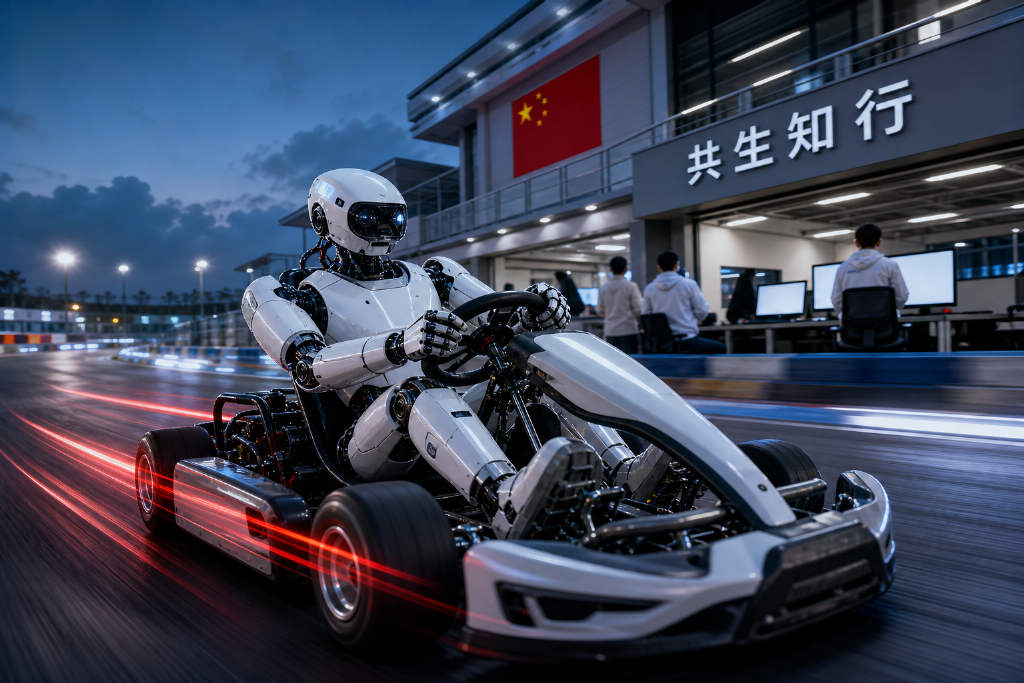
Symbiotic Zhixing, a startup founded just two months ago, is building what it describes as an end-to-end integrated sensing-and-control "brain" for biped humanoid robots. The company drew attention with a video showing a humanoid robot driving a go-kart through turns at speed, a demo meant to highlight full-body coordination rather than the slower manipulation tasks often seen in robotics showcases. Founder Ding Pengxiang, born in 1996, said the company believes humanoid robots will ultimately need a unified model that learns the full chain from perception to action, instead of relying on layered architectures that split high-level decision-making from low-level motion control. He argues layered systems introduce information bottlenecks, cascade errors, and limited scaling potential. The team, made up of doctoral students including several post-2000 members, says it has won two Best Paper awards in embodied intelligence, had one work selected as a Best Paper Candidate, and built China’s first embodied foundation model project to surpass 2,000 GitHub stars. Ding said the industry still faces major constraints in data, control, and force modeling, but sees a window of opportunity as biped robot data infrastructure begins to take shape after NVIDIA Sonic was open-sourced in April 2026.

1210
Symbiotic Zhixing bets on an end-to-end brain for biped humanoid robots
Embodied AI
2026-08-23 05:19:00

Embodied AI’s valuation surge runs ahead of proven demand, technology, and pricing logic

A Late Post report cited by PANews paints a crowded and overheated embodied AI market in China, where capital has rushed into humanoid robots, dexterous hands, data collection, joint modules, and tactile sensors long before the sector has established durable industrial demand or a broadly accepted valuation framework. In the first half of 2026 alone, domestic embodied AI financing exceeded RMB 90 billion, and 22 companies were valued above RMB 10 billion, according to IT Juzi. Yet field observations described in the report show many robots still move too slowly for real factory deployment, while some revenue is tied to research, education, data collection loops, channel stocking, or related-party structures rather than large-scale end-user adoption. Unitree’s listing has become the market’s closest thing to a public benchmark. Morgan Stanley said more than 10,000 embodied robots were actually shipped in China last year, with Unitree accounting for 5,215 units. Its 2025 revenue reached RMB 1.699 billion, but the report notes that more than 70% of revenue as of last September came from research and education, and less than 10% came from industry applications. The broader question now is whether public markets will price Unitree as a high-growth embodied AI platform with future "brain" capabilities, or more like a strong engineering and hardware company. That answer may shape how long today’s private-market valuations can hold.

1590
Embodied AI’s valuation surge runs ahead of proven demand, technology, and pricing logic
Unitree Robot
2026-08-20 04:09:00

Unitree founder Wang Xingxing says embodied AI could hit its ChatGPT moment in as little as two to three years

Wang Xingxing, founder of Unitree Robotics, said at the 2026 World Robot Conference that the biggest constraint on embodied intelligence is still weak generalization, and that the industry’s “ChatGPT moment” could arrive in as little as two to three years, or as long as five to ten years. Speaking a day after Unitree’s listing, Wang framed the next major milestone in simple terms: if a robot can be placed in a completely unfamiliar environment and complete roughly 80% of tasks through voice or language instructions alone, embodied AI will have crossed a key threshold. His speech also reviewed Unitree’s 10-year path from quadruped robots to humanoids and outlined a broad product lineup, including the G1 humanoid launched in 2024, the H1 platform, the GD01 mass-produced passenger-carrying transforming mech, the As2-W wheeled-quadruped robot, and the lightweight R1 humanoid. Wang said Unitree has been testing robots in auto factories and in its own facilities, but large-scale rollouts remain limited because robot efficiency and task transfer still lag. He also spent considerable time on data and model training, arguing that humanoid AI needs large volumes of human or internet data for pretraining, combined with real-robot data to align models with the physical world. Wang said the company is also exploring AI-driven self-improving robot development loops, where large models write control code, validate it in simulation, deploy it to physical machines, and refine it through model and human evaluation.

1140
Unitree founder Wang Xingxing says embodied AI could hit its ChatGPT moment in as little as two to three years
Unitree
2026-08-19 08:02:52

Nomura starts coverage on Unitree with a Buy, says cost edge is its core moat

Nomura Securities initiated coverage on Unitree on Aug. 19 with a Buy rating and a price target of 370 yuan, implying 145% upside from the 151 yuan share price cited in the report. The brokerage said Unitree was the world’s top humanoid robot maker by shipments, with more than 5,500 pure humanoid units shipped in 2025, and one of the few embodied AI companies that had already turned profitable. Nomura’s central argument is that Unitree’s moat comes from vertically integrated hardware development, which it said pushed outsourced component costs down to 14% to 18% of total cost. The report also highlighted the company’s broad product lineup, covering quadruped robots, humanoids, robotic arms, dexterous hands and lidar, as well as a fast product cycle that has helped it build real-world machine data. At the same time, Nomura identified U.S. policy restrictions as the biggest risk. It pointed to the Pentagon’s decision in June 2026 to place Unitree on the Section 1260H list and the FCC’s July 28 move to restrict “foreign adversary advanced communications equipment and services,” as described in the article, affecting non-U.S.-made mobile robots and limiting new product access to the U.S. market.

1460
Nomura starts coverage on Unitree with a Buy, says cost edge is its core moat
Embodied AI
2026-08-13 04:11:12

China’s Embodied AI Boom Is Running Into a New Problem: Many Startups Still Don’t Know How to Spend

China’s embodied AI sector has moved from a funding shortage to a capital management problem. A lengthy report carried by MarsBit, citing Leo Zhang ToB Notes and written by Zhang Shenyu, describes how startups flush with cash are now exposing opposite but equally damaging habits: reckless spending and excessive frugality. One investor said a well-known embodied AI company paid RMB 100 million in cash and equity for just a few minutes of gala exposure without board or shareholder approval. The campaign failed to show the value of its product, the investor said, and the spending reduced the firm’s R&D ratio enough to hit a Hong Kong listing rule threshold, potentially forcing it to re-queue for an IPO attempt. At the other extreme, another company reportedly had more than RMB 100 million on its books but refused to send hardware staff to oversee production lines in person, choosing remote video acceptance for more than 100 robots. A potential investor later learned of that decision and dropped the financing. The report argues that with hundreds of billions of yuan flowing into embodied AI, founders and investors alike are struggling to measure what spending should look like in a sector defined by heavy costs in talent, compute, data and hardware, but few mature benchmarks for judging whether the money is producing real progress.

1450
China’s Embodied AI Boom Is Running Into a New Problem: Many Startups Still Don’t Know How to Spend
Unitree
2026-08-13 02:32:34

Unitree IPO frenzy puts valuation debate front and center as market weighs a $2,000 billion RMB outcome

Unitree Technology, widely described in the source article as China’s "first humanoid robotics stock," drew intense demand in its IPO, with an online allotment rate of just 0.01809759% after a callback mechanism and an oversubscription multiple of 8,288.82 times. The company priced its shares at RMB 150.8, issued 40.4464 million shares, and raised about RMB 6.099 billion, exceeding its original fundraising target by 45.15%. Pre-listing perpetual contract data from trade.xyz implied a market capitalization of about $35.47 billion, or roughly RMB 239 billion, while predict.fun showed a 75% probability that Unitree’s closing market value would top RMB 200 billion. The article also lays out a wide range of post-listing valuation views, from RMB 109 billion to more than RMB 400 billion, and highlights founder Wang Xingxing’s responses on valuation, shipment scale, embodied AI capabilities, and criticism over remote control features.

1390
Unitree IPO frenzy puts valuation debate front and center as market weighs a $2,000 billion RMB outcome