Backliability

liability

Cipher Mining
2026-09-22 09:31:26

Cipher Mining discloses up to 300 MW of ERCOT power capacity and a 15-year hyperscale lease

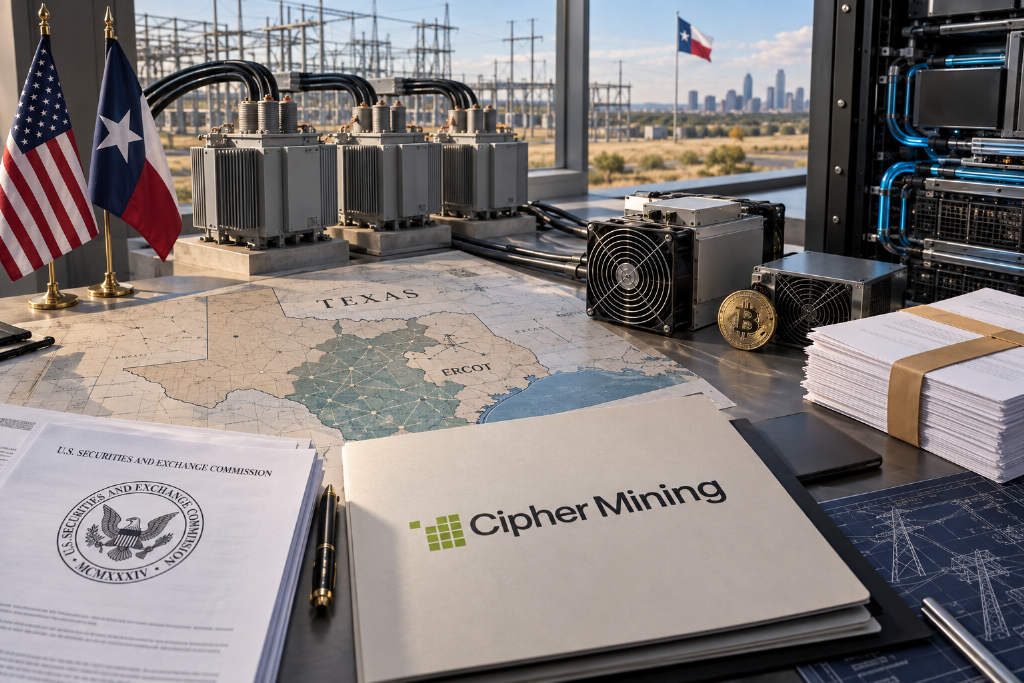
Bitcoin miner Cipher Mining said in a filing submitted to the U.S. Securities and Exchange Commission on Sept. 21 that it has secured conditional interconnection rights for up to 300 megawatts of power capacity on the Electric Reliability Council of Texas, or ERCOT, grid. The company also disclosed that it has signed a 15-year master lease with a hyperscale customer tied to high-performance computing data center infrastructure, though the filing did not identify the tenant. The disclosure points to Cipher Mining using power assets built around its mining business to expand into AI and high-performance computing infrastructure, with the aim of pursuing longer-term data center contract revenue. Techub cited NewsBTC in its report.

80
Cipher Mining discloses up to 300 MW of ERCOT power capacity and a 15-year hyperscale lease
Hong Kong reg
2026-09-22 08:10:46

Hong Kong’s Crypto Rulebook Takes Shape Across Exchanges, Stablecoins and New Licensing Plans

Hong Kong’s crypto regime is being built through multiple statutes rather than a single all-in-one code, with different rules applying to securities tokens, non-security virtual asset trading platforms and fiat-referenced stablecoins. The framework now links issuance, trading, client onboarding and custody more closely after the Hong Kong Monetary Authority issued the first two stablecoin issuer licenses on April 10, 2026, followed by a Securities and Futures Commission circular on May 27 setting out how licensed virtual asset trading platforms and licensed corporations may offer those licensed stablecoins to clients. The article maps out how the system works in practice. Securities tokens remain under the Securities and Futures Ordinance, while centralized spot crypto platforms fall under the Anti-Money Laundering and Counter-Terrorist Financing Ordinance. Stablecoin issuance is handled separately under the Stablecoins Ordinance, which took effect in August 2025. It also details licensing thresholds for trading platforms, including capital and liquidity requirements, token admission rules for retail access, and custody standards such as the 98% cold-storage requirement. Beyond current law, Hong Kong is still moving to add new licensing regimes for custody, trading intermediation, advisory and asset management. The piece also covers the role of banks and licensed corporations, the treatment of tokenized securities, and the city’s settlement infrastructure work through the HKMA’s Ensemble project.

60
Hong Kong’s Crypto Rulebook Takes Shape Across Exchanges, Stablecoins and New Licensing Plans
CLARITY Act
2026-09-22 05:57:33

Why the CLARITY Act Stalled in the Senate and What Comes Next for U.S. Crypto Market Structure

The U.S. Senate failed on Sept. 15, 2026 to advance the Digital Asset Market Clarity Act, or CLARITY Act, after a procedural vote ended 49-50. The bill was not defeated on the merits, but it did not secure enough support to move into amendment, debate, and a final vote, leaving little time in the current Congress as the election calendar tightens. The setback matters because the bill was designed to answer several unresolved questions at the center of U.S. crypto regulation: when a token is treated as a security or a commodity, whether trading platforms should register with the Securities and Exchange Commission or the Commodity Futures Trading Commission, and under what conditions fundraising-related legal obligations tied to token sales can end. Its failure shifts the center of gravity back to regulators, courts, and the states. The debate also exposed unresolved fault lines over conflicts of interest, anti-money laundering rules for DeFi, and stablecoin rewards. With Congress stalled, the most likely near-term outcome is a patchwork approach: renewed legislative talks in a later session, more SEC and CFTC guidance and exemptions, and continued reliance on state licensing regimes.

70
Why the CLARITY Act Stalled in the Senate and What Comes Next for U.S. Crypto Market Structure
Texas
2026-09-22 03:41:48

Texas pauses new data center permits until ERCOT grid audit is completed

Texas Governor Greg Abbott has ordered the Texas Commission on Environmental Quality to stop issuing permits for data center projects until the state grid operator, the Electric Reliability Council of Texas (ERCOT), finishes an audit expected in December. Abbott said data centers must bear their own costs, protect the power grid and water resources, and complete the required review. He also plans to propose ending incentives for data centers in the next legislative session. The move puts Texas alongside New York and Pennsylvania as another state tightening scrutiny of data center approvals. The directive also stands in contrast to Donald Trump’s support for expanding AI infrastructure. Trump had previously criticized efforts to restrict data center development and warned that such limits could benefit China. Texas’ grid is currently facing more than 474 gigawatts of interconnection requests, with about 90% tied to data centers.

50
Texas pauses new data center permits until ERCOT grid audit is completed
Trueo
2026-09-22 03:16:22

TRUE Jumps More Than 10x After Vitalik Backs Trueo’s Ethereum Mainnet Move

Decentralized prediction market protocol Trueo said on Sept. 22 that it will deploy on Ethereum mainnet, expanding beyond its original Base-native setup launched in March 2025. Project lead MilliΞ later confirmed the move, and Ethereum co-founder Vitalik Buterin publicly welcomed it, saying he was glad to see a strong new prediction-market competitor on Ethereum L1 that is focused on decentralization and ethical standards rather than what he described as soulless, corporatized content. The market reacted quickly: TRUE rose from about $0.02 to roughly $0.214 within five hours, a gain of more than 10x, before easing to around $0.11 at press time, according to GMGN, with a fully diluted valuation near $11 million based on a 100 million maximum supply. The report also lays out why Trueo is shifting to Ethereum, how its yield-bearing USDC-based design works, the protocol’s seven-stage dispute process, and the gap between its product ambitions and its current on-chain traction on Base, where TVL is about $800,000 but recent trading activity has remained limited.

50
TRUE Jumps More Than 10x After Vitalik Backs Trueo’s Ethereum Mainnet Move
Cynthia Lummi
2026-09-21 18:50:04

Lummis says Democrats oppose CLARITY Act despite issuer disclosure liability provision

U.S. Senator Cynthia Lummis said Democrats are opposing the CLARITY Act even though the bill includes a liability provision aimed at false disclosures by crypto issuers. According to Lummis, that part of the legislation is designed to protect investors. She said Democratic lawmakers remain against the measure despite the inclusion of that investor-protection language. The remark, cited by Techub News, frames the dispute around the bill as one centered not only on market structure but also on whether disclosure-based safeguards within the legislation are being recognized by its opponents. No additional details on the scope of the opposition or next procedural steps were provided in the source item.

50
Lummis says Democrats oppose CLARITY Act despite issuer disclosure liability provision
xAI
2026-09-21 17:16:03

xAI launches Grok 4.7 with 2.1 trillion parameters, but benchmark gap remains

xAI released Grok 4.7 on Monday afternoon and described it as its best model so far, saying it delivers a notable improvement over Grok 4.6 at the same price and speed. The launch followed a string of delays, with Elon Musk revising the timeline at least five times since late July. The new model is now live in the Grok app, Cursor, Grok Build, and the xAI API, with no waitlist. Grok 4.7 expands to 2.1 trillion parameters, up 40% from Grok 4.6’s 1.5 trillion, and is priced at $2 per million input tokens and $6 per million output tokens. xAI said the model spends more time on hard problems, checks its answers more often, and includes its strongest safety guardrails yet. The company also added supplemental training data from SpaceX, including Starlink telemetry, manufacturing records, and engineering failure logs, to improve reasoning about hardware and physical systems. Still, the benchmark picture was familiar. On GDPval, Grok 4.7 scored 1695 versus Claude Fable 5.1 at 1735. On AA-Briefcase, it posted 1657 against Fable 5.1’s 1678. CursorBench 4.0 also placed Grok 4.7 in the middle of the pack, with higher per-task cost than GPT-6 Astra and Claude Sonnet 5 while still trailing Fable 5.1. The article argues that xAI’s strategy remains centered on lower token pricing and broad distribution rather than outright leadership on raw model capability.

80
xAI launches Grok 4.7 with 2.1 trillion parameters, but benchmark gap remains
ChainFeeds
2026-09-21 12:33:00

ChainFeeds PRO reviews encrypted mempool design, Frame Transactions, and a Lightning-based "Bitcoin dollar"

ChainFeeds’ latest PRO issue pulls together a wide set of research threads across Bitcoin, Ethereum, MEV, and academic work, with several pieces standing out. One is Ethereum Foundation researcher Gottfried Herold’s proposal for an encrypted mempool design that drops the need for batch threshold decryption and instead uses threshold identity-based encryption tied to block hashes and ticket ordering. Another is lightclient’s case for EIP-8141 Frame Transactions as a more general transaction format for Ethereum accounts, covering use cases such as key rotation, gas sponsorship, privacy-pool withdrawals, transaction assertions, full-balance transfers, and signature aggregation. The issue also highlights BTCPay Server founder Nicolas Dorier’s idea of creating a "Bitcoin dollar" through Lightning channels by adjusting expected balances rather than issuing a dollar liability, alongside updates from Bitcoin Optech Newsletter #423 on mining pool vardiff behavior, Utreexo sync optimization, and a proposed unspendable Taproot internal key. On the Ethereum side, it covers atoranzo’s attempt to remove relayer dependence in EVM shielded pools and K1-R1’s RawVentures concept, which would route part of ETH staking rewards into an on-chain venture fund governed through prediction markets. The MEV section summarizes Flashbots’ The MEV Letter #153, and the paper roundup includes XSplicer, a system that reportedly achieved a 92.5% recovery rate in reconstructing cross-chain transaction correspondences across heterogeneous blockchains.

50
ChainFeeds PRO reviews encrypted mempool design, Frame Transactions, and a Lightning-based "Bitcoin dollar"